Helping Sports Teams Improve Decision Making with AI
How PlayVision transforms basketball footage into advanced analytics and reports using computer vision.


Sports
- AI Dataset Optimization
- Hosted Model Training
- Continuous Model Improvement
PlayVision is a sports technology company that leverages AI to automatically analyze game footage and provide teams with advanced statistics. The company was founded to solve a pertinent problem for coaching staff, who often spend hours in the film room manually tagging different stats and actions. By automating this process, PlayVision allows teams to focus on strategy rather than data entry.
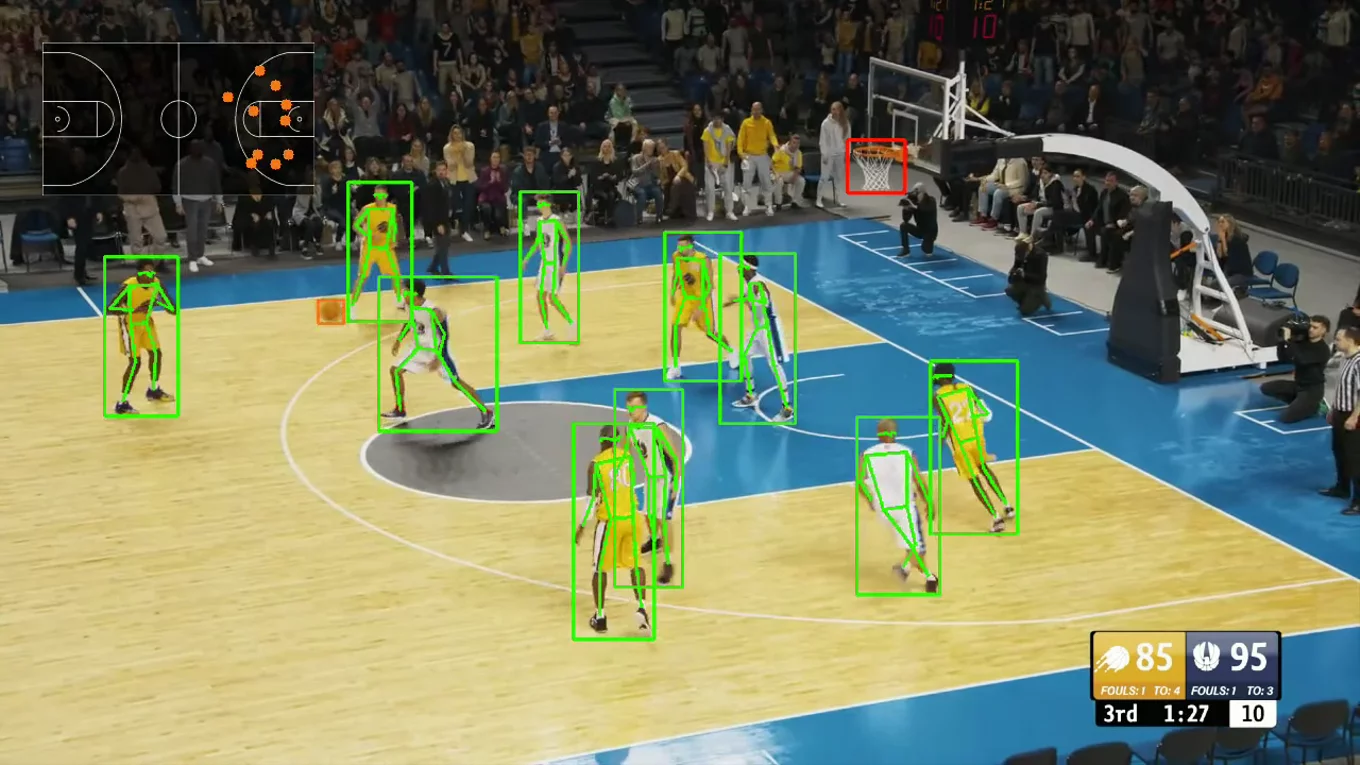
Unlocking advanced sports analytics with AI
PlayVision has developed a sophisticated computer vision system that tracks multiple elements on the court simultaneously, such as different players, specific actions, the ball, hope, and more. Beyond simple identification, the system maps players to 2D coordinates on the court and detects specific game events as they happen.
For coaches and scouts, PlayVision offers deep contextual metrics from these detections, such as analyzing passing accuracy or determining if a pass was "good" or "bad" based on where the receiving player caught the ball. For example, the system can differentiate between a pass caught easily in a shooting pocket versus one that forces a player to jump or bend down. This adds a layer of quality control to standard passing stats that is difficult for humans to capture and process manually.
For sports teams, reviewing and analyzing game footage can be incredibly difficult and time consuming. That’s what inspired us to leverage vision AI to assist with analyzing game footage,” said Marc Zoghby, co-founder of PlayVision. “Now sports teams can get advanced analytics that go way beyond the typical box score and track statistics that wouldn’t be feasible with manual review."

Custom AI models that improve over time
Building a computer vision model that works across different gyms, lighting conditions, and camera angles requires a robust approach to data management. PlayVision leverages Roboflow to manage annotation and train custom models. To handle the variability of different stadiums where cameras might be positioned much higher or lower than a typical broadcast, the team employs an active learning loop.
When processing new footage, the team uses sophisticated workflows in Roboflow to filter for low-confidence detections or anomalies such as a missing ball or an unexpected number of players. These specific clips are then reviewed by human annotators who correct the labels before re-training their models. This allows the model to improve iteratively.

Watch the interview with PlayVision co-founder Marc Zoghby.
Furthermore, PlayVision uses Roboflow’s pre-processing tools to expand the diversity of training data and improve the generalizability of their vision models. By applying augmentations like blur, noise, or changes in saturation to their training data, they can simulate difficult conditions like motion blur or poor lighting before deploying the model.
"Roboflow saves you a lot of heavy lifting as a developer. It allows us to quickly annotate our datasets and easily do all sorts of different pre-processing, like adding blur or noise,” Zoghby said. “Plus, you get access to a huge number of open source models and the ability to fine-tune them to your specific use case."
About PlayVision
PlayVision is the AI Moneyball for Sports: the future for scouting, recruiting, and playing the game. Basketball teams upload their practices or games, and PlayVision uses AI and computer vision to automatically tag and analyze the film, giving coaches and scouts 10 times the information on their players and their opponents. PlayVision also uses algorithms to rank every single college and professional basketball player in the country with over 40 different metrics from tracking and play-by-play data.