Wood and Lumber Defect Detection AI
Catch knots, splits, wane, decay, and grade-out defects on every board, panel, and finished wood product before defects ship.
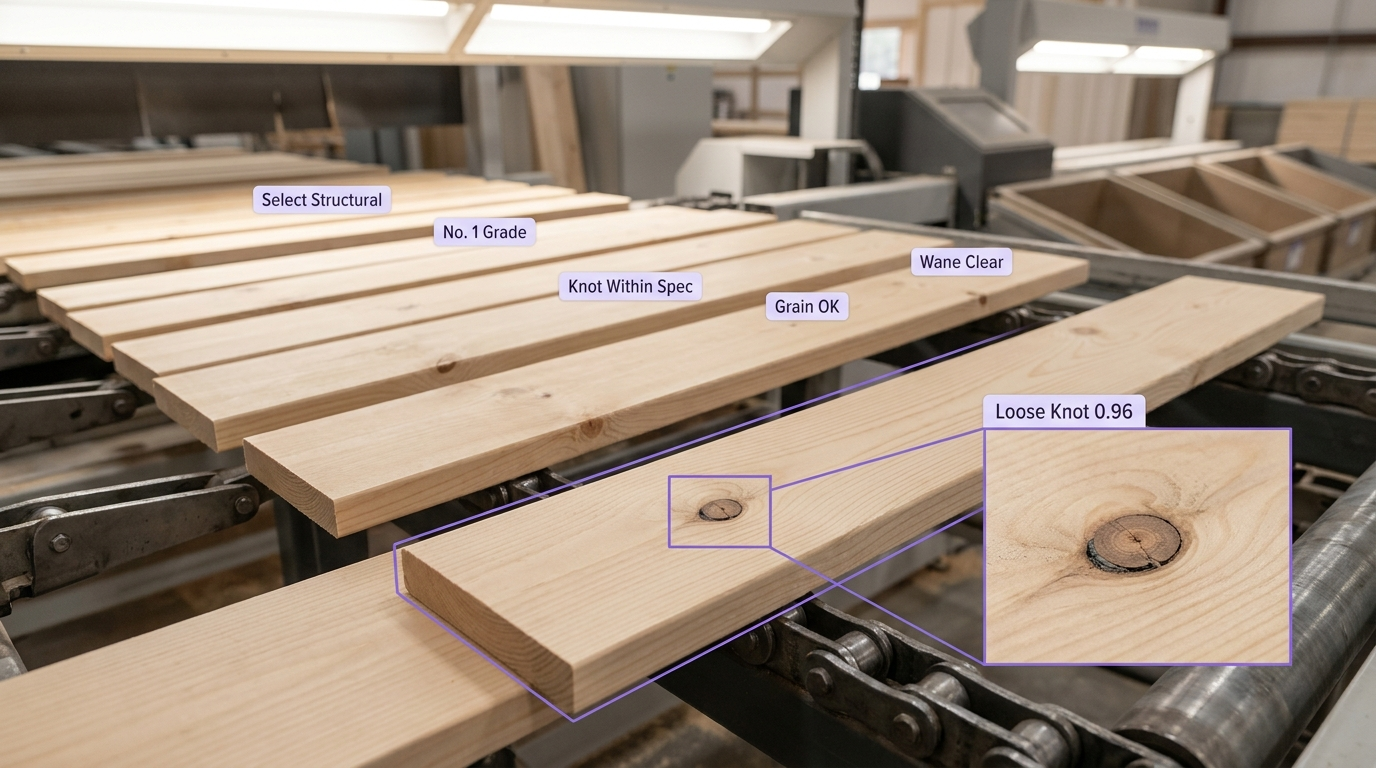
Wood and Lumber Defect Detection AI Across Sawmill, Plywood, OSB, MDF, and Millwork
Deploy Anywhere, Run Everywhere
Run wood and lumber defect detection on sawmill scanning stations, lumber grading lines, plywood and OSB layup inspection, MDF panel QC, finished millwork inspection, and final pack-out checkpoints, on the edge, on-prem, in your VPC, or via API.
One Platform, Full Adoption
Tools every wood manufacturing team can adopt, from sawmill operators, grading station inspectors, and panel process engineers to plant managers, manufacturing engineering, and operations leadership at sawmills.
Built for Wood Manufacturing Grading Rules and Audit-Ready Records
Data stays safe with SOC 2 Type II, encrypted data, on-prem or air-gapped deployment, and an uptime SLA on every line.
- Knot, Split & Shake Detection
- Wane, Decay & Stain Detection
- Worm Hole & Insect Damage
- Pitch Pocket & Grain Defect Detection
- Veneer, Glue Line & Panel Defects
- Warp, Twist & Dimensional Verification
“Roboflow has been instrumental in accelerating our deployment of innovative AI solutions.”
Travis Turnbull
Vice President & CIO, Pella Corporation
Talk to a Vision AI engineer who's shipped wood and lumber defect detection.
A single missed loose knot on a structural grade board, undetected decay on a premium hardwood panel, or grade-out defect on a finished millwork can mean rework downstream, a warranty claim from the field, a customer chargeback that downgrades the entire load to commercial grade, or a structural field-failure on a deployed engineered wood program. Bring us your toughest wood and lumber defect detection problem and we'll map a working solution.
Ask us about:
- Solution architecture for NHLA, WWPA, SPIB, WCLIB, APA, ANSI/HPVA HP-1, ASTM lumber standards, EN 13017, EN 13986, FSC, PEFC, and customer-specific supplier acceptance environments
- Live demo on your sawmill scanning footage, plywood layup imagery, MDF panel video, or finished millwork samples
- Deployment options: edge, on-prem, air-gapped, robot-mounted, or VPC, with integration into sawmill PLCs, scanner-optimizer-edger systems, dry kiln control, planer mills, and MES
- ROI modeling against grade-out scrap, rework, downgrade losses, customer chargebacks, warranty claims, and recall risk on structural engineered wood
Over 16,000 organizations build with Roboflow.
- Rivian
- Pella
- Chobani
- USG Corporation
- BNSF Railway
- American Woodmark
Catch Every Knot, Split, Wane, and Surface Defect, with Vision AI
Add a real-time inspection layer to every board, panel, and finished wood product on the line with Vision AI for wood and lumber defect detection. Built for the operations where one missed loose knot on a structural grade board, undetected decay on a premium hardwood panel, mis-flagged wane on dimensional lumber destined for a customer, or grade-out defect on a finished millwork can mean rework downstream, a warranty claim, a structural field-failure on engineered wood, a customer chargeback that downgrades the entire load to commercial grade, or a load rejection at the construction site that costs days of schedule. Whether you're inspecting hardwood and softwood at sawmill scanning stations, lumber on the grading line, plywood and OSB veneer at the layup, MDF panels at final QC, glulam and LVL at the engineered wood plant, or finished millwork before shipping, Roboflow extends QC coverage to every board on the line.
Sawmill, Grading, and Dimensional Lumber Defects:
- Catch loose knots, dead knots, tight knots, splits, shakes, checks, wane, and decay across every board on the lumber grading line per NHLA, WWPA, SPIB, and WCLIB grading rules
- Detect blue stain, mineral stain, color variation, worm holes, insect damage, and pitch pockets that downgrade premium grades to commercial
- Verify dimensional features, warp, twist, cup, bow, and crook against customer acceptance criteria
Plywood, OSB, MDF, and Engineered Wood Panel Defects:
- Inspect veneer for knots, splits, color variation, and surface defects at the layup before pressing
- Catch glue line defects, delamination, surface bubbles, and surface chip-out on plywood, OSB, MDF, glulam, and LVL panels
- Verify panel surface quality, finish, and dimensional tolerances against APA engineered wood standards and ANSI/HPVA HP-1 hardwood plywood criteria
Millwork, Finished Wood, and Final QC:
- Inspect finished millwork for surface defects (planer skips, raised grain, fuzzy grain, chip-out), color and grain match across joined pieces, and dimensional tolerance
- Catch finish defects on stained, painted, and clear-coated finished wood products before shipping
- Maintain validated inspection records that support NHLA, WWPA, SPIB, APA, ANSI/HPVA HP-1, ASTM, EN 13017, EN 13986, FSC and PEFC traceability, and customer-specific PPAP submissions
Bring intelligence to every board today. Stop wood defects from becoming warranty claims, grade-out losses, customer chargebacks, or structural field failures on engineered wood programs.
Automating Wood and Lumber Defect Detection
What is wood and lumber defect detection with Vision AI?
Wood and lumber defect detection with Vision AI uses computer vision models to inspect wood products at every stage of manufacturing, catching loose, dead, and tight knots per grading rules, splits, shakes and checks, wane, decay and rot, blue and mineral stain and discoloration, worm holes and insect damage, pitch pockets, grain defects, surface defects (planer skips, raised grain, fuzzy grain, chip-out), dimensional defects (warp, twist, cup, bow, crook), glue line defects on engineered panels, and finish defects across sawmill, plywood, OSB, MDF, engineered wood, and millwork operations.
Can Vision AI catch knot grade, decay, and grain defects that rule-based vision struggles with on natural product?
Yes. Knot grade classification, subtle decay, grain defects, and species-specific morphological variation are exactly where rule-based and template-based machine vision systems feel the most pressure on wood. Rule-based vision excels at deterministic measurement tasks with high-contrast features, fixed lighting, and consistent product presentation, but struggles with wood defects because wood is a natural material with infinite color and grain variation (no two boards from the same species look identical, let alone across species), defect morphology varies wildly (a loose knot looks different from a tight knot looks different from a dead knot, and grading rules require classification not just detection), surface finish varies by sawing, planing, drying, and finishing, and SKU complexity spans hundreds of species, grades, and customer-specific acceptance criteria. Roboflow models add a deep-learning inspection layer trained on your actual product appearance, species-specific characteristics, and grade-specific morphology, catching the defect categories rule-based vision struggles with and co-piloting existing sawmill scanning systems from USNR (including Lucidyne and Comact scanning lines), Microtec, and Halco by adding visual verification on borderline grade calls.
Does wood and lumber defect detection support NHLA, WWPA, SPIB, and APA grading rules?
Yes. Roboflow models can be trained against your specific NHLA (National Hardwood Lumber Association) grading rules for hardwood lumber, WWPA (Western Wood Products Association) for western softwood, SPIB (Southern Pine Inspection Bureau) for southern pine, WCLIB (West Coast Lumber Inspection Bureau), APA (Engineered Wood Association) standards for plywood, OSB, glulam, LVL, and other engineered wood, ANSI/HPVA HP-1 (Hardwood and Decorative Plywood), TPI (Truss Plate Institute) standards, ASTM D245 (visual grading) and ASTM D2555 (mechanical properties), EN 13017 (European solid wood panels), EN 13986 (European wood panels in construction), EN 1995 Eurocode 5 for timber design, FSC (Forest Stewardship Council) chain-of-custody, PEFC, and customer-specific supplier acceptance criteria and PPAP submissions for OEM millwork and engineered wood customers. Your grading teams and lumber graders own the grading rule application; Roboflow provides the inspection engine that enforces them at line speed across every board and panel.
Can it integrate with our sawmill PLCs, scanner-optimizer-edger systems, dry kiln control, planer mills, MES, and ERP?
Yes. Roboflow Inference exposes a standard API and supports common wood manufacturing automation protocols. Customers integrate with sawmill PLCs from Allen-Bradley, Siemens, and ABB, sawmill scanning and optimization systems from USNR (including Lucidyne and Comact lines), Microtec, and Halco, dry kiln control from Wellons, USNR, and Brunner-Hildebrand, planer mill equipment from Coastal Machinery and Mereen-Johnson, plywood and OSB layup equipment from Raute and Dieffenbacher, MDF press control from Siempelkamp and Dieffenbacher, sawmill MES platforms (Trimble, Microtec MES), eQMS (MasterControl, Veeva Vault QMS adapted, Sparta TrackWise, ETQ Reliance), and ERP (SAP, Oracle) through REST, MQTT, OPC UA, and direct database writes, with PLC-level integration to sawmill edger and trimmer decisions, scanner-optimizer grade calls, planer mill grade routing, and downstream sorting where pass/fail and grade decisions need to drive line behavior.