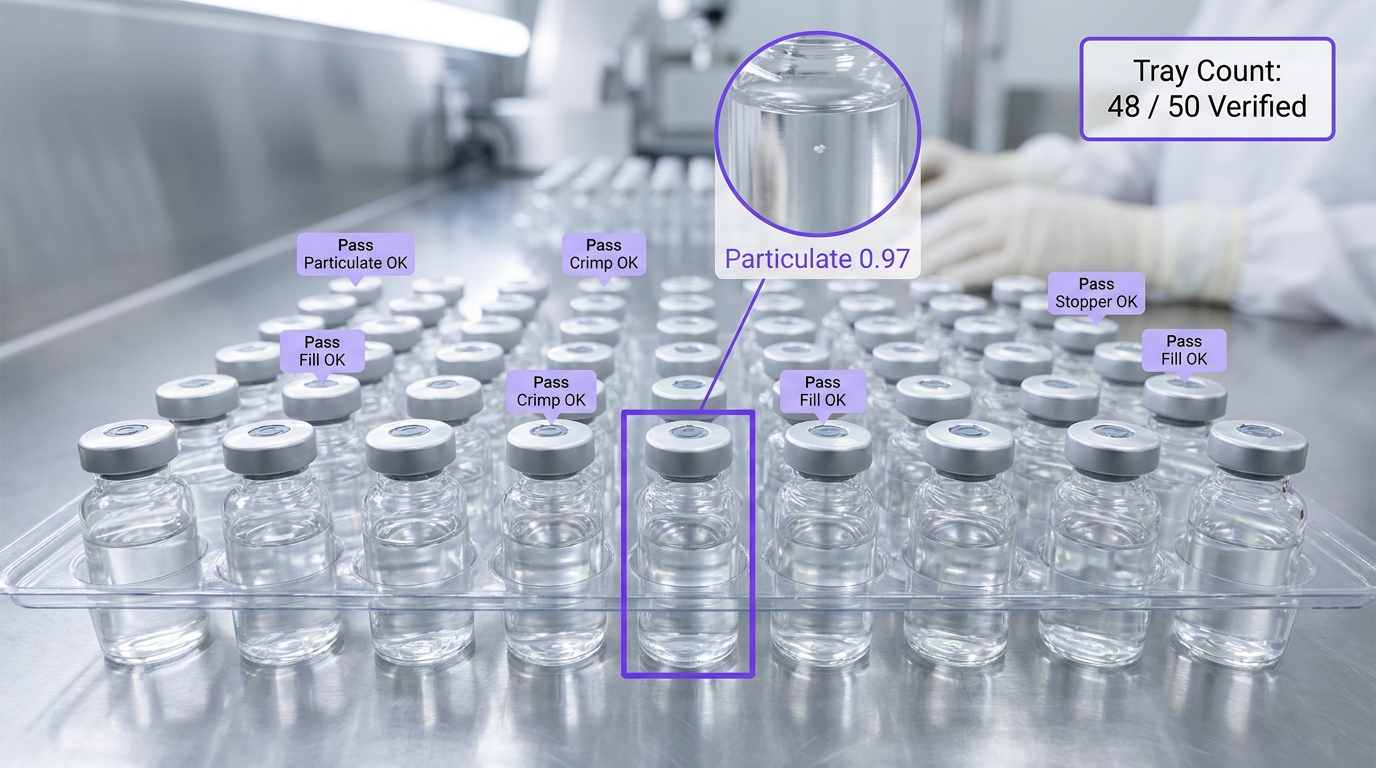
Add a real-time inspection layer to every vial on the line with Vision AI for vial inspection. Built for the operations where one missed particulate, mis-seated stopper, breached crimp seal, or short-count tray can mean a recall, an FDA 483, or a batch rejected at QA review. Whether you're inspecting clear injectable vials, lyophilized vials, ampoules, biologic containers, or finished trays of vials before pack-out, Roboflow extends your QC coverage to every vial on the line, validatable under USP <790>, FDA 21 CFR Part 11, and EU GMP Annex 1.
Vial Contents and Particulate Inspection:
- Detect visible particulates per USP <790> in clear vials, lyophilized vials, biologic containers, and ampoules
- Verify fill volume, headspace, and meniscus position on every filled vial
- Inspect lyophilized cake structure for collapse, fissure, melt-back, shrinkage, and color anomalies
Vial Closure and Cosmetic Inspection:
- Verify stopper seating, plunger position, and bromobutyl rubber stopper integrity on every vial
- Inspect aluminum crimp seal integrity, dimple position, and tamper-evident closure
- Catch glass cosmetic defects (cracks, chips, scratches, delamination) on vial bodies, necks, and finishes
Tray Count, Label, and Lot Code Verification:
- Count vials in trays at the end of fill-finish and before pack-out to catch short or over counts before they ship
- Read and verify lot codes, expiration dates, and 2D codes on every vial and tray label
- Maintain a validated audit trail for every vial per FDA 21 CFR Part 11 and EU GMP Annex 11
Bring intelligence to every vial today. Stop visual quality risks from becoming 483s, recalls, or batch rejections.
Frequently asked questions
What is vial inspection with Vision AI?
Vial inspection with Vision AI uses computer vision models to inspect glass and plastic vials at every stage of pharma, biotech, and specialty manufacturing, from fill through stoppering, crimping, lyophilization, labeling, and final tray pack-out. The system extends QC coverage to every vial on the line, catching visible particulates per USP <790>, fill volume errors, stopper and crimp seal defects, glass cosmetic flaws, lyophilized cake anomalies, label misprints, lot code errors, and short or over counts in finished trays. Manufacturers use it to cut false rejects, prevent batch rejections at QA review, reduce field-failure escapes, and document compliance under USP <790>, FDA 21 CFR Part 11, 21 CFR Part 211 (cGMP), and EU GMP Annex 1.
Can Vision AI count vials in trays and detect visible particulates in the same line?
Yes, and the combined inspection-plus-counting capability is one of the strongest reasons to deploy deep learning on vial lines specifically. Traditional rule-based vision systems typically handle counting as one task (with fixed-pattern template matching across the tray) and visual inspection as a separate task (with thresholded particle detection or feature matching per vial), often requiring separate cameras and separate inspection cells.
Roboflow models can be trained to run both tasks in a single pipeline on the same camera feed, counting vials in a tray while simultaneously flagging any vial that fails particulate, fill, stopper, crimp, or cosmetic inspection criteria. This means a single inspection station can do the work of multiple traditional cells, with a unified pass/fail decision per vial and per tray that integrates directly into your MES or batch release workflow.
Does vial inspection support USP <790>, EU GMP Annex 1, and 21 CFR Part 11?
Yes. Roboflow models can be trained against your specific USP <790> (Visible Particulates in Injections), USP <1790> (Visual Inspection of Injectable Drug Products guidance), USP <787> (Subvisible Particulate Matter in Therapeutic Protein Injections), USP <788> (Particulate Matter in Injections), EP 2.9.20 (Particulate Contamination, European Pharmacopoeia), JP 6.06 (Foreign Insoluble Matter Test for Injections, Japanese Pharmacopoeia), FDA 21 CFR Part 11 (Electronic Records and Electronic Signatures), 21 CFR Part 211 (cGMP for Finished Pharmaceuticals), and EU GMP Annex 1 (Manufacture of Sterile Products) acceptance criteria. The system produces a validated inspection record for every vial that supports your FDA, EMA, MHRA, PMDA, and other regulatory submissions, batch release documentation, and audit response packets. Your quality and regulatory teams own the acceptance criteria; Roboflow provides the inspection engine that enforces them at line speed.
Can it integrate with our AVI line, MES, eQMS, and validation workflow?
Yes. Roboflow Inference (opens in a new tab) exposes a standard API and supports common pharma manufacturing protocols, so Vision AI vial inspection events flow into your existing AVI line equipment, MES, eQMS, EBR, and validation workflow. Roboflow can deploy alongside existing AVI lines from major pharma inspection equipment vendors as a deep-learning second-pass that reduces false rejects and catches the borderline defects rule-based systems struggle with, or run as the primary inspection on new lines. Customers integrate with MasterControl, Veeva Vault QMS, Sparta TrackWise, Werum PAS-X (EBR and MES), SAP, and custom GMP platforms through REST, MQTT, OPC UA, and direct database writes.