Tire Defect Detection AI

Catch sidewall blisters, splice defects, and mold flash on every tire before it carries someone at highway speed.
Shipping container with OCR output

Tire Inspection AI Across Building, Curing, and Final Inspection

Deploy Anywhere, Run Everywhere

Run tire defect detection on the edge, on-prem, in your VPC, or via API, wherever your building machines, curing presses, and final inspection lines need it.

One Platform, Full Adoption

Tools every tire team can adopt, from building machine operators and cure techs to final inspectors, process engineers, and quality leads, no separate ML team required to ship and own inspection models.

Secure, Compliant, and Audit-Ready

Data stays safe with SOC 2 Type II compliance, encrypted data, and an uptime SLA, with per-tire records that support DOT and FMVSS 139 documentation, IATF 16949, and customer audit requirements.
Sidewall Defect Detection
Blister, Bulge & Splice Flags
Tread & Bead Inspection
Mold Flash & Underfill Detection
DOT Code & Lettering Checks
Per-Tire Inspection Records
Sidewall Defect Detection
Blister, Bulge & Splice Flags
Tread & Bead Inspection
Mold Flash & Underfill Detection
DOT Code & Lettering Checks
Per-Tire Inspection Records
Sidewall Defect Detection
Blister, Bulge & Splice Flags
Tread & Bead Inspection
Mold Flash & Underfill Detection
DOT Code & Lettering Checks
Per-Tire Inspection Records
Sidewall Defect Detection
Blister, Bulge & Splice Flags
Tread & Bead Inspection
Mold Flash & Underfill Detection
DOT Code & Lettering Checks
Per-Tire Inspection Records

Talk to a vision AI engineer who's shipped tire inspection.

A sidewall blister that becomes a blowout at highway speed, splice laid wrong on the building drum and cured into a thousand tires, or mold underfill batch discovered by a dealer instead of the final line can mean a failure investigation with a family's car in it, a cure-press problem that ran for a week, and a recall in the product that carries every other product. Bring us your toughest tire inspection problem and we'll map a working solution.
  • Solution architecture for DOT and FMVSS 139 documentation, IATF 16949, and customer audit environments
  • Live demo on your sidewall imagery, tread photos, or final inspection footage
  • Deployment options: edge, on-prem, air-gapped, or VPC, with integration into building machines, presses, PLCs, and MES
  • ROI modeling against final inspection labor, scrap and downgrade rates, escaped defects, and warranty adjustments
  • We will connect you with an AI subject matter expert on our team based on your answers.
    What challenges would you like to solve with vision AI?
    Where will you run vision AI?
    Are you replacing a current solution with AI or will this be a new solution?
    How many detections do you anticipate per month?
    Describe the business problem you would like to solve.
    Oops! Something went wrong while submitting the form.

    Over 16,000 organizations build with Roboflow.

    “Roboflow has been instrumental in accelerating our learning and deployment of innovative AI solutions”
    Travis Turnbull Vice President & CIO, Pella Corporation
    See customer stories
    Trusted by top manufacturers

    Vision AI is transforming manufacturing

    Customers are deploying solutions across the entire business and driving meaningful impact
    $0 million
    Saved by automatically detecting defects
    0%
    Less time spent manually tracking inventory
    0%
    Reduction in customer return rate

    Inspect Every Tire the Way the Road Will, with Vision AI

    Add a real-time inspection layer to every tire with vision AI for tire defect detection. Built for the plants where a blister hides in black-on-black sidewall texture until heat and speed find it, the final inspection line depends on how the tenth hour of a spinner's shift is going, and a curing press that started flashing at dawn gets discovered by the day shift's complaints. Whether you're building green tires, curing, or running final inspection, Roboflow inspects every tire's surfaces at line rate, with per-tire records tied to the DOT serial behind every shipment.

    Sidewall and Lettering:

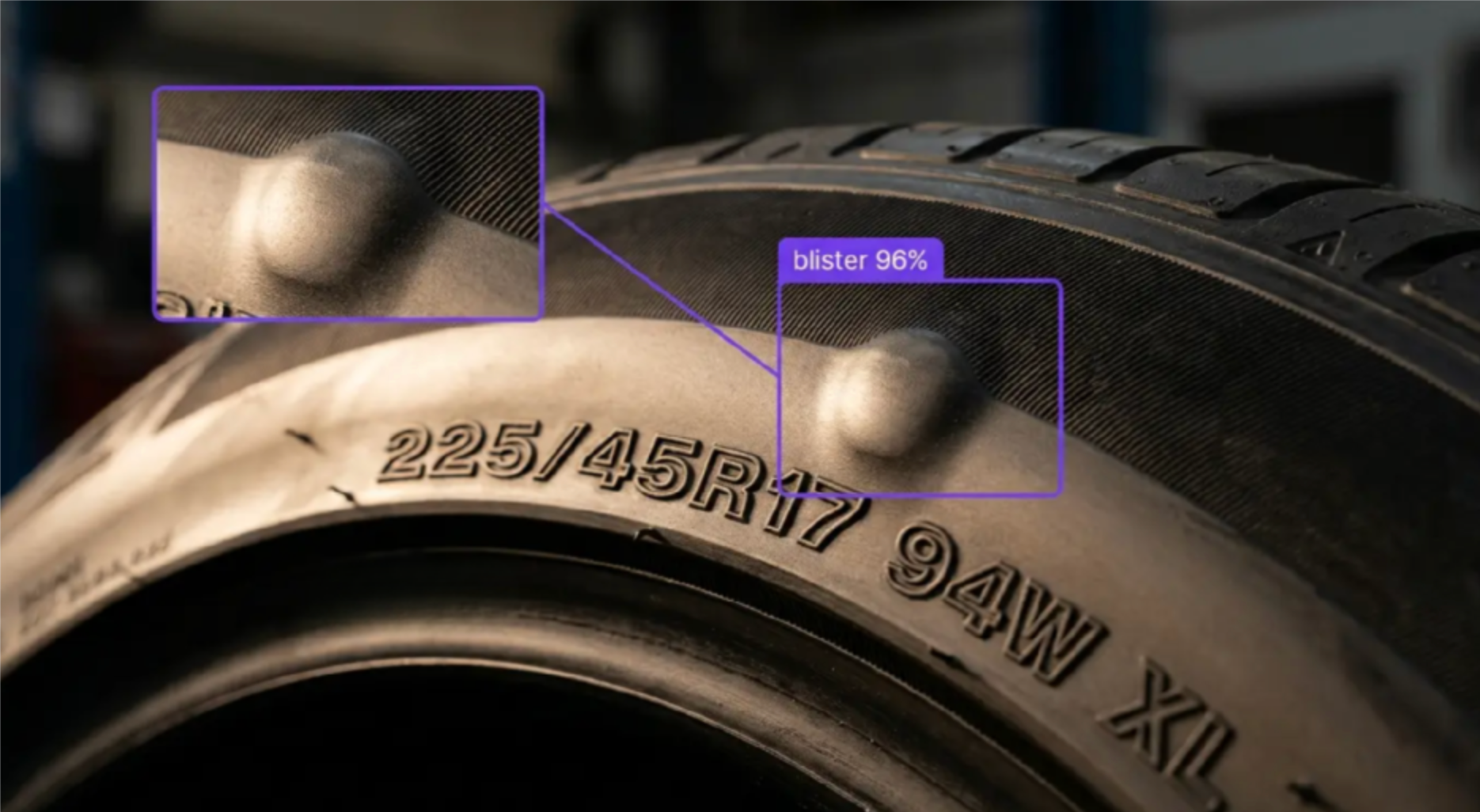
    • Catch blisters, bulges, and cuts on sidewalls, where black defects hide in black rubber until the road finds them
    • Detect splice marks, open splices, and cured-in building defects on every tire rather than sampled ones
    • Verify lettering and read DOT codes on every sidewall, tying each inspection to its serial

    Tread, Bead, and Building:

    • Detect mold underfill, foreign material, and tread pattern defects at cure discharge
    • Inspect bead areas for defects that turn into mounting and seating problems downstream
    • Check splice placement and component position at the building machine, before the press cures a mistake into a batch

    Final Inspection, Presses, and Systems Integration:

    • Run consistent visual judgment at final inspection, augmenting the spinners with a standard that doesn't fade by hour ten
    • Trend defects by press, mold, and building machine, so a flashing mold reaches maintenance at dawn instead of day shift
    • Route tires in real time through PLC and MES integration, with per-tire records tied to DOT serial that support FMVSS 139 and IATF 16949 documentation

    Bring intelligence to every tire today. Stop tire defects from becoming highway failures, week-long press problems, or the recall that carries your name on every sidewall.

    More About Tire Defect Detection

    What is tire defect detection with Vision AI?

    Tire defect detection with vision AI uses computer vision models to inspect tires through building, curing, and final inspection: sidewall blisters, bulges, and splice defects, tread underfill and foreign material, bead defects, mold flash, and lettering and DOT code verification. Models trained on your actual tires and molds inspect every unit at line rate, with per-tire records tied to DOT serial that support FMVSS 139 and IATF 16949 documentation.

    Can Vision AI find black defects on black rubber?

    The tire is the definitive black-on-black case: a blister that's a subtle change in curvature, a splice mark that's a texture shift, raised lettering and mold patterns everywhere, and every bit of it the same light-absorbing rubber. Deep-learning models trained on your actual tires, molds, and lighting learn each tire line's normal surface, curvature, and texture, flag what breaks it, hold that judgment across sizes and patterns, and route borderline tires to an inspector instead of guessing, which is the consistency the tenth hour of a shift can't offer.

    How does this fit with our X-ray and uniformity machines?

    X-ray keeps seeing what vision can't: cord placement, belt alignment, and internal structure. Uniformity and balance machines keep measuring force variation. Vision AI adds the visual surface layer between them: the blister X-ray doesn't flag, the mold flash no force measurement feels, the splice mark and the DOT read, all on every tire, all feeding the same per-tire record. Three instruments, one record per serial, which is what a warranty adjuster or an investigator actually asks for.

    Can it integrate with our building machines, presses, PLCs, and MES?

    Yes. Roboflow Inference exposes a standard API and supports common industrial protocols, so tire inspection events flow into your existing systems: building machine and press PLCs from Allen-Bradley and Siemens, MES and ERP platforms like SAP and Oracle, and SCADA and HMI platforms like Ignition and AVEVA, through REST, MQTT, OPC UA, and direct database writes. PLC-level integration routes a flagged tire the moment a check fails, and every event carries DOT serial, press, mold, imagery, and disposition, with a full audit trail behind every tire.

    Stay Connected

    Get the Latest in Computer Vision First

    Thank you for subscribing!
    Oops! Something went wrong!.
    Unsubscribe at any time. Review our Privacy Policy.

    Additional resources

    Vision AI is transforming every industry. Let’s transform yours.