Time Studies AI

Time every element of every cycle from video, and set standard times from hundreds of cycles instead of a handful.
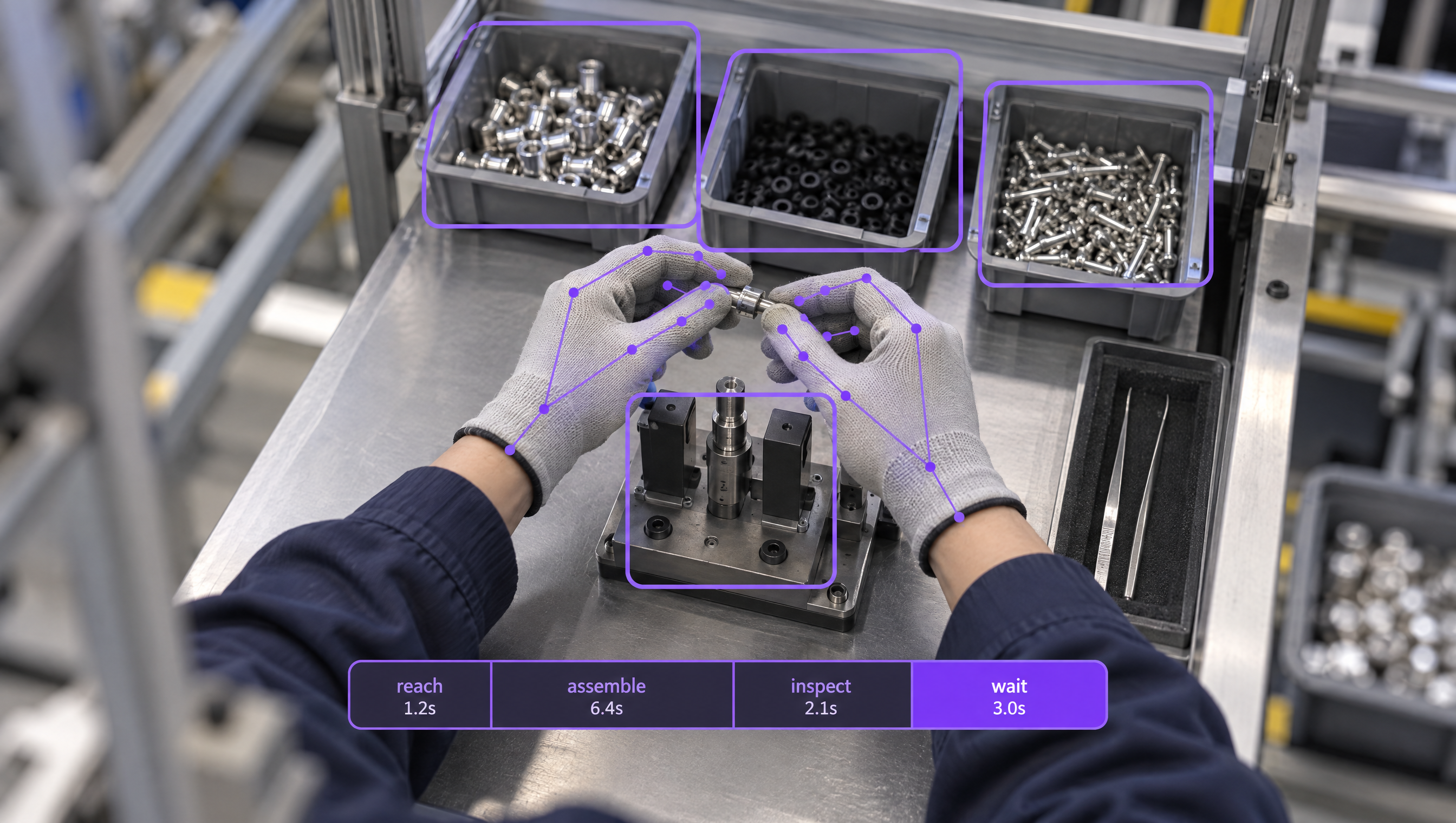
An assembly worker's gloved hands assembling metal parts, with computer vision motion-tracking overlays, object detection boxes, and task-timing metrics.

Time Studies AI for the Toughest Assembly, Machining, and Manual Work

  • Deploy Anywhere, Run Everywhere

    Run time studies on the cameras you already have or a temporary camera at the station, on the edge, on-prem, air-gapped, in your VPC, or via API.

  • One Platform, Full Adoption

    Tools every operations team can adopt, from industrial engineers and continuous improvement leads to supervisors and plant management, no separate ML team required.

  • Secure, Compliant, and Audit-Ready

    Data stays safe with SOC 2 Type II compliance, encrypted data, and an uptime SLA, with face blurring at the edge and results grouped by station and job, not by person.

  • Element-Level Timing from Video
  • Observed, Normal & Standard Times
  • Value-Added vs. Non-Value-Added Time
  • Walk, Reach & Wait Analysis
  • Line Balancing & Takt Fit
  • Standard Work Sequence Checks
“The vision AI solutions we developed with Roboflow have been a core component of connecting our teams and unlocking their ability to collaborate.”

Lou Stocco

Director of Manufacturing Advanced Analytics, USG

Talk to a Vision AI engineer who's shipped in manufacturing.

Bring us your toughest time study problem and we'll map a working solution.

Ask us about:

  • Solution architecture that fits your stations, element definitions, and IE methods
  • A live demo on video from your own workstations
  • Deployment options: existing cameras and edge, on-prem, air-gapped, or VPC
  • ROI modeling against IE hours, labor standards, line balance, and launch time

Over 80,000 organizations build with Roboflow.

  • Rivian
  • Pella
  • Chobani
  • USG Corporation
  • BNSF Railway
  • American Woodmark
Start where you are

Vision AI is transforming businesses

Customers across the board are solving complex challenges and driving meaningful impact.

  • Automotive customer

    $10 million

    Saved by automatically detecting defects on the production line

  • Logistics & freight company

    90%

    Less time spent manually tracking shipping inventory

  • Building materials supplier

    60%

    Lower customer return rate with improved product quality

Measure Every Element, from First Study to Final Standard

Add a continuous measurement layer to your industrial engineering work with Roboflow Vision AI for time studies. Built for plants where a time study means an engineer with a stopwatch and a clipboard watching 10 to 20 cycles of one operator on one shift, the standard that comes out of it drives staffing, line balance, and costing for years, and nobody has time to redo it when the product, the fixture, or the layout changes. Roboflow times every element of every cycle from video, across every shift, so standards rest on hundreds of real cycles.

Element timing:

  • Break each job into its elements, such as get part, position, fasten, inspect, and aside, and time every one from video.
  • Time every repetition across shifts, products, and stations, and report the average, spread, and outliers for each element.
  • Keep the video clip behind every timed element, so any result can be checked and any outlier explained.

Waste and motion:

  • Split value-added from non-value-added time, and find the walks, reaches, waits, and searches that lean teams target first.
  • Track hand and body motion with pose estimation to measure reach distances and repeated motions at the workstation.
  • Flag awkward reaches and lifts in the same footage, alongside ergonomics assessment.

Standards and line balancing:

  • Turn observed times into normal and standard times with your own performance ratings and allowances.
  • Balance work across stations against takt time, and see which station is overloaded before you move a single task.
  • Build and verify standard work, and compare element times before and after every kaizen, fixture change, or new product launch.

Bring intelligence to every time study today. Set standards from every cycle, not the ten you had time to watch.

‍

Frequently asked questions

What is a time study with Vision AI?

A time study with Vision AI uses video of the workstation and trained computer vision models to find when each element of a job starts and ends, time it on every cycle, and roll the results up into observed, normal, and standard times. Industrial engineers get the same outputs as a stopwatch study, built from far more cycles, with the video behind every number.

How is it different from cycle time monitoring?

A time study sets the standard: how long each element of a job should take, how many people a line needs, and how work is split between stations. Cycle time monitoring runs every day after that, measuring actual cycles against the standard. Many plants use the same cameras for both.

How do you handle operator privacy?

Time studies measure the job, not the person. Models detect hands, parts, tools, and steps rather than identities, faces can be blurred at the edge before any frame is stored, retention follows your policy, and results are grouped by station and job. Plants that bring operators in early see the best results, because the waits and walks the study finds are the ones that make the job harder.

Can results go into our industrial engineering and MES tools?

Yes. Models run on an edge device in the plant or fully air-gapped, and element times are sent over REST, MQTT, or a database write to your spreadsheets, BI dashboards, line balancing tools, and MES, with station, job, product, and the video clip attached.

Roboflow serves as the measurement engine, and your industrial engineering team owns the element definitions, ratings, allowances, and standards.

‍