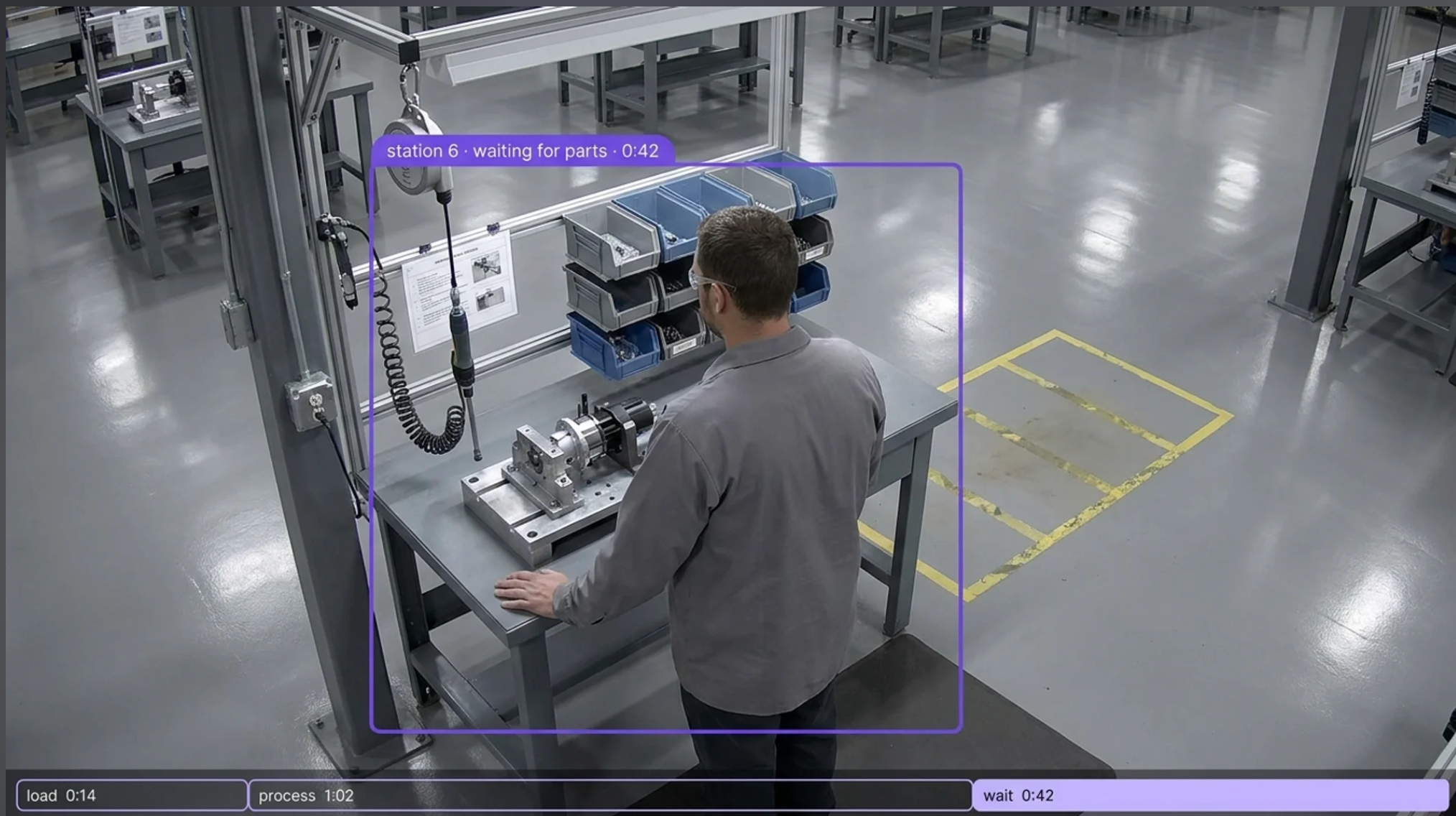
Add a real-time measurement layer to every station with vision AI for cycle time and process monitoring. Built for the plants where the MES says the line ran at rate and the shift still missed by 400 units, the time study is six months old and was done on the best operator on the best day, and nobody can say whether the 40 seconds lost per cycle is the machine, the material, or the walk to the bin. Roboflow watches the cameras you already have, measures every cycle, every step, and every wait from the footage itself, and turns the plant floor into a continuous, timestamped process record, without a stopwatch, a clipboard, or a PLC tag for every event.
Cycle Time and Takt Measurement:
- Measure every cycle at every station from video, start to finish, so cycle time is a distribution across every shift and operator rather than a single number from a time study
- Break each cycle into steps, load, process, inspect, unload, walk, and wait, so the seconds lost are attributed to the step that lost them
- Compare cycle time to takt in real time and flag the station that drifts, before it becomes a missed shift target
Bottlenecks, Waits, and Process Adherence:
- Detect blocked and starved states, empty fixtures, full buffers, and idle machines, so the bottleneck is located from what the cameras see rather than inferred from counts
- Detect waiting for parts, tools, forklifts, and quality sign-off, and measure micro-stops the PLC never logs because the machine never faulted
- Verify the sequence of operations against the standard work, so a skipped step, an out-of-order step, or a workaround is flagged with the video clip behind it
OEE, Root Cause, and Systems Integration:
- Feed performance and availability losses into OEE with the reason attached, so the loss tree is built from evidence instead of operator downtime codes
- Trend cycle time by shift, operator, product, and tooling, so a fixture that adds four seconds and a changeover that runs long show up as patterns
- Push cycle events, step times, and states into MES, OEE, and analytics systems through PLC and API integration, with a video clip behind every anomaly
Bring intelligence to every station today.
More About Cycle Time and Process Monitoring
What is cycle time and process monitoring with Vision AI?
Cycle time and process monitoring with vision AI uses cameras over stations, cells, and lines and deep-learning models to measure production processes directly from video: cycle start and end, step-by-step timing, operator and machine states, blocked and starved conditions, waits for parts and tools, micro-stops, and adherence to the standard sequence of operations. It measures every cycle rather than a sample, attributes lost time to the step that lost it, and feeds cycle events and states into MES, OEE, and analytics systems, so continuous improvement, industrial engineering, and operations work from a complete, timestamped record with a video clip behind every anomaly. It complements PLC and MES data, which capture machine events but not the walk, the wait, or the workaround.
How is this different from PLC counters and MES cycle data?
PLC and MES data are accurate about what the machine did and blind to everything around it. A PLC logs a cycle when the press closes; it does not see the operator waiting 30 seconds for the part cart, the second reach for a tool that should have been at the fixture, or the inspection step that was skipped because the line was behind. Manual workstations, assembly cells, and material handling often have no PLC data at all, which is why time studies exist. Vision AI measures the whole cycle, human and machine, from the camera, and does it continuously across every shift and operator, so the time study becomes a live distribution and the difference between the MES count and the shift target has a reason attached. The two together are the full picture: the PLC for machine states, vision for everything the PLC cannot see.
How does this handle operator privacy and workforce concerns?
Process monitoring is about the process, and deployments are designed that way from the start. Models detect states, steps, and objects, not identities; faces can be blurred at the edge before any frame is stored; footage retention is set by your policy; and reporting aggregates by station, shift, and product rather than by individual. The most successful deployments are introduced with the operators and the union where there is one, with the framing that the system finds the waits and the workarounds that make the job harder, and the standard work changes that come out of it are the visible result. Roboflow provides the controls; your plant sets the policy.
Can it integrate with our MES, OEE, and analytics systems?
Yes. Roboflow Inference (opens in a new tab) runs on an edge device at the line and exposes a standard API and common industrial protocols, so cycle events, step times, and states flow into your existing systems: MES and OEE platforms from Siemens Opcenter, Rockwell Plex, and others, historians like AVEVA PI, PLCs from Allen-Bradley and Siemens, and analytics and BI tools like Power BI, Tableau, and Grafana, through REST, MQTT, OPC UA, and direct database writes. PLC-level integration lets a vision-detected state trigger an andon or a material call on the spot, and every event carries station, shift, product, step, duration, timestamp, and the video clip behind it, with a full record behind every cycle.