Surgical Instrument Inspection AI
Catch damage, residue, and the missing instrument before the tray is wrapped and the case is called.
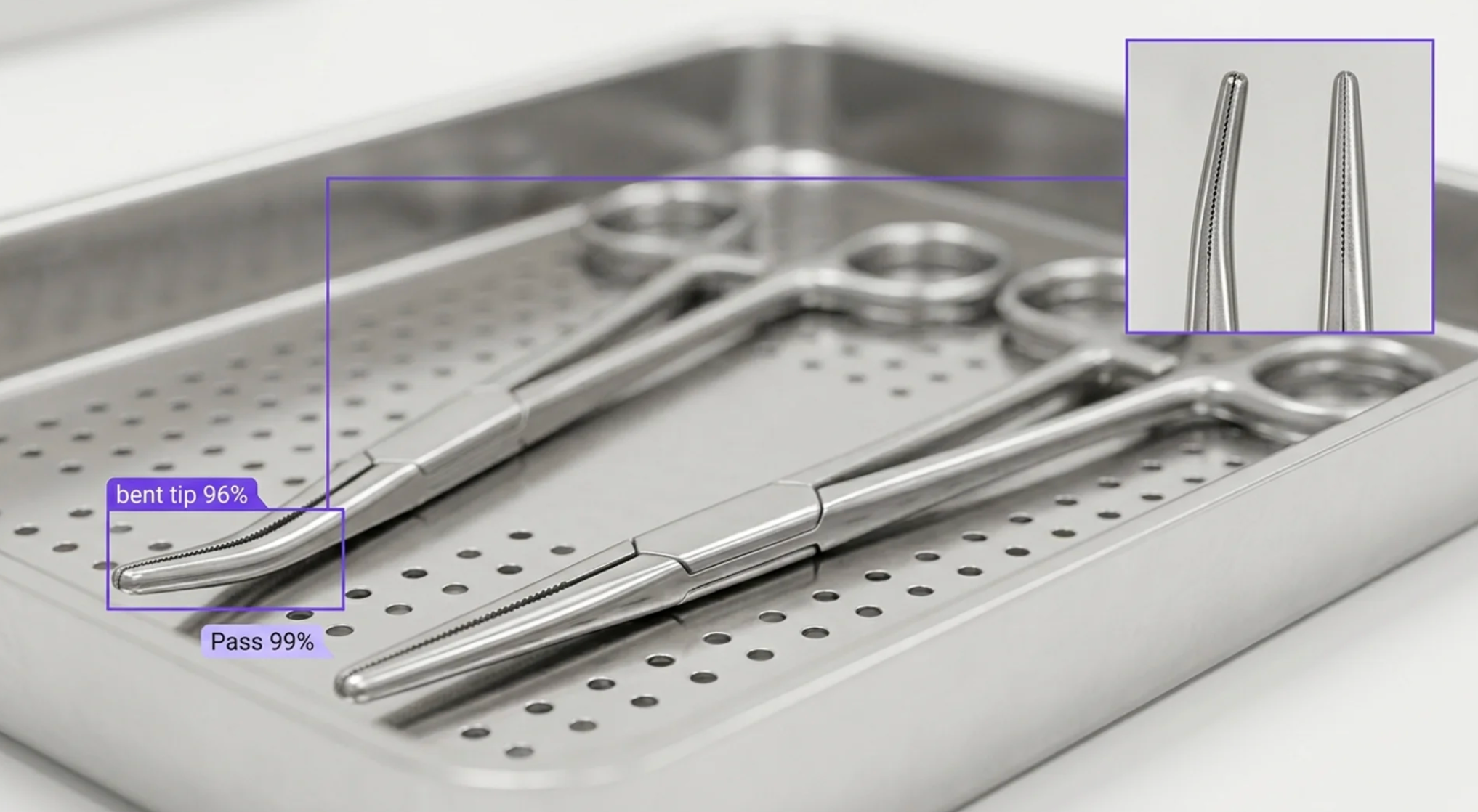
Instrument Inspection AI Across Manufacturing, Reprocessing, and Set Assembly
Deploy Anywhere, Run Everywhere
Run surgical instrument inspection on the edge, on-prem, in your VPC, or via API, wherever your finishing lines, decontam and prep benches, and set assembly stations need it.
One Platform, Full Adoption
Tools every team can adopt, from finishing operators and sterile processing techs to SPD leads, quality engineers, and OR liaisons, no separate ML team required to ship and own inspection models.
Secure, Compliant, and Audit-Ready
Data stays safe with SOC 2 Type II compliance, encrypted data, and an uptime SLA, with records that support ISO 13485, FDA 21 CFR 820, and AAMI ST79 programs.
- Instrument Damage Detection
- Residue & Stain Screening
- Tray & Set Verification
- Edge & Tip Condition Checks
- Etch & UDI Verification
- Per-Set Assembly Records
“We wanted to develop models using data we owned, have the ability to scale usage, leverage state-of-the-art AI capabilities, and along the way ensure the privacy of our users’ personal health information. That’s what we found in Roboflow.”
Alec Zopf
Co-founder and Chief AI & Automation Officer, Wellth
Talk to a vision AI engineer who's shipped instrument inspection.
A set that reaches the OR one hemostat short, a stained instrument a surveyor finds before your team does, or a cracked box lock that lets go mid-procedure can mean a delayed case with a full team waiting, a survey finding on the department, and an instrument history nobody can reconstruct. Bring us your toughest instrument inspection problem and we'll map a working solution.
Ask us about:
- Solution architecture for ISO 13485, FDA 21 CFR 820, and AAMI ST79 environments
- Live demo on your instrument imagery, tray photos, or prep station footage
- Deployment options: edge, on-prem, air-gapped, or VPC, with integration into instrument tracking systems and MES
- ROI modeling against tray errors, OR delays, repair spend, and survey readiness
Over 16,000 organizations build with Roboflow.
- Rivian
- Pella
- Chobani
- USG Corporation
- BNSF Railway
- American Woodmark
Vision AI is transforming businesses
Customers across the board are solving complex challenges and driving meaningful impact.
- Automotive customer
$10 million
Saved by automatically detecting defects on the production line
- Logistics & freight company
90%
Less time spent manually tracking shipping inventory
- Building materials supplier
60%
Lower customer return rate with improved product quality