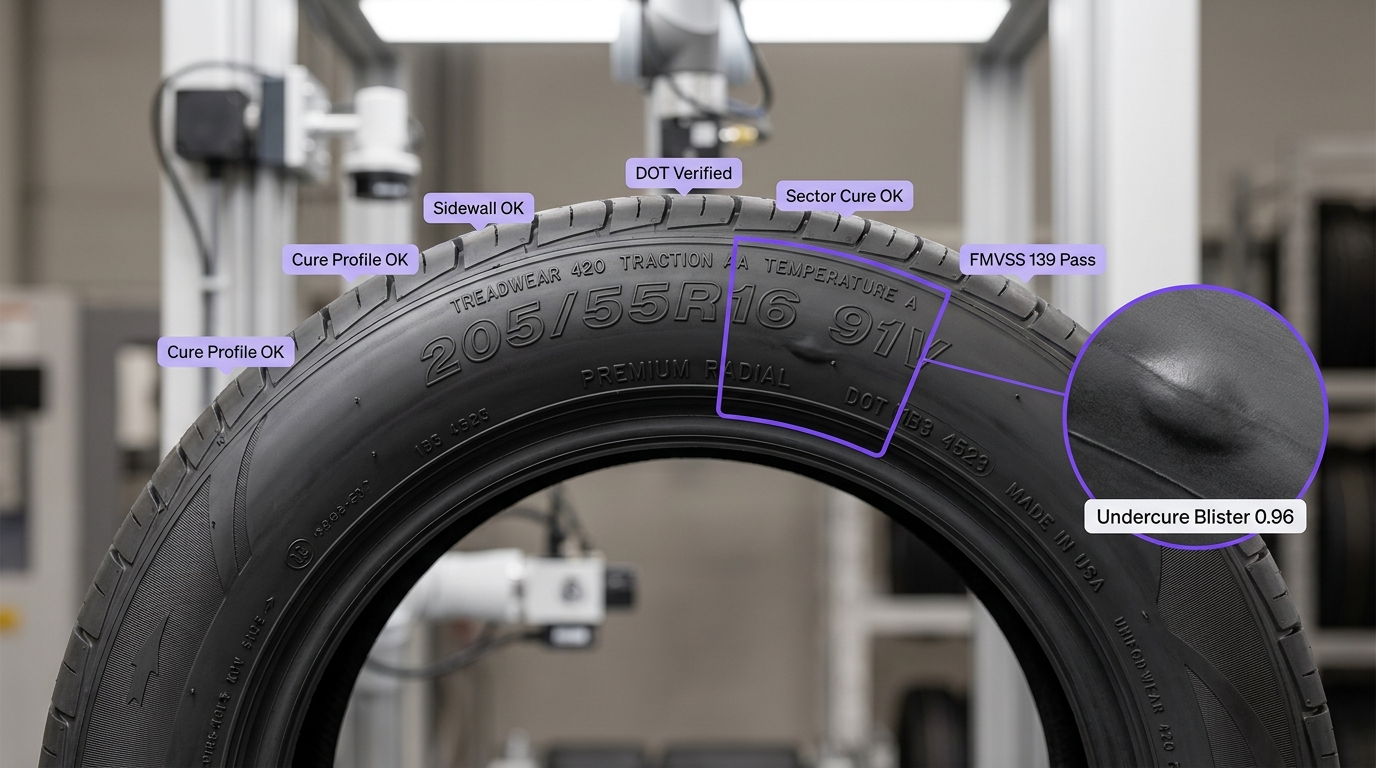
Add a real-time inspection layer to every rubber part on the line with Vision AI for rubber inspection. Whether you're inspecting green tires coming off the tire building drum, cured tires exiting the cure press, molded automotive rubber parts (seals, gaskets, hoses, engine mounts, weatherstripping), extruded profiles and O-rings, industrial belts and hoses, or finished consumer and medical rubber parts, Roboflow extends your QC coverage to every part on the line, on the cameras and inspection stations your facility already runs.
Tire and Cured Rubber Defects:
- Catch undercure and overcure indicators, blisters, porosity, spongy areas, and cure profile deviations on tires and molded parts as they exit the cure press
- Detect belt, ply, and bead misalignment on green tires at the tire building drum before they enter the cure press
- Verify sidewall markings, DOT labels, tread patterns, and tire uniformity against customer specification for every tire
Molded Rubber, Bond, and Extrusion Defects:
- Inspect rubber-to-metal bond and rubber-to-fabric bond quality on automotive engine mounts, weatherstripping, and reinforced hoses per ASTM D4482 adhesion test criteria
- Catch flash, trim defects, mold parting line issues, and ejector marks on molded rubber parts as they exit the press
- Detect extrusion defects (dimensional variation, surface blemishes, bloom, migration) on O-rings, seals, profile extrusions, and industrial hoses
Contamination, Compliance, and Final QC:
- Catch foreign material inclusions (metal, plastic, non-rubber contamination), color drift, and compound contamination that fail food-contact, medical, and aerospace acceptance criteria
- Verify surface finish, dimensional tolerance, and appearance quality against customer PPAP submissions on every part
- Maintain validated inspection records that support DOT tire marking, FMVSS 139, ECE R30 and R54, ASTM D2000, ISO 3601 and ISO 6194, IATF 16949 for automotive rubber, ISO 13485 for medical device rubber, FDA 21 CFR 177 for food-contact rubber, AS9100, and customer-specific PPAP submissions
Bring intelligence to every rubber part today. Stop rubber defects from becoming tire recalls, warranty claims, customer chargebacks, or medical rubber field failures.
More About Rubber Inspection
What is rubber inspection with Vision AI?
Rubber inspection with Vision AI uses computer vision models to inspect rubber products at every stage of manufacturing, from green tires coming off the tire building drum through cured tires exiting the cure press, molded automotive rubber parts (seals, gaskets, hoses, engine mounts, weatherstripping, wiper blades), extruded O-rings and profiles, industrial belts and hoses, roofing membranes, and finished consumer and medical rubber parts. The system extends QC coverage to every part on the line, catching undercure and overcure indicators, blisters and porosity, spongy areas from cure profile deviations, rubber-to-metal and rubber-to-fabric bond failures, foreign material inclusions (metal, plastic, non-rubber contamination), flash and trim defects, mold parting line issues, ejector marks, dimensional variation, surface blemishes, bloom and migration, color drift, belt and ply and bead misalignment on tires, sidewall marking errors, tread pattern defects, and adhesion failures across thousands of compound grades, cure profiles, and customer-specific part programs.
Can Vision AI catch cure defects, bond failures, and subtle surface anomalies that rule-based vision struggles with on rubber?
Yes. Roboflow models add a deep-learning inspection layer trained on your actual product appearance, compound-specific characteristics, and cure profile morphology, catching the defect categories rule-based vision struggles with and co-piloting existing inspection systems from ISRA Vision (now Atlas Copco), specialty tire uniformity vendors (Akron Standard / Micro-Poise Measurement Systems, Hofmann), and general machine vision installations by adding visual verification on borderline rejects (reducing false-positive scrap from over-sensitive thresholds, increasing true-positive confidence on safety-critical tires, automotive rubber, and medical rubber programs).
Does rubber inspection support DOT, FMVSS 139, ECE R30, ASTM D2000, and IATF 16949?
Yes. Roboflow models can be trained against your specific DOT tire marking requirements and FMVSS 139 (US new tire safety), ECE R30 (European passenger car tire) and ECE R54 (European truck tire) and ECE R117 (rolling resistance, noise, wet grip) European tire regulations, ISO 4223 (tire nomenclature), ISO 10454 (adhesion testing), ASTM D2000 (rubber material classification), ASTM D471 (fluid immersion), ASTM D412 (tensile), ASTM D573 (heat aging), ASTM D4482 (rubber-to-metal adhesion), ISO 3601 (O-rings), ISO 6194 (rotary shaft seals), ISO 4649 (abrasion), IATF 16949 (automotive quality management system for automotive rubber parts), ISO 13485 (medical device quality management system for medical rubber components), FDA 21 CFR 177 (food contact substances for food-contact rubber), USP and USP (biological reactivity for medical device rubber), AS9100 for aerospace rubber applications, ISO 9001, and customer-specific PPAP (Production Part Approval Process) and APQP (Advanced Product Quality Planning) acceptance criteria.
The system applies the same pass/fail logic your trained quality engineers and cure press operators use, against your written specifications, compound formulations, mold programs, and customer release documentation, and produces validated inspection records that support customer audits, automotive Tier 1 PPAP submissions, tire recall investigation defense on safety-critical programs, medical device FDA inspections, food-contact rubber regulatory filings, and traceability to the compound batch, cure profile, mold program, and run number. Your quality and regulatory teams own the acceptance criteria; Roboflow provides the inspection engine that enforces them at line speed across every rubber part.
Can it integrate with our tire building cell PLCs, cure press control, mold press automation, MES, eQMS, and ERP?
Yes. Roboflow Inference exposes a standard API and supports common rubber manufacturing automation protocols, so Vision AI rubber inspection events flow into your existing tire building cell PLCs, cure press control, mold press automation, MES, eQMS, ERP, and field-failure traceability platforms. Customers integrate with tire building cell automation from VMI Group, Marangoni, and specialty tire OEM in-house cells, cure press control from Kobelco, Uzer Makina, HF Group, and Marangoni, mold press automation for automotive rubber from Desma, Maplan, LWB Steinl, and Rep International, extrusion line equipment for O-rings and profiles from Troester, Bekum, and Reifenhauser, tire uniformity systems from Akron Standard (Micro-Poise Measurement Systems) and Hofmann, downstream inspection systems from ISRA Vision (now Atlas Copco), general machine vision installations, rubber MES platforms (Siemens Opcenter, custom plant systems), eQMS platforms (MasterControl, Veeva Vault QMS, Sparta TrackWise, ETQ Reliance), and ERP systems (SAP, Oracle) through REST, MQTT, OPC UA, and direct database writes, with PLC-level integration to tire building drum decisions, cure press cycle control, mold press rejects, and downstream sorting where pass/fail decisions need to drive line behavior.