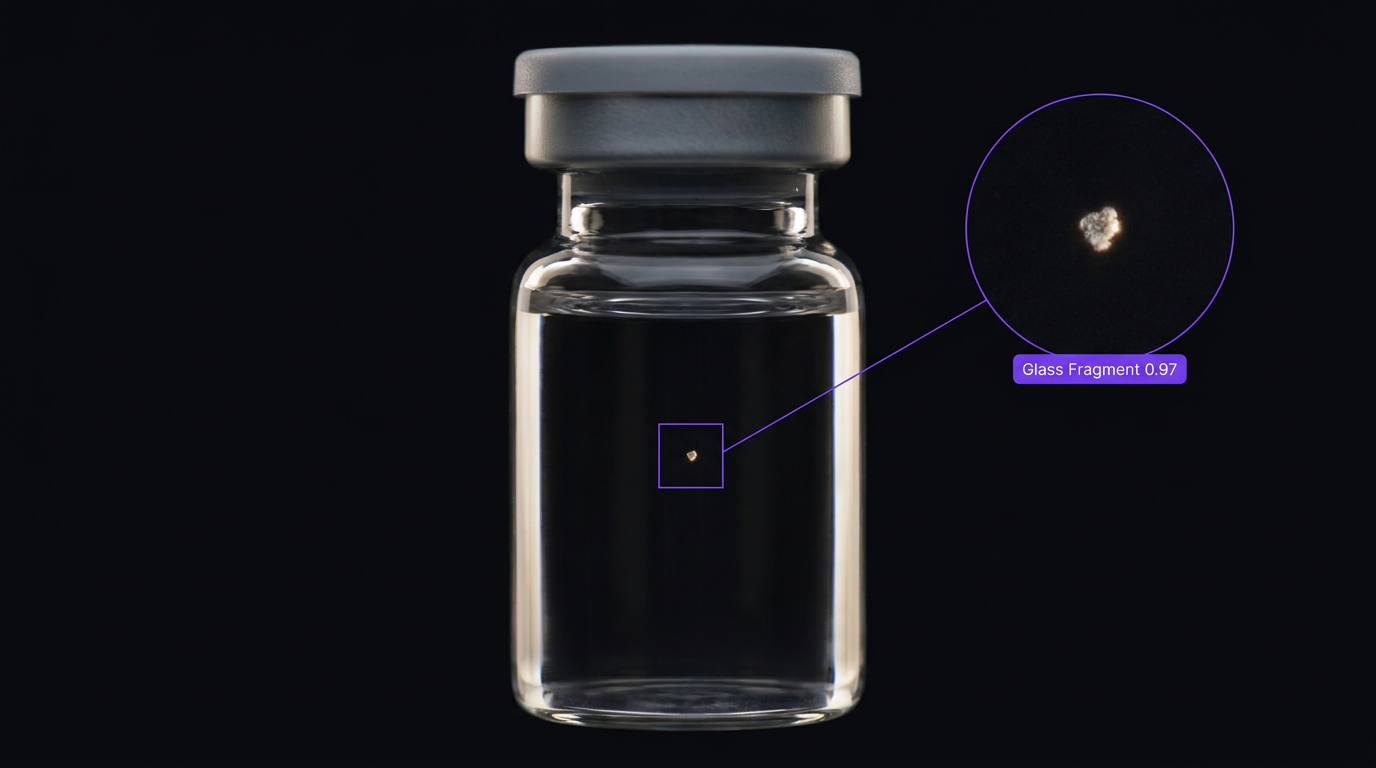
Add a real-time particle detection layer to every parenteral on the line with Vision AI for particle detection in injectables. Built for the cGMP environments where one visible particle in a vial of biologic, sterile injectable, or large-volume parenteral can mean a recall, an FDA 483, a manufacturing hold, or patient harm. Whether you're inspecting prefilled syringes, glass vials, ampoules, cartridges, or IV bags for glass fragments, fibers, stopper material, protein aggregates, or foreign matter, Roboflow extends your AVI coverage to every container on the line, validatable under USP <790>, FDA 21 CFR Part 11, and EU GMP Annex 1.
Particle Detection Across Container Types and Drug Products:
- Detect glass fragments, glass delamination flakes, and foreign glass per USP <790>
- Identify cellulose fibers, stopper rubber, silicone oil droplets, and crystalline drug particles
- Catch protein aggregates in biologics, color anomalies, and foreign matter at sub-millimeter scale
AVI Line Integration and False Reject Reduction:
- Deploy alongside existing AVI lines from Seidenader (Korber), Bosch / Syntegon, Brevetti CEA, Antares Vision, or Stevanato
- Reduce false rejects from air bubbles, stopper coatings, and benign artifacts using morphology-based deep learning
- Inspect containers across fill, capping, labeling, and final QC at line speed
Validation, Audit Trails, and USP / EP / JP Compliance:
- Deploy validated models under USP <790> (visible particulates), USP <787> and <788> (subvisible), and EP 2.9.20 / JP 6.06 acceptance criteria
- Maintain audit trails per FDA 21 CFR Part 11 and EU GMP Annex 11 for every container inspected
- Generate validated inspection records that support batch release, regulatory submissions, and audit response
Bring intelligence to every parenteral today. Stop visible particles from becoming 483s, recalls, or patient harm.
Frequently asked questions
What is particle detection in injectables with Vision AI?
Particle detection in injectables with Vision AI uses computer vision models to detect visible and subvisible particulates in parenteral drug products, including prefilled syringes, vials, ampoules, cartridges, and IV bags. The system extends 100% inspection coverage across every container coming off the fill-finish line, catching glass fragments, glass delamination, cellulose fibers, stopper rubber fragments, silicone oil droplets, protein aggregates, crystalline drug particles, and foreign matter at sub-millimeter scale. Pharma manufacturers use it to cut false rejects, improve detection sensitivity on subtle particle types, and document compliance under USP <790>, FDA 21 CFR Part 211 (cGMP for finished pharmaceuticals), and EU GMP Annex 1.
Can Vision AI detect visible particulates per USP <790>?
Yes. USP <790> visible particulate inspection is the canonical pharmaceutical AVI task, and a single missed visible particle can trigger an FDA recall and a warning letter that affects every batch released since the last successful audit. Roboflow models can be trained against your specific USP <790> visible particulates acceptance criteria, including the inherent, intrinsic, and extrinsic particle categories outlined in USP <1790> visual inspection guidance. The system applies the same pass/fail logic your trained inspectors would, against your written specifications, using both backlit and dark-field illumination per USP visual inspection standards. Roboflow extends 100% inspection coverage across every container, with edge-optimized models that flag suspect units for trained inspector adjudication, the same pattern operators already use with traditional AVI but with deep-learning sensitivity on subtle particle morphologies that rule-based systems often miss or false-reject.
Does particle detection support EP 2.9.20, JP 6.06, and EU GMP Annex 1?
Yes. Roboflow models can be trained against USP <790> (Visible Particulates in Injections), USP <1790> (Visual Inspection of Injectable Drug Products guidance), USP <787> (Subvisible Particulate Matter in Therapeutic Protein Injections), USP <788> (Particulate Matter in Injections), EP 2.9.20 (Particulate Contamination, European Pharmacopoeia), JP 6.06 (Foreign Insoluble Matter Test for Injections, Japanese Pharmacopoeia), and EU GMP Annex 1 (Manufacture of Sterile Products) acceptance criteria. The system produces a validated inspection record for every container that supports your FDA, EMA, MHRA, and PMDA regulatory submissions, batch release documentation, and audit response packets. Your quality and regulatory teams own the acceptance criteria; Roboflow provides the inspection engine that enforces them at line speed.
Can it integrate with our existing AVI line, MES, eQMS, and validation workflow?
Yes. Roboflow Inference exposes a standard API and supports common pharma manufacturing protocols, so Vision AI particle detection events flow into your existing AVI line equipment, MES, eQMS, EBR, and validation workflow. Roboflow can deploy alongside existing AVI lines from Seidenader (Korber), Bosch / Syntegon, Brevetti CEA, Antares Vision, and Stevanato Group, adding a deep-learning layer to the rule-based vision systems already in production, or run as the primary inspection on new lines. Customers integrate with MasterControl, Veeva Vault QMS, Sparta TrackWise, Werum PAS-X (EBR and MES), SAP, and custom GMP platforms through REST, MQTT, OPC UA, and direct database writes. Models are designed to be validatable under FDA 21 CFR Part 11 with IQ/OQ/PQ-ready documentation, audit trails for training data, model versions, and inspection results that pass validation engineer review and FDA audit scrutiny.