OCR on Wafer Carrier Rings AI
Read every laser-etched, dot-peened, or printed carrier-ring ID with computer vision.
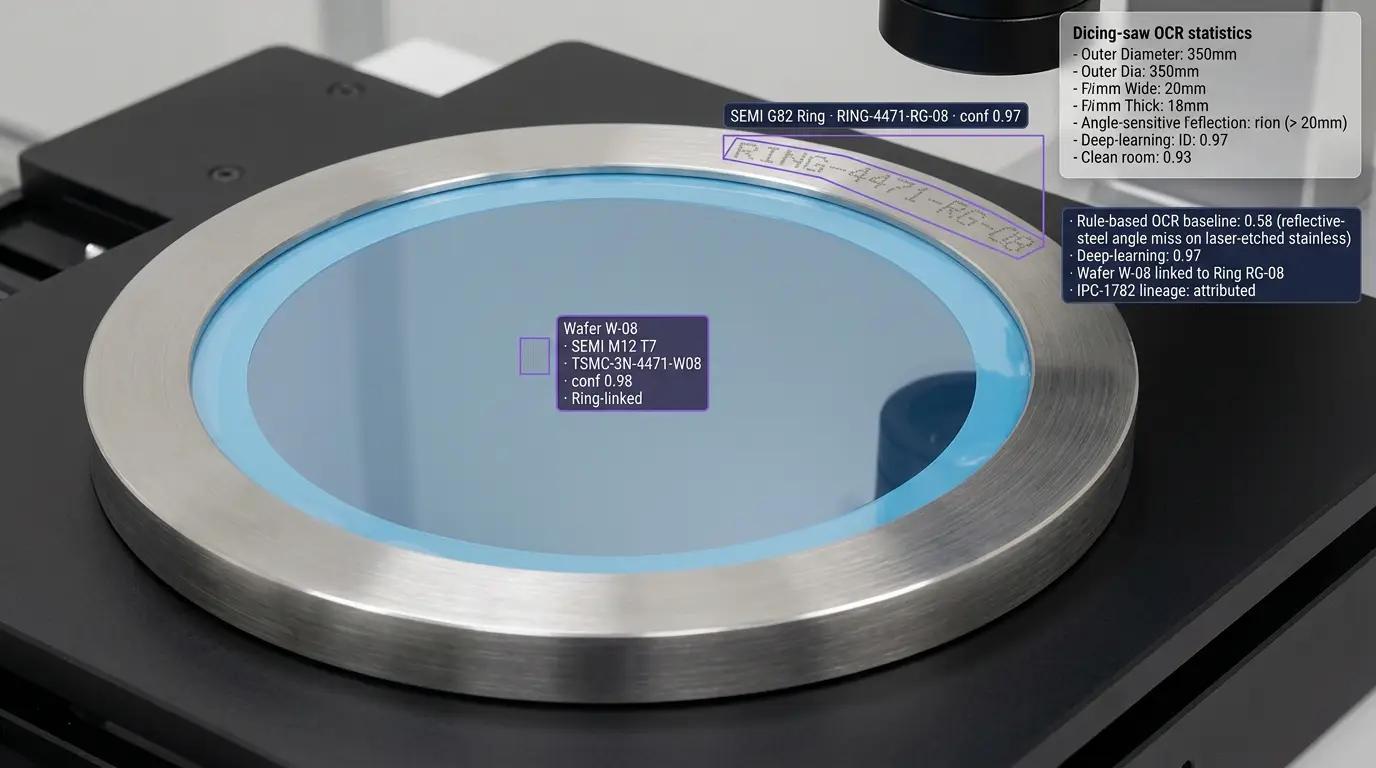
OCR on Wafer Carrier Rings AI Across Backgrind, Dicing, Probe Test, Die Attach, and Every Tape-Frame Traceability Task
Deploy Anywhere, Run Everywhere
Run OCR on wafer carrier rings on the edge (line-side jetson-class or industrial edge next to the backgrinder or dicing saw), on-prem in the fab or OSAT, in a customer-controlled VPC, or air-gapped for advanced-node process tools.
One Platform, Full Adoption
Tools every semi backend team can adopt, no separate ML team required.
Built for SEMI G74/G82/G87 Ring Standards and Every Semi Traceability Framework
SOC 2 Type II, encrypted data, and an uptime SLA on every backend tool.
- Laser-Etched, Dot-Peen & Ink-Jet Ring ID Reads
- SEMI G74 Backgrind & G82 Dicing Frame Standards
- Reflective Steel & Contamination-Robust OCR
- Backgrind, Dicing, Probe & Die Attach Coverage
- SECS/GEM MES Integration (E5, E30, E37)
- AEC-Q100 & MIL-STD-883 Wafer-to-Die Traceability
“Roboflow has been instrumental in accelerating our deployment of innovative AI solutions.”
Travis Turnbull
Vice President & CIO, Pella Corporation
Talk to a Vision AI engineer who's shipped OCR on wafer carrier rings.
A single misread tape-frame ring ID at backgrind, wrong-ring load into a dicing saw, or lost lot genealogy between wafer probe and die attach can mean a scrapped wafer worth $50,000+ at leading edge, an OSAT test-cell throughput hit, or an AEC-Q100 automotive traceability gap between wafer probe and die-level pick-out that a tier-one supplier catches on the next PPAP audit. Bring us your toughest OCR on wafer carrier rings problem and we'll map a working solution.
Ask us about:
- Solution architecture for SEMI G74, G82, G87, M60, M12, M13, E5 (SECS-II), E30 (GEM), E37 (HSMS), E40, E116, E10, S2, S8, E15, ISO 14644, IEC 62061, IPC-1782, IATF 16949, AEC-Q100/Q101/Q200, AS9100, MIL-STD-883, MIL-PRF-38534/38535/19500, ITAR/EAR export controls, and customer-specific tool qualification acceptance criteria
- Live demo on your real backgrinder input/output footage, dicing saw imagery, laser dicing camera capture, wafer taping/detaping video, probe-test cell captures, die bonder ring-load imagery, or ring stocker inventory in your real cleanroom lighting and ring mix conditions (stainless steel with laser-etch, dot-peen, ink-jet, printed labels, plus contamination from dicing-tape adhesive residue and process chemicals)
- Deployment options: backgrinder, dicing saw, laser dicing, wafer taping/detaping, pick-and-place from dicing tape, wafer probe test, die bonder, UV curing, detape station, ring stocker, robot end-effector, edge (fab-side or OSAT-side jetson-class or industrial edge), on-prem, air-gapped for advanced-node BEOL tools, with integration into SECS/GEM interfaces, tool controllers, fab MES/CIM (Applied Materials E3, IBM SiView, Siemens Opcenter Camstar, Critical Manufacturing), and OSAT test-cell controllers
- ROI modeling against scrapped wafers at leading-edge cost ($50k+ per wafer), scanner alignment kills cascading from misread rings, repeat carrier-ring misreads driving equipment reliability engineer overtime at OSAT backend, GEM event downtime, AEC-Q100 wafer-to-die traceability audit exposure, tier-one supplier PPAP rejections from broken ring-to-lot lineage, and hardware refresh on aging dedicated OCR readers on backgrinders and dicing saws
Over 16,000 organizations build with Roboflow.
- Rivian
- Pella
- Chobani
- USG Corporation
- BNSF Railway
- American Woodmark