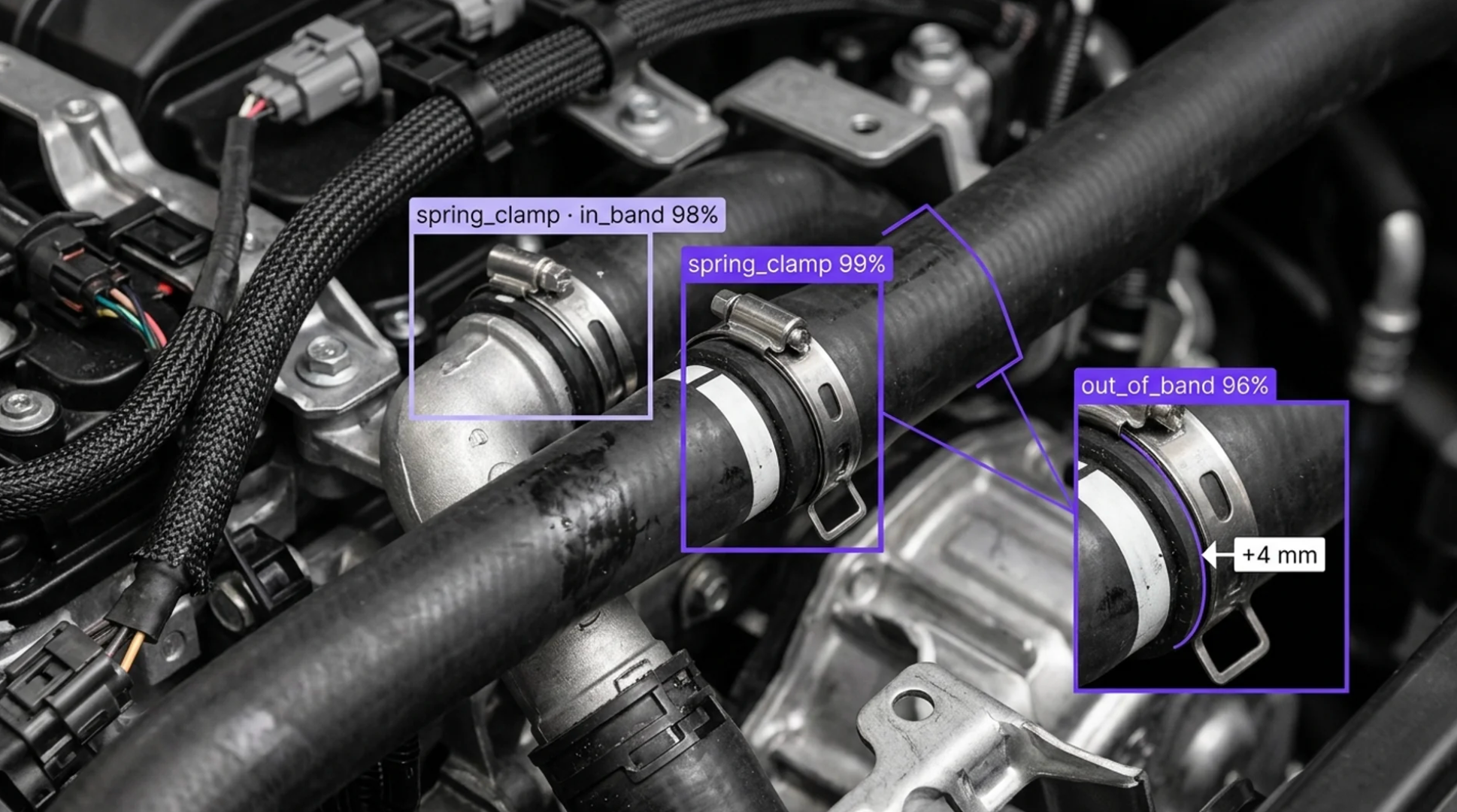
Add a real-time inspection layer to every hose and line connection on the truck, engine, or unit with Roboflow Vision AI for hose clamp verification.
Presence, type, and count at the station:
- Detect that a clamp is present at each hose end on coolant, fuel, hydraulic, air intake, and refrigerant lines with a model trained on your own station footage, across hose colors, sleeve markings, and the cable and bracket clutter of a real engine bay.
- Confirm clamp type and size (constant-tension spring, worm-drive, T-bolt, ear clamp) against the bill of materials for that variant so a 32 mm clamp on a 38 mm hose or a worm-drive where the print calls for a spring clamp is flagged before the hose is filled.
- Count clamps per variant on multi-connection sub-assemblies such as radiator, charge air cooler, and HVAC line sets, and compare the count to the routing for the VIN or serial at that station.
Position, orientation, and closure:
- Verify that the clamp sits inside the hose insertion band, past the barb bead and short of the hose end, and that the hose itself is fully seated on the barb or quick connect.
- Check spring clamp orientation and tab angle so the tabs point where the print and the service technician expect, and flag a clamp that was released off-position or left on the pliers mark.
- Confirm a worm-drive clamp is closed and torqued by reading the paint or torque mark and the screw head position, and catch a clamp that is closed but still loose on the hose.
End-of-line coverage, traceability, and line integration:
- Run the same models on a handheld camera at a repair bay, a fixed camera at a sub-assembly station, and a robot-mounted camera sweeping the engine bay at end-of-line, so coverage extends to every unit and not only audited samples.
- Write pass/fail per clamp to the PLC or station controller so the conveyor holds, the andon lights, or the torque tool sequence does not release until every clamp on the variant is verified.
- Log an image, result, and timestamp per clamp to the unit's serial or VIN for the control plan, PPAP evidence, and the warranty investigation that asks which clamp was verified on which day.
Bring intelligence to every hose connection today. Stop a missing or mis-set clamp from becoming a coolant leak in the field, a warranty campaign, or a recall.
Frequently asked questions
What is hose clamp inspection with Vision AI?
Hose clamp inspection with Vision AI uses handheld, fixed station, or robot-mounted cameras and a trained computer vision model (opens in a new tab) to confirm, at the assembly station and at end-of-line, that each clamp on a coolant, fuel, hydraulic, air intake, or refrigerant line is present, is the correct type and size for the variant, sits inside the hose insertion band, is oriented with the tab angle the print calls for, and is closed and torqued, with the hose fully seated on the barb. The model is trained on your own station footage so it handles hose colors, sleeve markings, and the cable and bracket clutter of a real engine bay, and it writes a per-clamp result to the unit's serial or VIN. It is a narrower cousin of fastener verification and presence and absence detection, and one of the highest-volume checks in heavy truck and equipment assembly inspection, with records that support IATF 16949, ISO 9001, and customer PPAP and control plan requirements.
Can Vision AI verify spring clamp tab angle and clamp position inside the insertion band?
Yes. A detection model trained on your own images learns the clamp, the hose end, the barb bead, and the tab geometry at the angles your cameras see, and a keypoint or segmentation head measures where the clamp sits relative to the hose end and what angle the tabs make relative to the hose axis. Position tolerances are set by your engineering print and the SAE J1508 clamp specification, and you own the acceptance limits.
Does hose clamp verification support IATF 16949 and customer PPAP requirements?
Hose clamp verification supports the error-proofing, control plan, and traceability expectations of IATF 16949 (the automotive quality management system standard built on ISO 9001 that governs vehicle, engine, and tier supplier production) and ISO 9001 (the general quality management system standard), and it produces the per-unit inspection evidence that customer PPAP submissions and control plans call for as a poka-yoke or 100 percent inspection step. Clamp type and size selection follow SAE J1508 (the SAE standard covering hose clamp specifications, dimensions, and performance), and your engineering print defines the insertion band and tab orientation the model checks against.
Roboflow serves as the inspection engine, and your quality, manufacturing, and product engineering teams own the acceptance criteria, the reaction plan, and the sign-off in the control plan, with image and result logs per serial that stand up in a warranty or recall investigation.
Can it integrate with our PLC, torque tools, MES, and andon system?
Yes. Roboflow writes a per-clamp pass/fail and a per-unit verified count to a PLC tag over OPC UA, Modbus TCP, or MQTT, so Allen-Bradley and Siemens controllers can hold the conveyor, light the andon, or gate the next torque tool sequence from Atlas Copco or Ingersoll Rand controllers until every clamp on the variant is confirmed.
Results, images, and serial or VIN links can be sent over REST (opens in a new tab) or written to a database for the MES and SCADA layer, including Ignition, AVEVA, SAP Digital Manufacturing, and Rockwell Plex, and the same records feed the final assembly inspection and engine component inspection checks that run alongside clamp verification on the same stations, and the line-set checks on HVAC manufacturing inspection.