Heavy Truck and Equipment Assembly Inspection AI

Catch a missing hose clamp, an unseated connector, a misrouted harness, or the wrong part for that VIN before the truck, bus, tractor, or excavator leaves the line.
Shipping container with OCR output

Heavy Truck and Equipment Assembly Inspection AI for the Toughest Truck, Bus, and Off-Highway Lines

Deploy Anywhere, Run Everywhere

Run truck assembly line inspection on end-of-line booth, station-mounted, and handheld tablet cameras on the edge, on-prem, in your VPC, or via API.

One Platform, Full Adoption

Tools every truck and off-highway plant team can adopt, from manufacturing and industrial engineers to quality leads and Industry 4.0 groups, no separate ML team required.

Secure, Compliant, and Audit-Ready

Data stays safe with SOC 2 Type II compliance, encrypted data, HIPAA compliance, and an uptime SLA, with validation documentation that supports IATF 16949, ISO 9001, and VDA 6.3 audits.
End-of-Line Hose Clamp & Fastener Presence
Hose & Cable Routing Verification
Harness Connector Seating & Lock Confirmation
Torque-Mark & Label Presence
Right Part for This VIN Across Build Variants
Cab, Chassis & Final Finish Checks
End-of-Line Hose Clamp & Fastener Presence
Hose & Cable Routing Verification
Harness Connector Seating & Lock Confirmation
Torque-Mark & Label Presence
Right Part for This VIN Across Build Variants
Cab, Chassis & Final Finish Checks
End-of-Line Hose Clamp & Fastener Presence
Hose & Cable Routing Verification
Harness Connector Seating & Lock Confirmation
Torque-Mark & Label Presence
Right Part for This VIN Across Build Variants
Cab, Chassis & Final Finish Checks
End-of-Line Hose Clamp & Fastener Presence
Hose & Cable Routing Verification
Harness Connector Seating & Lock Confirmation
Torque-Mark & Label Presence
Right Part for This VIN Across Build Variants
Cab, Chassis & Final Finish Checks

Talk to a Vision AI engineer who's shipped in truck and off-highway manufacturing.

Bring us your toughest truck assembly line inspection problem and we'll map a working solution.
  • Solution architecture that fits IATF 16949, ISO 9001, VDA 6.3, and your customer-specific PPAP and control plan requirements
  • A live demo on your own end-of-line and station camera footage
  • Deployment options: edge, on-prem, air-gapped, VPC, station-mounted, handheld tablet, or on the plant's existing camera and PLC network
  • ROI modeling against warranty claims, field campaigns, end-of-line repair loops, containment and sort labor, and the cost of adding rule-based vision stations to every variant
  • We will connect you with an AI subject matter expert on our team based on your answers.
    What challenges would you like to solve with vision AI?
    Where will you run vision AI?
    Are you replacing a current solution with AI or will this be a new solution?
    How many detections do you anticipate per month?
    Describe the business problem you would like to solve.
    Oops! Something went wrong while submitting the form.

    Over 16,000 organizations build with Roboflow.

    “Roboflow has been instrumental in accelerating our learning and deployment of innovative AI solutions”
    Travis Turnbull Vice President & CIO, Pella Corporation
    See customer stories
    Trusted by top manufacturers

    Vision AI is transforming manufacturing

    Customers are deploying solutions across the entire business and driving meaningful impact
    $0 million
    Saved by automatically detecting defects
    0%
    Less time spent manually tracking inventory
    0%
    Reduction in customer return rate

    Verify Every Clamp, Connector, and Part on Every Build Variant, from Chassis to Final Finish

    Add a real-time inspection layer to every truck, bus, tractor, and machine on the line with Roboflow Vision AI for heavy truck and equipment assembly inspection.

    Clamp, fastener, and routing presence at end of line:

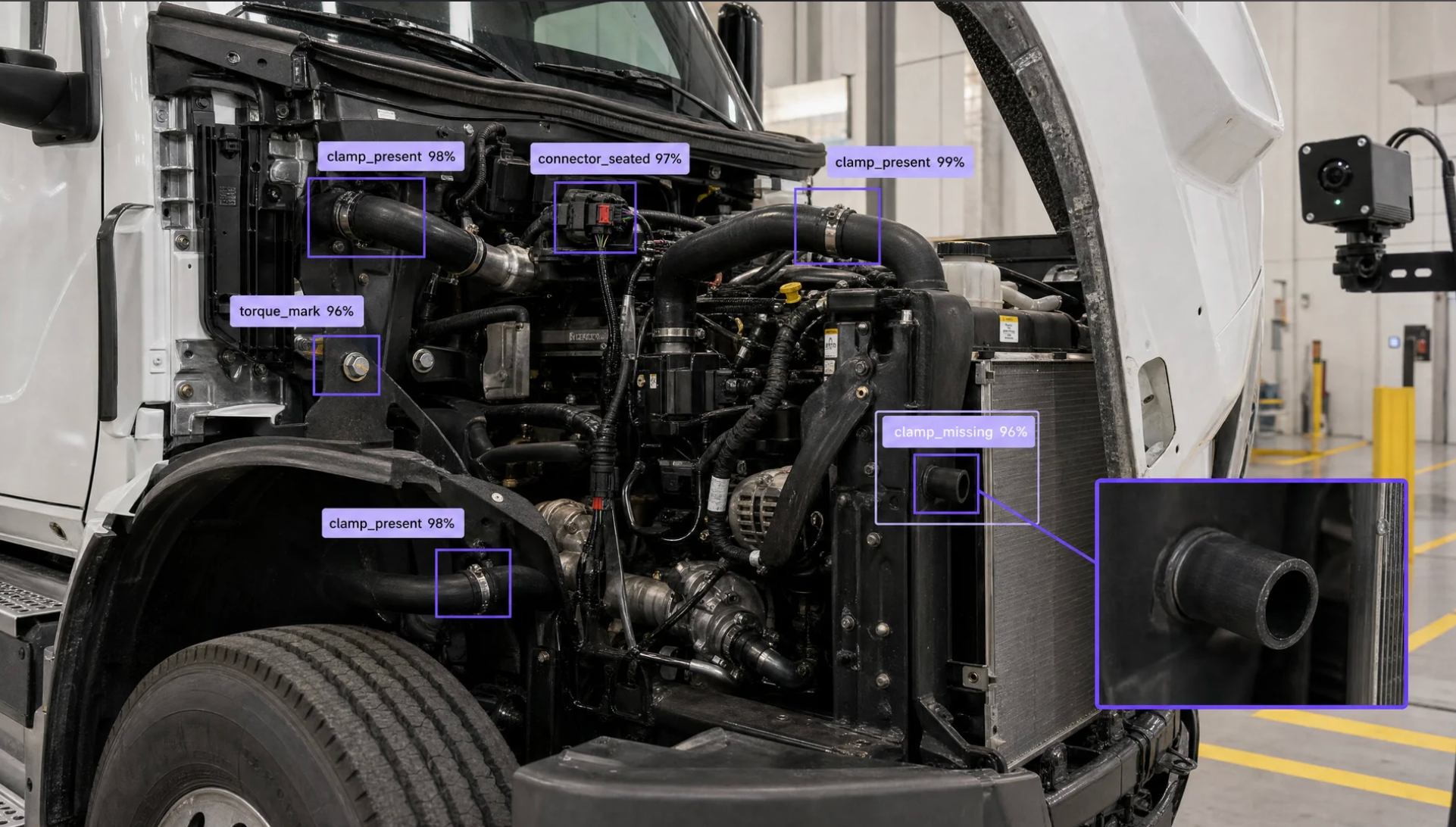
    • Confirm every hose clamp is present, closed, and positioned at the right location on coolant, charge-air, fuel, hydraulic, and DEF lines from end-of-line booth or station cameras, with a model trained on your own trucks under your own lighting.
    • Verify fastener presence, torque marks, and cable ties across engine bay, frame rail, and cab areas that today are covered by a paper or tablet checklist.
    • Check hose and cable routing against the intended path so a line that chafes on a bracket or crosses an exhaust component is flagged before the unit ships.

    Harness, connector, and build-variant verification:

    • Confirm harness connectors are fully seated and locked on ECMs, sensors, lighting, and telematics modules, including the partial-seat cases a pull test at the station can miss.
    • Pull the build sheet for the VIN from your MES and verify the right part, bracket, badge, or option is installed for that variant, and the wrong one is not, across 4x2, 6x4, sleeper, day cab, tier-4 aftertreatment, and export configurations.
    • Read part labels, serial plates, and lot codes with OCR so traceability data lands in the build record without a manual scan.

    Cab, chassis, and final finish at the last station:

    • Inspect cab exterior, chassis paint, and decal placement for scratches, runs, missing badges, and mismatched panel finish on every unit before customer acceptance.
    • Run one model across manual stations, automated cells, and the end-of-line booth, with a deployment manager for edge devices across multiple plants.
    • Log every pass, fail, and rework with the image, station, and VIN so quality has the record for IATF 16949 layered process audits, PPAP submissions, and warranty root cause.

    Stop a missing clamp or a wrong-variant part from becoming a warranty claim or a field campaign.

    Frequently asked questions

    What is truck assembly line inspection with Vision AI?

    Truck assembly line inspection with Vision AI uses cameras at build stations and the end-of-line booth, plus a trained computer vision model, to verify that each truck, bus, tractor, or construction machine was built the way its build sheet says. The model checks hose clamp presence and position, fastener and torque-mark presence, hose and harness routing, connector seating, label presence, and the right part for that VIN, and it records the result with an image per unit. It sits alongside your existing final assembly inspection checklist and extends coverage to every unit, with records that support IATF 16949, ISO 9001, VDA 6.3, and customer-specific PPAP and control plan requirements.

    Can Vision AI verify the right part for each build variant on a high-mix line?

    Yes. A detection model trained on your own footage learns what each part and clamp looks like across variants, and a Roboflow Workflow pulls the expected configuration for that VIN from your MES or build sheet and compares it to what the camera sees.

    Does truck assembly line inspection support IATF 16949 and VDA 6.3?

    Yes. Truck assembly line inspection on Roboflow supports IATF 16949 (the automotive quality management system standard built on ISO 9001 with additional requirements for error-proofing, control plans, and layered process audits), ISO 9001 (the general quality management system standard), and VDA 6.3 (the German automotive process audit standard), plus customer-specific PPAP and control plan requirements, by giving quality a per-unit inspection record with image, station, VIN, and result. Inspection results can be referenced as a control method in the control plan and as an error-proofing device in the PFMEA. Roboflow serves as the inspection engine, and your quality and manufacturing engineering teams own the acceptance criteria, the control plan, and the disposition of every fail.

    Can it integrate with our MES, andon, and station PLCs?

    Yes. Roboflow returns pass/fail and the list of missed items per unit over REST or MQTT so an MES such as SAP ME, Siemens Opcenter, or Rockwell FactoryTalk can hold the unit, open a repair ticket, and attach the image to the build record for that VIN. Results can be written to Allen-Bradley or Siemens station PLCs over OPC UA to trigger an andon call or stop a conveyor advance, and to SCADA platforms such as Ignition and AVEVA for plant-level dashboards. The same platform runs wire harness inspection and fastener verification upstream, so one model set covers the sub-assembly cell and the end-of-line booth.

    Stay Connected

    Get the Latest in Computer Vision First

    Thank you for subscribing!
    Oops! Something went wrong!.
    Unsubscribe at any time. Review our Privacy Policy.

    Additional resources

    Vision AI is transforming every industry. Let’s transform yours.