Glass Defect Detection AI
Catch inclusions, bubbles, scratches, stones, coating defects, and edge cracks on every glass product before defects ship.
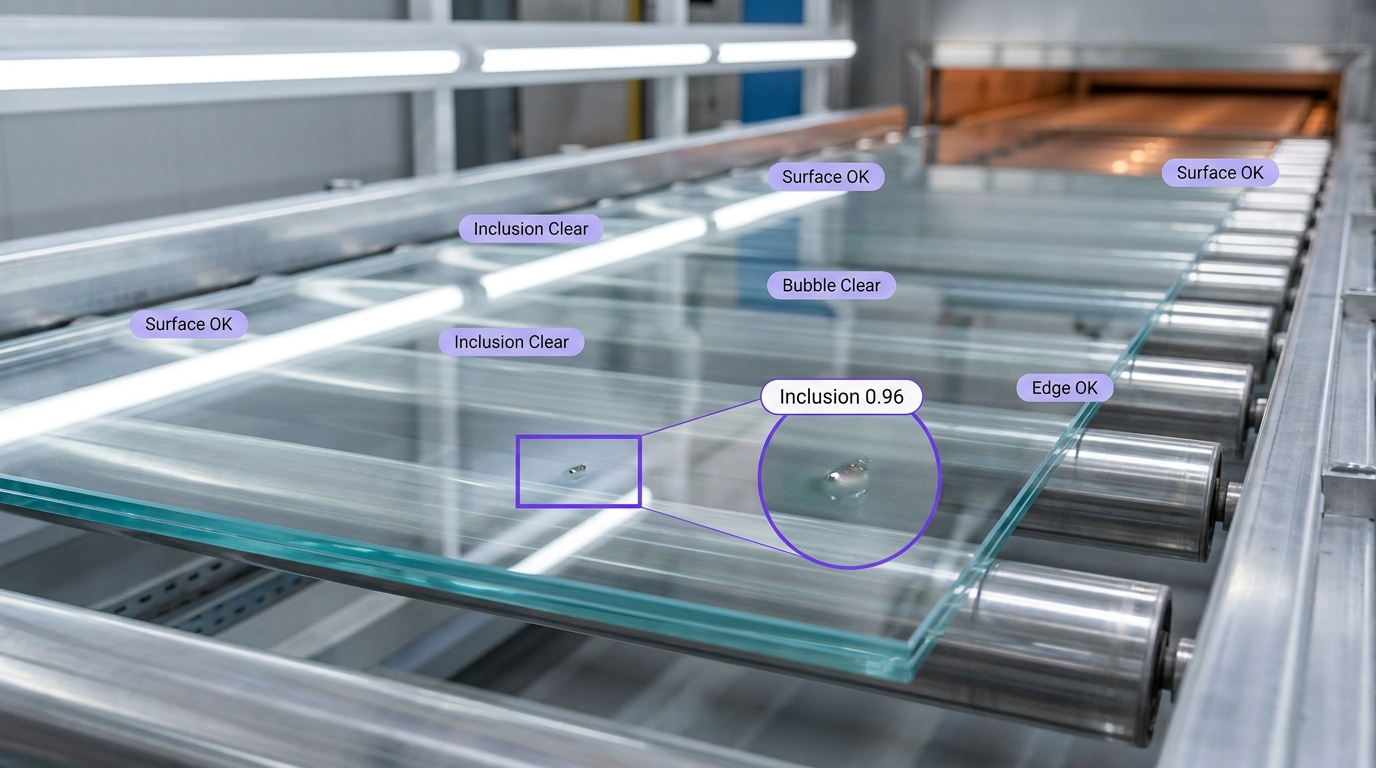
Glass Defect Detection AI Across Float, Container, Specialty, and Automotive Glass
Deploy Anywhere, Run Everywhere
Run glass defect detection on float lines, container forming lines, automotive tempering and laminating cells, specialty glass coating verification, edge inspection stations, and final QC checkpoints, on the edge, on-prem, in your VPC, or via API.
One Platform, Full Adoption
Tools every glass manufacturing team can adopt, from float bath operators, container forming engineers, and tempering process leads to plant managers, manufacturing engineering, and operations leadership.
Built for Glass Manufacturing Standards and Audit-Ready Records
Data stays safe with SOC 2 Type II, encrypted data, on-prem or air-gapped deployment, and an uptime SLA on every line.
- Inclusion, Stone & Knot Detection
- Bubble, Seed & Cord Detection
- Scratch, Dig & Abrasion Detection
- Tin Side & Edge Defect Detection
- Coating, Mirror & Anti-Reflective QC
- Stress, Warp & Dimensional Verification
“Roboflow has been instrumental in accelerating our deployment of innovative AI solutions.”
Travis Turnbull
Vice President & CIO, Pella Corporation
Talk to a Vision AI engineer who's shipped glass defect detection.
A single missed inclusion in float glass, undetected stone in a container, or coating defect on a tempered automotive windshield can mean rework downstream, a warranty claim from the field, a customer chargeback, or a recall on a deployed program that erodes margin and supplier reputation. Bring us your toughest glass defect detection problem and we'll map a working solution.
Ask us about:
- Solution architecture for ASTM C1036, ASTM C1048, ASTM C1503, ANSI Z97.1, EN 12150, EN 1279, FMVSS 205, ECE R43, IATF 16949, USP <660>, and customer-specific PPAP environments
- Live demo on your float line footage, container line video, automotive tempering imagery, or finished glass samples
- Deployment options: edge, on-prem, air-gapped, robot-mounted, or VPC, with integration into float line PLCs, container forming line monitoring, tempering oven control, and MES
- ROI modeling against rework, scrap, warranty claims, customer chargebacks, recall risk, and field-failure exposure
Over 16,000 organizations build with Roboflow.
- Rivian
- Pella
- Chobani
- USG Corporation
- BNSF Railway
- American Woodmark
Catch Every Inclusion, Bubble, Coating Defect, and Edge Crack, with Vision AI
Add a real-time inspection layer to every glass product on the line with Vision AI for glass defect detection. Built for the operations where one missed inclusion in float glass destined for premium architectural glazing, undetected stone in a container destined for premium beverage, coating defect on a tempered automotive windshield, or edge crack on a specialty display glass can mean rework downstream, a warranty claim, an automotive recall on a deployed safety glass program, a customer chargeback that erodes margin and supplier reputation, or a field-failure that ends in litigation on a regulated safety glazing program. Whether you're inspecting float glass coming off the tin bath, container glass on the forming line, automotive glass at tempering and laminating, specialty display glass coating, edge inspection on finished panels, or final QC before shipping, Roboflow extends QC coverage to every glass product on the line.
Float, Container, and Forming Defects:
- Catch inclusions, stones, knots, and refractory particles in float glass as it cools off the tin bath, before downstream cutting commits product to scrap
- Detect bubbles, seeds, and gobs of un-melted material in container glass on the forming line at production speed
- Flag cords, optical distortion, and birefringence patterns that affect downstream lamination and customer acceptance
Surface, Edge, and Coating Defects:
- Inspect glass surfaces for scratches, digs, abrasions, and tin-side defects from the float process
- Verify edge quality, edge chips, edge cracks, and edge seaming on tempered, laminated, and insulating glass units
- Detect coating defects on low-E coatings, anti-reflective coatings, mirror silvering, and printed graphics across architectural, automotive, and display glass
Tempering, Lamination, and Final Safety QC:
- Verify tempering quality through stress pattern recognition, distortion measurement, and surface integrity after the tempering oven
- Catch lamination defects (delamination, bubbles, foreign material between glass and PVB layer) on automotive windshields and architectural laminated glass
- Maintain validated inspection records that support ASTM C1036, ASTM C1048, ASTM C1503, ANSI Z97.1, EN 12150, EN 1279, FMVSS 205, ECE R43, IATF 16949, USP , and customer-specific PPAP submissions
Bring intelligence to every glass product today. Stop glass defects from becoming warranty claims, recalls, customer chargebacks, or safety glazing field failures.
More About Glass Defect Detection
What is glass defect detection with Vision AI?
Glass defect detection with Vision AI uses computer vision models to inspect glass products at every stage of manufacturing, catching inclusions and stones, bubbles and seeds, knots and gobs of un-melted material, cords and birefringence patterns, scratches and digs and abrasions, tin-side defects, edge chips and cracks, coating defects on low-E, anti-reflective, and mirror silvering, lamination defects on PVB-laminated assemblies, and stress and warp defects from tempering, across float, container, automotive, and specialty glass programs.
Can Vision AI catch the inclusions and bubbles that rule-based vision struggles with on transparent product?
Yes. Inclusions, bubbles, and subtle defects in transparent product are exactly where rule-based and template-based machine vision systems feel the most pressure. Rule-based vision excels at deterministic measurement tasks with high-contrast features, fixed lighting, and consistent product presentation, but struggles with glass defects because glass is transparent and refractive (rule-based detection has limited contrast to work with), defect morphology varies lot to lot (an inclusion in one batch looks different from another batch from the same furnace), product thickness and tint varies (thicker or tinted glass refracts differently), and SKU complexity spans hundreds of product specifications across float, container, automotive, and specialty glass programs. R
oboflow models add a deep-learning inspection layer trained on your actual product appearance, lot variation, and grade-specific characteristics, catching the defect categories rule-based vision struggles with and co-piloting existing glass surface inspection systems from ISRA Vision (now Atlas Copco), Sparklike, Glassrobots, Light Works, and specialty container inspection systems from Krones, Heuft, Tiama, and Iris Inspection Machines by adding visual verification on borderline rejects.
Does glass defect detection support ASTM C1036, ANSI Z97.1, FMVSS 205, and IATF 16949?
Yes. Roboflow models can be trained against your specific ASTM C162 (glass terminology), ASTM C1036 (flat glass), ASTM C1048 (heat-strengthened and fully tempered flat glass), ASTM C1503 (silvered flat glass mirror), ANSI Z97.1 (safety glazing materials used in buildings), EN 12150 (European tempered glass), EN 1279 (European insulating glass), FMVSS 205 (US automotive safety glazing), ECE R43 (European automotive safety glazing), IATF 16949 (automotive glass), AS9100 (aerospace glazing), USP (pharmaceutical glass containers, including Type I borosilicate pharma vials), ISO 9001, and customer-specific PPAP and APQP acceptance criteria. Your glass quality teams own the acceptance criteria; Roboflow provides the inspection engine that enforces them at line speed across every glass product.
Can it integrate with our float line PLCs, container forming line, tempering oven control, MES, eQMS, and ERP?
Yes. Roboflow Inference exposes a standard API and supports common glass manufacturing automation protocols. Customers integrate with float line PLCs from Allen-Bradley, Siemens, and ABB, container forming line PLCs from Bottero, GPS, and Heye, tempering oven control from Glaston, LandGlass, and HHH Tempering, lamination line equipment from Glaston, Lisec, and Bystronic Glass, specialty glass inspection systems from ISRA Vision (now Atlas Copco), Sparklike, Glassrobots, and Light Works, container glass inspection from Krones, Heuft, Tiama, and Iris Inspection Machines, glass MES (Lisec FENZI, Glaston platforms), eQMS (MasterControl, Veeva Vault QMS, Sparta TrackWise, ETQ Reliance), and ERP (SAP, Oracle) through REST, MQTT, OPC UA, and direct database writes, with PLC-level integration to float line cooling rates, container forming gob distribution, tempering oven cycle decisions, and downstream cutting and sorting where pass/fail decisions need to drive line behavior.