Crusher Foreign Material Detection AI
Spot a bucket tooth, drill steel, liner bolt, timber, or oversized slab on the feed conveyor or in the dump pocket before it reaches the crusher, and stop the belt or divert the load in time.
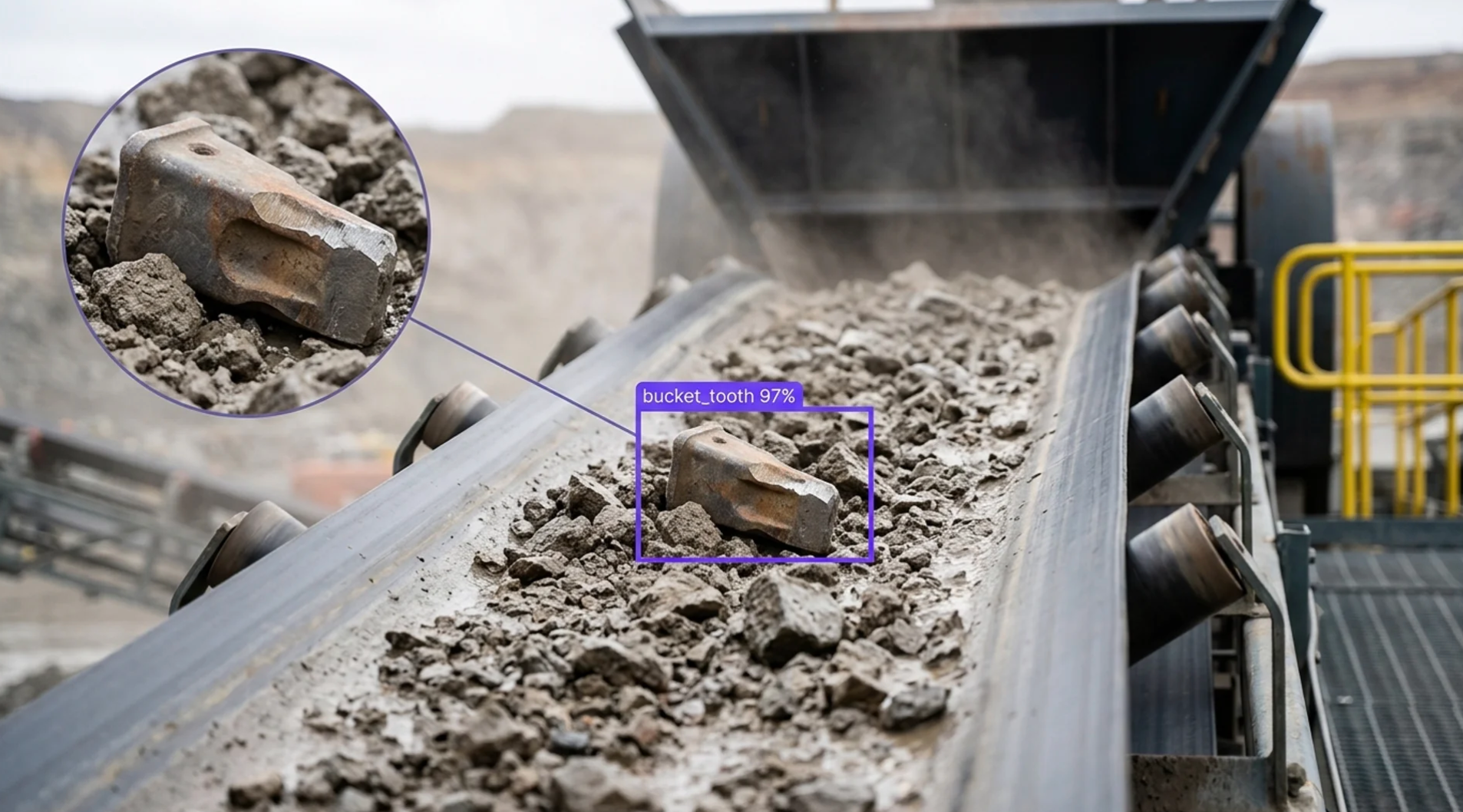
Crusher Foreign Material Detection AI for the Toughest Mine, Quarry, and Aggregate Plant Feed Lines
Deploy Anywhere, Run Everywhere
Run crusher foreign material detection on dump pocket, apron feeder, and conveyor cameras on the edge, on-prem, in your VPC, or via API, in dust, rain, and night shift lighting.
One Platform, Full Adoption
Tools every processing plant team can adopt, from plant metallurgists and maintenance planners to control room operators and site engineers, no separate ML team required.
Secure, Compliant, and Audit-Ready
Data stays safe with SOC 2 Type II compliance, encrypted data, HIPAA compliance, and an uptime SLA, with event records that support MSHA 30 CFR Part 56 and 57 conveyor and crusher safety programs and ISO 45001.
- Tramp Metal: Bucket Teeth, Drill Steel & Liner Bolts
- Non-Metallic Tramp: Timber, Rubber & Plastic
- Oversize Rock & Slab Detection in the Dump Pocket
- Belt Stop, Divert & Magnet Trigger Signals
- Foreign Material on Secondary & Tertiary Feeds
- Per-Event Clip, Truck & Shovel Traceability
“Roboflow has been instrumental in accelerating our deployment of innovative AI solutions.”
Travis Turnbull
Vice President & CIO, Pella Corporation
Talk to a Vision AI engineer who's shipped in mining and aggregates.
Bring us your toughest crusher foreign material detection problem and we'll map a working solution.
Ask us about:
- Solution architecture that fits MSHA 30 CFR Part 56 and 57, ISO 45001, and how a Vision AI layer sits alongside metal detectors, tramp magnets, and belt interlocks
- A live demo on your own dump pocket or conveyor camera footage
- Deployment options: edge, on-prem, air-gapped, VPC, or on dust-rated cameras and NVIDIA Jetson hardware at the feed conveyor
- ROI modeling against crusher liner and mantle damage, unplanned downtime, belt rips, and the throughput lost to every stop
Over 16,000 organizations build with Roboflow.
- Rivian
- Pella
- Chobani
- USG Corporation
- BNSF Railway
- American Woodmark
Vision AI is transforming businesses
Customers across the board are solving complex challenges and driving meaningful impact.
- Automotive customer
$10 million
Saved by automatically detecting defects on the production line
- Logistics & freight company
90%
Less time spent manually tracking shipping inventory
- Building materials supplier
60%
Lower customer return rate with improved product quality
Keep Tramp Metal and Foreign Material Out of Every Crusher, from the Dump Pocket to the Tertiary Feed
Bring real-time intelligence to every tonne that reaches the crusher with Roboflow Vision AI for foreign material detection. Built for mines, quarries, and aggregate plants where one shovel tooth or length of drill steel in the feed can crack a mantle, jam a jaw, rip a belt, or take the primary down for a shift.
Catch tramp metal and non-metallic foreign material on the feed:
- Detect bucket and shovel teeth, adapters, drill steel, rock bolts, mesh, grinding media, and liner bolts on the feed conveyor or in the dump pocket with a model trained on your own footage, including wet ore, dust, and low light.
- Flag timber, rubber, conveyor belt scraps, and plastic that a metal detector does not see, so they are pulled before they blind a screen or jam a chute.
- Separate foreign material from ordinary ore and rock by shape and texture, so alerts fire on a tooth and not on every dark rock on the belt.
Find oversize and bridging before the crusher chokes:
- Detect oversize slabs and boulders in the dump pocket or on the apron feeder and alert the rock breaker operator before the jaw bridges.
- Watch the crusher throat and chute for blockage and build-up so the control room sees a choke forming, not a stopped crusher.
- Extend the same models to secondary and tertiary crusher feeds, where a missed tooth from the primary does the most damage to cones.
Trigger the right response and keep the record:
- Send a stop, divert, or magnet trigger to the belt PLC so the conveyor halts or the load is rejected before the item reaches the crusher.
- Run alongside metal detectors and tramp magnets as a supplementary layer that covers non-metallic material and the angles those devices do not see.
- Log every event with a clip, belt, timestamp, and the haul truck or shovel that loaded it so maintenance can trace which bucket is losing teeth.
Bring intelligence to every crusher feed today. Stop tramp metal and foreign material from becoming cracked mantles, ripped belts, and lost production.
Frequently asked questions
What is crusher foreign material detection with Vision AI?
Crusher foreign material detection with Vision AI uses cameras over the dump pocket, apron feeder, and feed conveyor and a trained computer vision model to find material that should not go through the crusher: bucket and shovel teeth, drill steel, rock bolts, liner bolts, timber, rubber, and oversize rock. When the model finds an item, it can stop the belt, trigger a divert or magnet, or alert the operator, and it logs the event with a clip. It is the mining counterpart to foreign object detection for manufacturing, and it pairs with rock fragmentation analysis and conveyor belt monitoring on the same cameras.
Can Vision AI find a shovel tooth on a fast, dusty conveyor?
A missing ground engaging tool is one of the costliest events on a processing plant, and it hides in a stream of ore that looks similar at speed. A detection model trained on your own belt footage learns tooth, adapter, and drill steel shapes against your ore, and a camera with a fast shutter and good lighting over the belt keeps motion blur low enough to see them.
Does crusher foreign material detection support MSHA and ISO 45001 programs?
Crusher foreign material detection supports the conveyor and crusher safety expectations of MSHA 30 CFR Part 56 and 57 (the US safety and health standards for surface and underground metal and nonmetal mines) and ISO 45001 (the occupational health and safety management system standard) by reducing manual belt interventions and blocked-crusher clearing, and by keeping a record of every event.
Roboflow serves as the detection engine, and your plant, maintenance, and safety teams own the stop and divert logic, the lockout procedure for removing tramp material, and the sign-off on how the belt control responds.
Can it integrate with our belt controls, SCADA, and maintenance system?
Yes. Roboflow writes detection events to a PLC tag over OPC UA, Modbus TCP, or MQTT, so Allen-Bradley, Siemens, and ABB controllers can stop the conveyor, fire a divert gate, or pulse a tramp magnet. Events and clips can be sent over REST or written to a database for SCADA and historians such as Ignition, AVEVA PI, and Citect, and to maintenance systems such as SAP PM, IBM Maximo, and Pronto, so a missing tooth becomes a work order on the right shovel.