Engine Leak Inspection AI

Find oil, coolant, and fuel leaks on every engine at hot test and end of line, and pinpoint the joint that leaked.
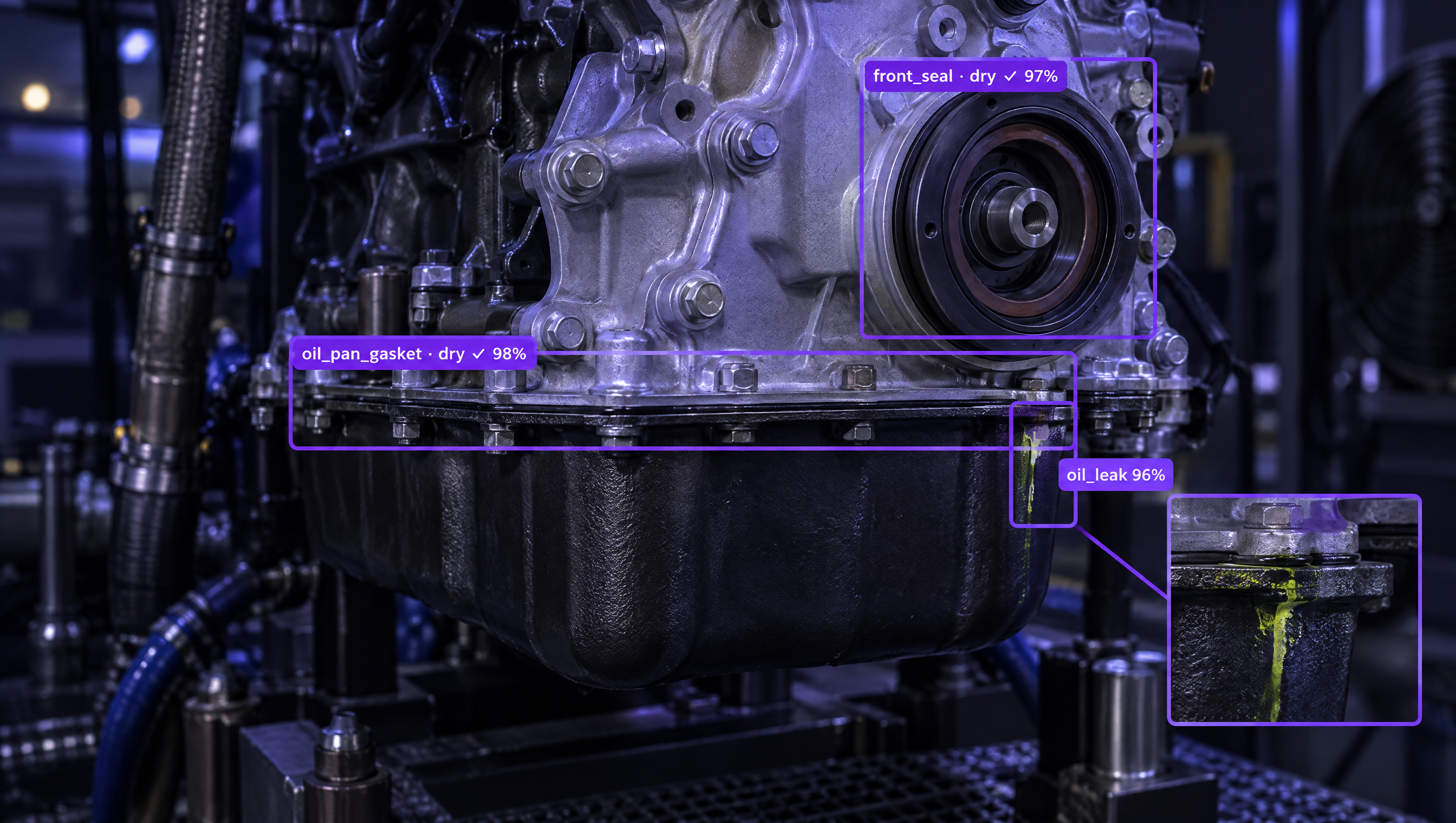
Automated visual inspection of an engine assembly, with digital bounding boxes highlighting components and detecting an oil leak along the gasket.

Engine Leak Inspection AI for the Toughest Engine and Vehicle Assembly Lines

  • Deploy Anywhere, Run Everywhere

    Run engine leak inspection at hot and cold test cells, dye booths, and end-of-line pits and roll-test bays, on the edge, on-prem, air-gapped, in your VPC, or via API.

  • One Platform, Full Adoption

    Tools every powertrain team can adopt, from test operators and repair technicians to test, quality, and manufacturing engineers, no separate ML team required.

  • Secure, Compliant, and Audit-Ready

    Data stays safe with SOC 2 Type II compliance, encrypted data, and an uptime SLA, with an image record for every engine serial number and VIN that supports IATF 16949 quality systems.

  • Oil, Coolant & Fuel Seepage
  • Fluorescent Dye Leak Indication
  • Leak Location by Joint & Seal
  • Drips & Wet Spots Under the Vehicle
  • Leak Size Against Your Threshold
  • Per-Engine & Per-VIN Leak Records
“The vision AI solutions we developed with Roboflow have been a core component of connecting our teams and unlocking their ability to collaborate.”

Lou Stocco

Director of Manufacturing Advanced Analytics, USG

Talk to a Vision AI engineer who's shipped in automotive manufacturing.

Bring us your toughest engine leak inspection problem and we'll map a working solution.

Ask us about:

  • Solution architecture that fits your test cells, dye process, and IATF 16949 quality system
  • A live demo on images of your own engines under test
  • Deployment options: edge, on-prem, air-gapped, or VPC
  • ROI modeling against repairs, warranty claims, retest, and inspection hours

Over 80,000 organizations build with Roboflow.

  • Rivian
  • Pella
  • Chobani
  • USG Corporation
  • BNSF Railway
  • American Woodmark
Start where you are

Vision AI is transforming businesses

Customers across the board are solving complex challenges and driving meaningful impact.

  • Automotive customer

    $10 million

    Saved by automatically detecting defects on the production line

  • Logistics & freight company

    90%

    Less time spent manually tracking shipping inventory

  • Building materials supplier

    60%

    Lower customer return rate with improved product quality

Catch Every Leak, from Engine Test to Vehicle Roll-Off

Add a real-time inspection layer to every engine and vehicle with Roboflow Vision AI for engine leak inspection. Built for engine and vehicle assembly where each engine is run on a hot or cold test stand, inspectors look for seepage under UV light in a few seconds per engine, and a weeping gasket or fitting that slips through becomes a repair at the vehicle plant, a warranty claim, or a customer who finds oil on the driveway.

Leak detection:

  • Detect wet seepage, drips, and residue of oil, coolant, and fuel on the engine during and after the test run.
  • Find the glow of fluorescent tracer dye under UV or blue light, and outline each leak with segmentation.
  • Measure the size of each leak and compare it to your pass threshold for that joint, so normal residue passes and real leaks fail.

Leak location:

  • Map each leak to its joint: oil pan, valve cover, front and rear crank seals, and timing cover, alongside gasket inspection before assembly.
  • Check fuel rail and injector connections, coolant hoses, and fittings, alongside hose clamp verification.
  • Send repair a marked-up image of the exact joint, so the technician goes straight to the leak.

End of line and records:

  • Check the underbody for drips and wet spots after fluid fill, in the end-of-line pit or after the roll test.
  • Store images and results for every engine serial number and VIN for audits and warranty investigations.
  • Trend leaks by joint, station, shift, and supplier lot to find where they start.

Bring intelligence to every engine today. Stop leaking gaskets, seals, and fittings from becoming repairs, warranty claims, and oil on the customer's driveway.

‍

Frequently asked questions

What is engine leak inspection with Vision AI?

Engine leak inspection with Vision AI uses cameras at the engine test cell and the vehicle end-of-line station, plus trained computer vision models, to find oil, coolant, and fuel leaks, locate each one to a joint or seal, measure it, and record a pass or fail with a marked-up image for every engine and vehicle.

How does it work with fluorescent dye?

Many plants add a fluorescent tracer dye to oil, fuel, or coolant so leaks glow under UV or blue light. A segmentation model outlines every glowing area, a Workflow matches it to the nearest joint and measures its size, and the result is compared to the threshold for that joint. Anomaly detection can also learn what a clean, dry engine looks like and flag anything new.

How is it different from pressure and bubble leak testing?

Pressure decay and bubble testing tell you a part or assembly leaks by measuring air loss or watching for bubbles. Engine leak inspection checks the engine and vehicle with fluid in it and running, and shows exactly which joint leaked, so the two work together across the line.

Can it connect to our test cells and MES?

Yes. Roboflow runs on-prem and fully air-gapped, and sends results over OPC UA, MQTT, or REST to the test cell PLC and your MES, so a leaking engine is held and routed to repair with its images attached.

Roboflow serves as the inspection engine, and your test and quality teams own the leak thresholds, test procedures, and acceptance criteria.

‍