Document Understanding AI

Read invoices, forms, labels, and receipts with OCR and vision-language models, and turn every page into structured data your app can use.
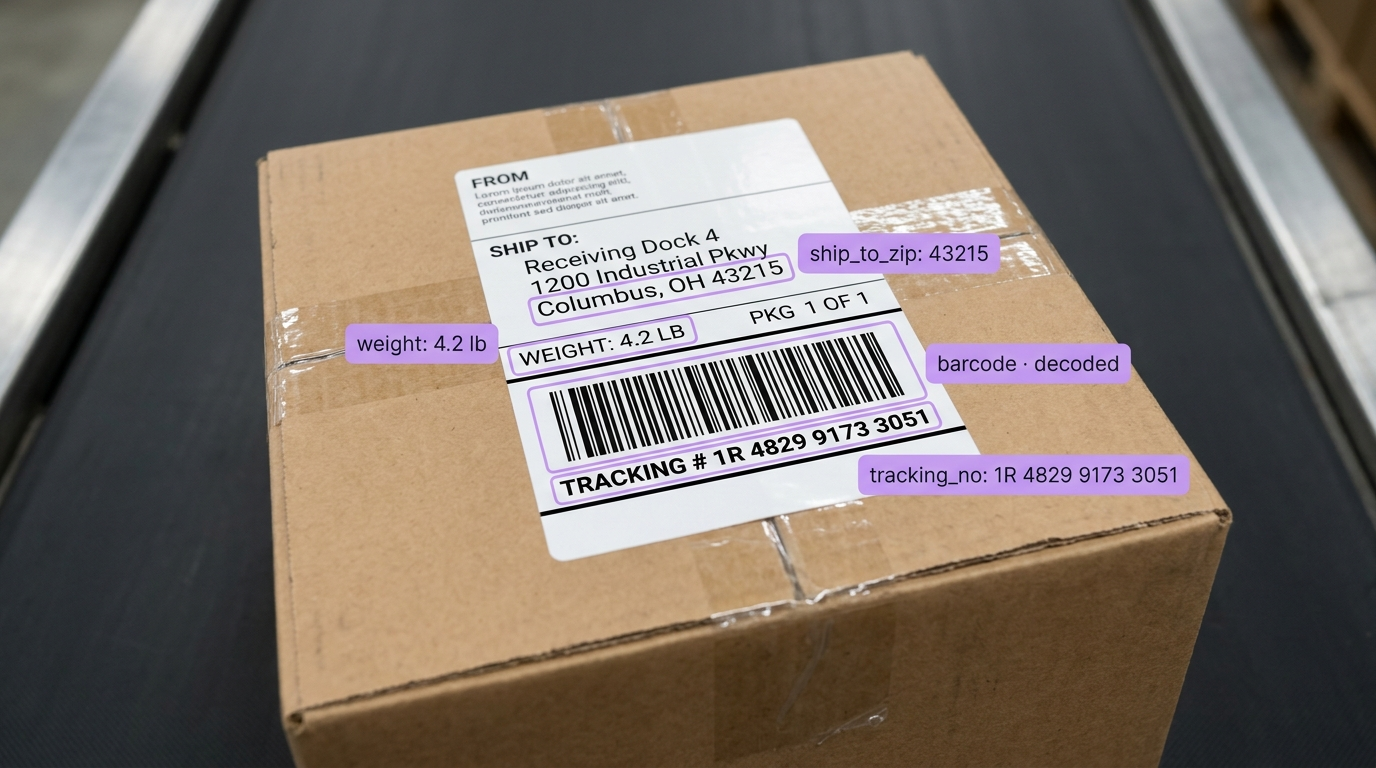
A package on a conveyor belt with its shipping label showing highlighted extracted data like weight, tracking number, and destination.

Document Understanding AI, Built Your Way

  • Pick the Right Reader

    Compare OCR models like DocTR, PP-OCR, EasyOCR, and GLM-OCR, or vision-language models like Gemini, Claude, GPT, and Qwen-VL, on your own documents in Playground for free.

  • Ask for Exactly the Fields You Need

    Prompt a vision-language model for the fields you want, parse the answer with the JSON Parser block, and get clean structured output every time.

  • Run It at Any Scale

    Call your Workflow over the API for one document, run it on your own hardware with Roboflow Inference, or process a whole folder with Batch Processing.

  • Invoice & Receipt Extraction
  • Form Field Extraction
  • OCR Model Comparison
  • VLM Document Q&A
  • Barcode & QR Reading
  • Structured JSON Output

Building something bigger? Talk to an engineer.

Scaling past a prototype, or need on-prem, air-gapped, or fleet deployment? We'll help you plan it.

Ask us about:

  • Architecture review for your cameras, pipeline, and edge hardware
  • Help moving a prototype Workflow into production
  • Deployment options: edge, on-prem, air-gapped, or VPC
  • Volume pricing and enterprise support

Over 16,000 organizations build with Roboflow.

  • Rivian
  • Pella
  • Chobani
  • USG Corporation
  • BNSF Railway
  • American Woodmark
Start where you are

Understand Every Document, from First Page to Structured Data

OCR tells you what text is on a page. Document understanding tells you what it means: which number is the total, which date is the due date, which line is the lot code. With Roboflow you combine OCR models, vision-language models, and your own trained models in one Workflow, and get structured data out the other end.

Read the text:

  • Choose from OCR blocks including EasyOCR, OCR Model (DocTR), PP-OCR, GLM-OCR, and Google Vision OCR, and test OCR models on your own images in Roboflow Playground for free.
  • Combine OCR results into a single text string with the Stitch OCR Detections block, and read barcodes and QR codes with the Barcode Detection and QR Code Detection blocks.
  • Reading text on parts and packaging instead of paper? See industrial OCR.

Understand it:

  • Ask a vision-language model for exactly the fields you need with the Google Gemini, Anthropic Claude, OpenAI, or Qwen-VL blocks, then turn the answer into structured fields with the JSON Parser block.
  • Train a detection model to find the regions you care about on your own document types, like a stamp, a signature box, or a table, and read each one separately.
  • Follow a full example: read an invoice with AI and send a Slack notification with the details.

Process at scale:

Start building today. Your first structured document is one Workflow away.

‍

Frequently asked questions

What is document understanding?

Document understanding goes beyond reading text: it extracts the specific fields and meaning from a document, like the total, due date, and invoice number, and returns them as structured data your software can use.

Should I use OCR or a vision-language model?

Use OCR when you need the raw text at high volume, and a vision-language model when you need specific fields and their meaning. In a Workflow you can use both: OCR for speed, and a vision-language model to interpret the result.

Can it handle PDFs?

Yes. Render each PDF page as an image with a library like pdf2image, then send the pages through your Workflow one by one or in a batch.

Can I keep sensitive documents on my own hardware?

Yes. Run your Workflow with Roboflow Inference on your own CPU, NVIDIA GPU, or Jetson, using OCR and open document models that run locally.

‍

Stay connected

Get the Latest in Computer Vision First

Unsubscribe at any time. Review our Privacy Policy.