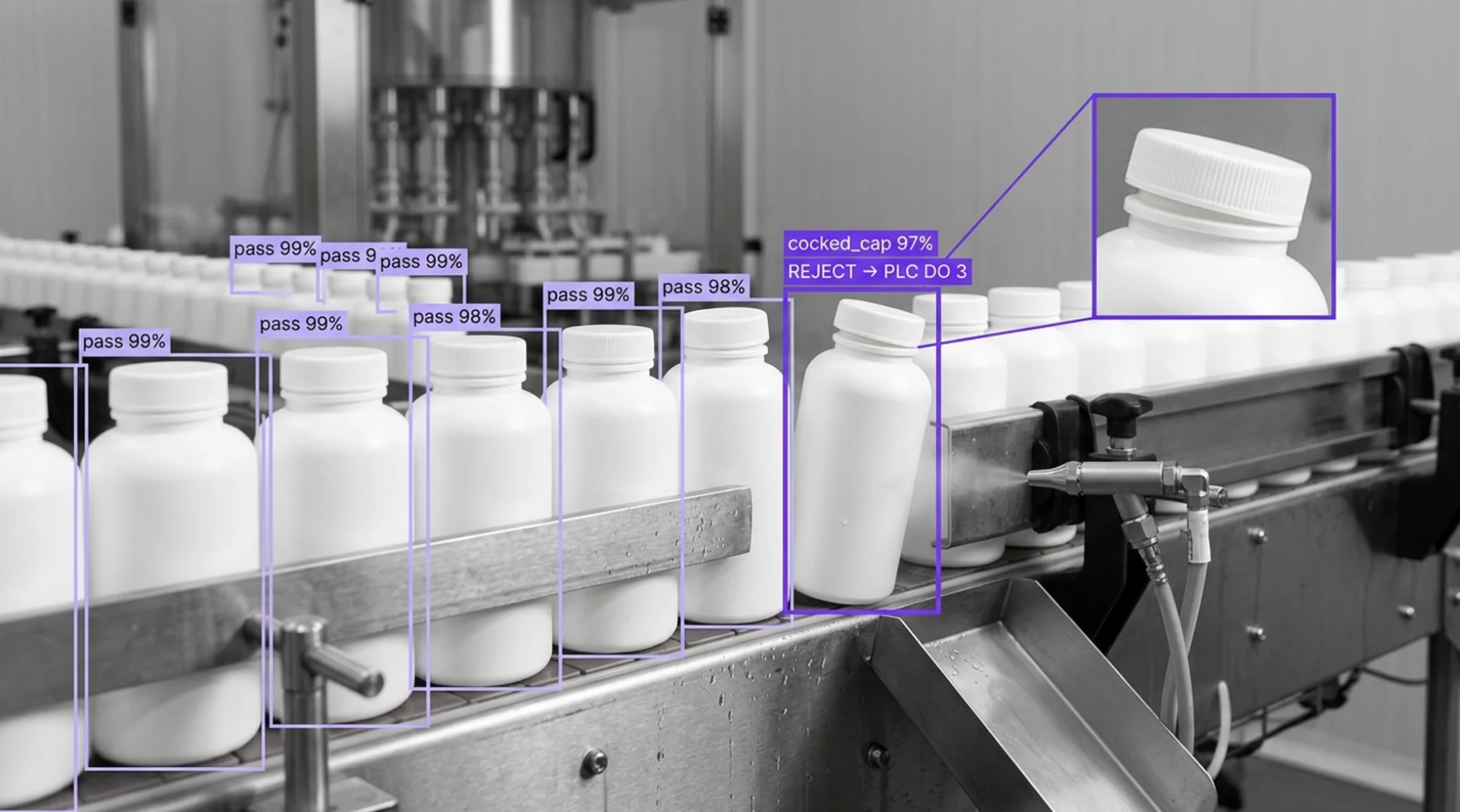
Add a real-time inspection and reject layer to every unit on the line with Roboflow Vision AI for automated defect rejection.
Find the defect and decide pass/fail:
- Detect cracks, chips, short-shots, dents, scorching, missing caps, torn seals, underfills, and contamination with a model trained on your own line footage, on the cameras already mounted over your conveyor, extruder, filler, or press.
- Apply pass/fail logic in a Workflow with confidence thresholds, per-defect-class severity, minimum defect size, and frame debounce so a single noisy frame does not eject a good unit.
- Write per-frame measurements, counts, and defect classes to the PLC alongside the pass/fail bit, the way a roofing line now ingests shingle measurements from Roboflow on every frame.
Fire the reject on the right unit:
- Write the reject bit to the PLC over OPC UA, Modbus TCP, MQTT, or a digital output on the edge device, with latency measured in tens of milliseconds so the signal lands within the reject window.
- Track each unit from camera to reject station with encoder counts, conveyor speed, or photoeye triggers so an air-blast, pusher, diverter, flipper, or robot pick removes the flagged unit and not its neighbor at 200 or 600 units per minute.
- Add a reject verification camera downstream to confirm the unit actually left the line, and alarm on a reject that fires but the unit is still in the lane.
Log, trace, and tune across shifts and sites:
- Log every rejection with the image, timestamp, defect class, confidence, and PLC acknowledgment, so quality can trace a customer complaint back to a specific unit and shift.
- Dashboard reject rate by defect class, shift, lane, and product SKU in Ignition or AVEVA, and push counts to the MES so scrap is costed per shift.
- Roll the same model and Workflow to a second line or plant with a deployment manager for edge devices, and prove a new reject use case in a day, as a pipe plant did overnight during an onsite.
Bring intelligence to every reject station today. Stop defects from becoming customer returns and chargebacks.
Frequently asked questions
What is an automated defect rejection system with Vision AI?
An automated defect rejection system with Vision AI uses inspection cameras on the line and a trained computer vision model (opens in a new tab) to find a defect on each unit, applies pass/fail logic with thresholds and debounce in a Workflow, writes the result to the PLC over OPC UA, Modbus TCP, MQTT, or a digital output, and lets the line actuate an air-blast, pusher, diverter, flipper, or robot pick to remove the unit. Encoder or conveyor tracking ties the decision to the right unit at line speed, and every rejection is logged with an image for traceability. It extends coverage from sampled lots to every unit on packaging, food and beverage, building materials, and automotive lines, with records that support ISO 9001 and, where required, FDA 21 CFR Part 11 and BRCGS or SQF audits. It builds on the same inspection layer as automated defect detection and presence/absence detection.
Can Vision AI fire the reject on the right unit at line speed?
Yes. The camera trigger, the model inference on the edge device, and the PLC write each add measurable latency, so the Workflow stamps each decision with the encoder count or frame index at capture and the PLC uses that offset, plus the known distance from camera to reject station, to fire the air-blast or pusher when that unit arrives.
Does an automated defect rejection system support ISO 9001 and FDA 21 CFR Part 11?
An automated defect rejection system supports the documentation expectations of ISO 9001 (the quality management system standard that requires control of nonconforming output and records of the disposition), FDA 21 CFR Part 11 (the electronic records and signatures rule for FDA-regulated food, beverage, and pharma production), and BRCGS and SQF (the GFSI-benchmarked food safety certification schemes that audit foreign body and packaging controls), by logging every rejection with the image, decision, and PLC acknowledgment. The PLC logic that consumes the reject bit stays in your controls team's hands under IEC 61131 programming practice, and the edge device sits in the OT zone your IEC 62443 network segmentation defines. Roboflow serves as the inspection and decision engine, and your quality and regulatory teams own the acceptance criteria, the threshold sign-off, and the validation package.
Can it integrate with our PLC, SCADA, and MES?
Yes. Roboflow writes pass/fail, defect class, and per-frame measurements to a PLC tag over OPC UA, Modbus TCP, or MQTT, or drives a digital output directly from the edge device, so Allen-Bradley and Rockwell ControlLogix, Siemens S7, Beckhoff TwinCAT, and Omron controllers can gate the reject actuator in ladder or structured text. Reject events, images, and counts can be sent over REST (opens in a new tab) or written to a database for SCADA and HMI dashboards in Ignition and AVEVA, and for MES and ERP platforms such as SAP so scrap and reject rate are costed by shift and SKU. The same pipeline extends to count and quantity verification and fill level inspection on the same line.