Catheter Manufacturing Inspection AI
Inspect every catheter from extrusion to sterile pack at line speed, under the rigor MDR and FDA demand.
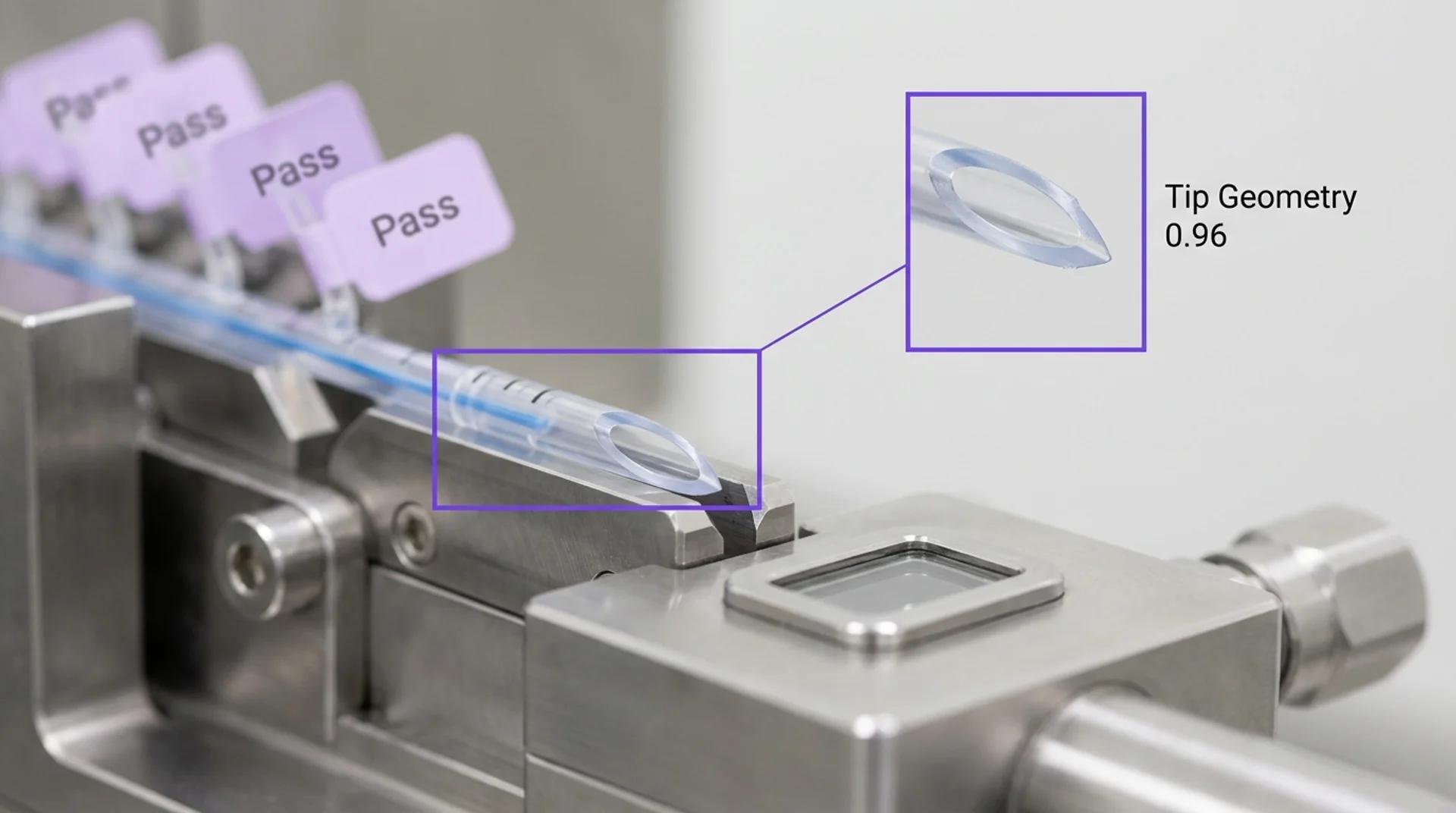
Catheter Manufacturing Inspection AI for the Toughest Medical Device Line Problems
Deploy Anywhere, Run Everywhere
Run catheter inspection on extrusion line cameras, tip-forming stations, assembly benches, packaging line cameras, the edge, on-prem, in your VPC, or via API, wherever your line, cleanroom, or final Q
One Platform, Full Adoption
Tools every team can adopt, from developers to business owners, no ML team required.
Secure and Reliable, Always
Data stays safe with SOC 2 Type II compliance, encrypted data, HIPAA compliance, and an uptime SLA.
- Tubing Kinks, Bubbles & Inclusions
- Diameter, Ovality & Wall Thickness
- Tip Geometry & Edge Finish
- Lubricious Coating Uniformity
- Color Band & Length Markings
- Hub Assembly & Luer Integrity
“We wanted to develop models using data we owned, have the ability to scale usage, leverage state-of-the-art AI capabilities, and along the way ensure the privacy of our users’ personal health information. That’s what we found in Roboflow.”
Alec Zopf
Co-founder and Chief AI & Automation Officer, Wellth
Talk to a Vision AI engineer who's shipped catheter manufacturing inspection on the line.
A single kinked lumen, off-center tip, or unreadable UDI can mean a recall, an FDA warning letter, or a patient at risk. Bring us your toughest catheter inspection problem and we'll map a working solution on the first call.
Ask us about:
- Solution architecture for FDA 21 CFR Part 820, FDA 21 CFR Part 11, ISO 13485, ISO 10555, ISO 11070, EU MDR, and ISO 14644 cleanroom environments
- Live demo on your extrusion line footage, tip-forming station imagery, or finished catheter samples
- Deployment options: edge, on-prem, air-gapped, robot-mounted, or VPC
- ROI modeling against scrap, recall, regulatory, and field-failure costs
Over 16,000 organizations build with Roboflow.
- Rivian
- Pella
- Chobani
- USG Corporation
- BNSF Railway
- American Woodmark
Automate Catheter Manufacturing Inspection from Extrusion to Sterile Pack with Vision AI
Turn slow, manual catheter checks into real-time intelligence with Vision AI for catheter manufacturing inspection. Built for the operations where one kinked lumen, off-center tip, or unreadable UDI can mean a recall, an FDA warning letter, or a patient at risk. Whether you're inspecting tubing on the extrusion line, tip geometry at the forming station, lubricious coating uniformity, hub assembly, or final sterile packaging, Roboflow delivers accurate, scalable Vision AI on the cameras and inspection stations your facility already runs, validatable under FDA 21 CFR Part 820, ISO 13485, ISO 10555, and EU MDR.
Extrusion Line and Tubing Inspection:
- Detect tubing kinks, bubbles, material inclusions, and surface defects at line speed
- Verify outer diameter, ovality, and wall thickness against tolerance for every meter extruded
- Catch color band, stripe, and length marking errors before tubing moves to assembly
Tip Forming, Coating, and Assembly Inspection:
- Inspect tip geometry, edge smoothness, and tip-to-shaft concentricity on every formed catheter
- Verify lubricious coating uniformity and detect coverage gaps or excessive coating
- Validate hub assembly, luer seating, connector integrity, and printed shaft markings
Final Packaging, UDI, and Compliance:
- Verify final catheter against lot specs before sterile barrier sealing
- Read and verify UDI 2D codes, lot numbers, and label text against FDA and EU MDR requirements
- Maintain a validated audit trail for FDA 21 CFR Part 11 electronic records
Bring intelligence to every catheter today. Stop defects from becoming recalls, warning letters, or patient harm.
Frequently asked questions
What is catheter manufacturing inspection with Vision AI?
Catheter manufacturing inspection with Vision AI uses computer vision models to inspect catheters at every stage of production, from tubing extrusion through tip forming, coating, hub assembly, and final sterile packaging. The system catches kinks, bubbles, ovality, tip geometry defects, coating gaps, and UDI errors that human inspectors miss at line speed. Manufacturers across IV, urinary, vascular, and interventional catheter lines use it to cut scrap, protect first-pass yield, and document compliance under FDA Part 820 and ISO 13485.
Can Vision AI inspect catheter tubing at extrusion line speed?
Yes. Vision AI runs at the line speeds modern catheter extrusion operates at, with edge-optimized models that process inspection footage frame by frame without slowing the line. Customers typically deploy fixed line cameras above the haul-off or downstream of the gauge head, with Roboflow Inference running on local edge hardware so detection happens at the line, not over a cloud round-trip. For high-speed lines, the system flags borderline pieces in real time and surfaces only the ones a human operator needs to review, so throughput holds while defect coverage improves.
Does catheter inspection support ISO 10555 and ISO 11070 acceptance criteria?
Yes. Roboflow models can be trained against your specific ISO 10555 (intravascular catheters general requirements) and ISO 11070 (sterile single-use intravascular catheter introducers) acceptance criteria, including surface defects, dimensional tolerance, tip geometry, and freedom from contamination. The system applies the same pass/fail logic a trained inspector would, against your written specifications, and produces a validated record of every catheter inspected. Your quality and regulatory teams own the acceptance rules; Roboflow provides the inspection engine that enforces them at line speed.
Can it integrate with our cleanroom, eQMS, and validation workflow?
Yes. Roboflow Inference exposes a standard API and supports common industrial and life sciences protocols, so Vision AI inspection events flow into your existing eQMS, MES, and validation workflow. Customers integrate with MasterControl, Veeva Vault QMS, Sparta TrackWise, and custom eQMS platforms through REST, MQTT, OPC UA, and direct database writes. Models are designed to be validatable under FDA 21 CFR Part 11, with audit trails for training data, model versions, and inspection results that support IQ/OQ/PQ documentation. Hardware fits cleanroom environments (ISO 14644-compatible cameras with sealed housings), and Roboflow's field engineering team helps you select cameras that meet your cleanroom classification.