Cap and Closure Inspection AI
Catch missing, high, cocked, and wrong caps on every bottle, and verify tamper bands and seals before product leaves the line.
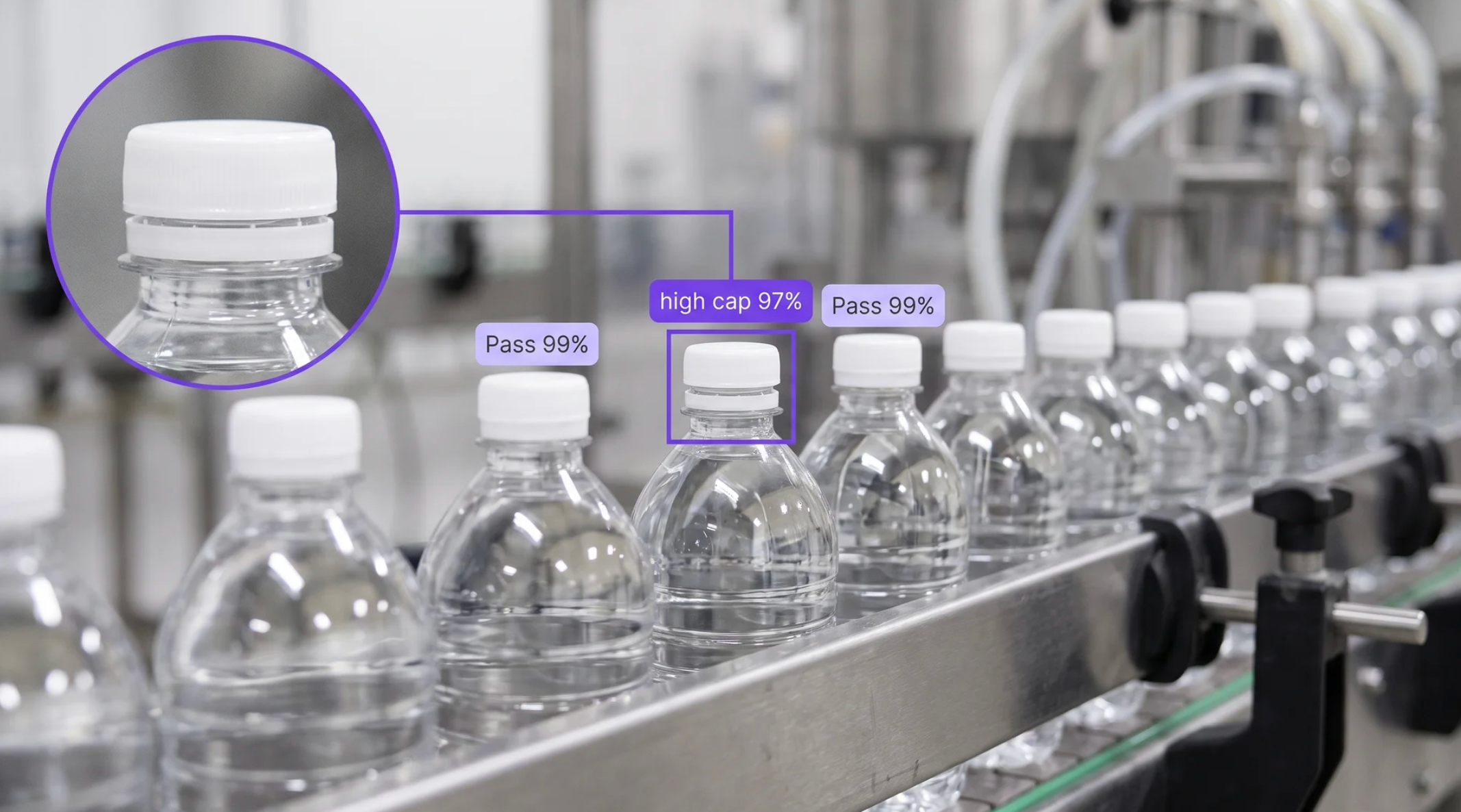
Cap and Closure Inspection AI Across Bottling, Food, Pharma, and Personal Care
Deploy Anywhere, Run Everywhere
Run cap and closure inspection on the edge, on-prem, in your VPC, or via API, wherever your filling and capping line needs it.
One Platform, Full Adoption
Tools every bottling and packaging team can adopt, from packaging and process engineers to capper operators, QA leads, and plant operations, no separate ML team required to ship and own inspection models.
Secure, Compliant, and Audit-Ready
Data stays safe with SOC 2 Type II compliance, encrypted data, and an uptime SLA, with validation documentation that supports FDA 21 CFR Part 11, cGMP, FSMA, and FDA tamper-evident packaging (21 CFR 211.132) audit requirements.
- Missing & High Cap Detection
- Cocked & Skewed Cap Detection
- Tamper Band & Safety Seal Integrity
- Wrong Cap & Color Verification
- Foil, Liner & Induction Seal Presence
- Pump, Trigger & Sport Cap Assembly
“We’ve seen situations where, by reducing waste, a single food processor can eliminate the equivalent of millions of tons of carbon per year. It feels great seeing AI-powered insights improve profitability and contribute to sustainability goals.”
Rian McDonnell
Founder and CEO, FloVision
Talk to a vision AI engineer who's shipped cap and closure inspection on the bottling line.
A single high cap that leaks in the case, missing tamper band on an OTC bottle, or cocked closure that fails at the customer's DC can mean a leaking-pallet chargeback, a tamper-evidence compliance finding, or a recall. Bring us your toughest cap and closure inspection problem and we'll map a working solution.
Ask us about:
- Solution architecture for FDA 21 CFR Part 11, cGMP, FSMA, and FDA tamper-evident packaging (21 CFR 211.132) environments
- Live demo on your capper imagery, closure samples, or line footage
- Deployment options: edge, on-prem, air-gapped, or VPC, with integration into cappers, reject systems, line PLCs, MES, and ERP
- ROI modeling against leaker chargebacks, rework and recapping, line downtime, and recall risk
Over 16,000 organizations build with Roboflow.
- Rivian
- Pella
- Chobani
- USG Corporation
- BNSF Railway
- American Woodmark
Vision AI is transforming businesses
Customers across the board are solving complex challenges and driving meaningful impact.
- Automotive customer
$10 million
Saved by automatically detecting defects on the production line
- Logistics & freight company
90%
Less time spent manually tracking shipping inventory
- Building materials supplier
60%
Lower customer return rate with improved product quality