Camera Module Inspection AI

Catch lens particles, scratches, adhesive bead gaps, and missing seals on every automotive camera module before end-of-line test.
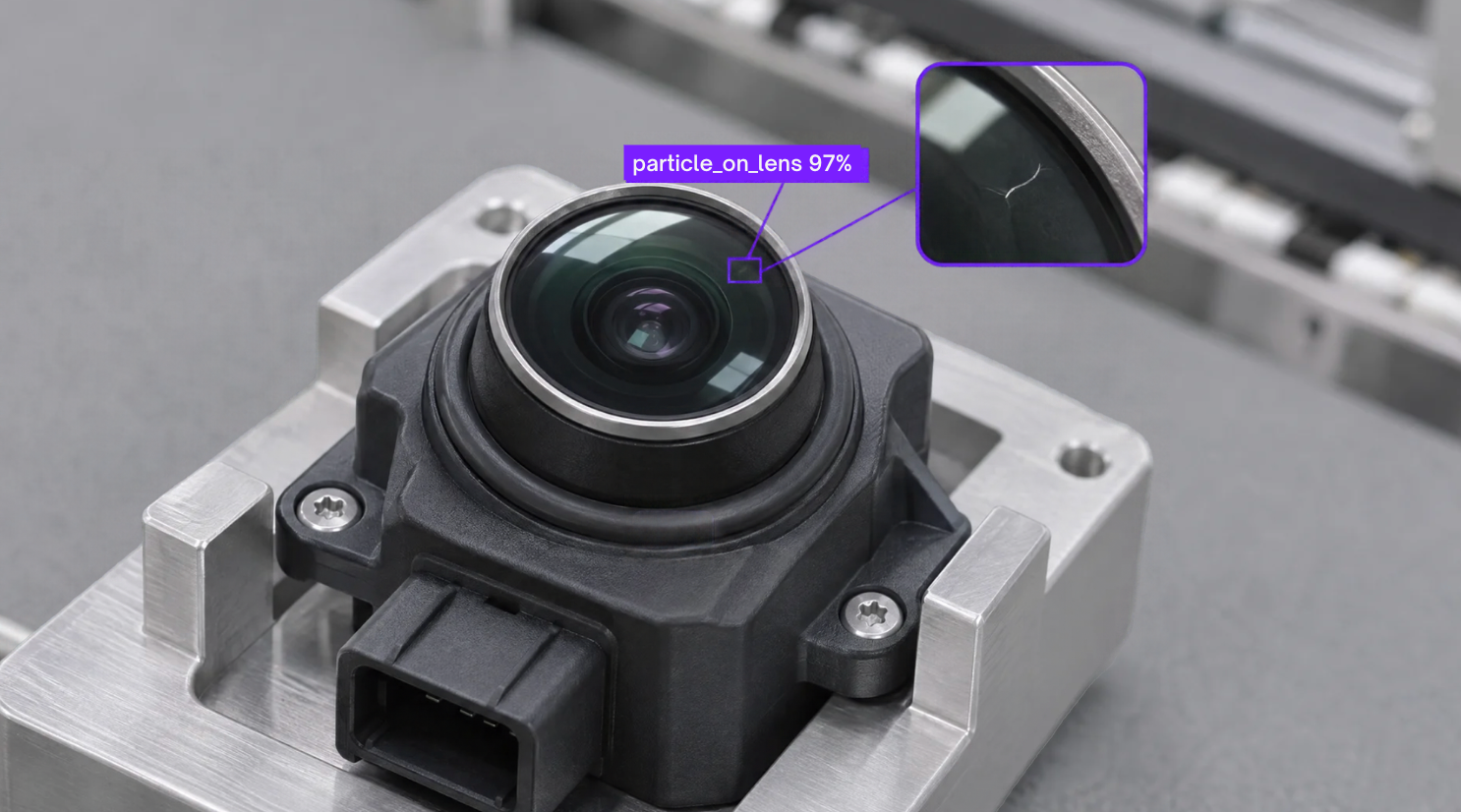
Automated visual inspection of a camera module detecting a particle defect on the automotive camera lens with a magnified detail inset.

Camera Module Inspection AI for the Toughest ADAS, Surround-View, and In-Cabin Camera Lines

  • Deploy Anywhere, Run Everywhere

    Run camera module inspection on the cameras at your sensor placement, lens alignment, dispensing, and end-of-line stations, on the edge, on-prem, air-gapped, in your VPC, or via API.

  • One Platform, Full Adoption

    Tools every camera module team can adopt, from optical and process engineers to quality and test engineers, no separate ML team required.

  • Secure, Compliant, and Audit-Ready

    Data stays safe with SOC 2 Type II compliance, encrypted data, and an uptime SLA, with per-serial records that support IATF 16949 and ISO 9001 documentation.

  • Lens & Sensor Particles
  • Scratches & Coating Defects
  • Adhesive Bead Gaps & Overflow
  • Seal, O-Ring & Screw Checks
  • Connector Seating
  • Per-Serial Inspection Records
“The vision AI solutions we developed with Roboflow have been a core component of connecting our teams and unlocking their ability to collaborate.”

Lou Stocco

Director of Manufacturing Advanced Analytics, USG

Talk to a Vision AI engineer who's shipped in automotive manufacturing.

Bring us your toughest camera module inspection problem and we'll map a working solution.

Ask us about:

  • Solution architecture for IATF 16949 and ISO 9001 environments
  • A live demo on images of your own modules and defects
  • Deployment options: edge, on-prem, air-gapped, or VPC
  • ROI modeling against scrapped modules, rework, end-of-line test failures, and field returns

Over 80,000 organizations build with Roboflow.

  • Rivian
  • Pella
  • Chobani
  • USG Corporation
  • BNSF Railway
  • American Woodmark
Start where you are

Vision AI is transforming businesses

Customers across the board are solving complex challenges and driving meaningful impact.

  • Automotive customer

    $10 million

    Saved by automatically detecting defects on the production line

  • Logistics & freight company

    90%

    Less time spent manually tracking shipping inventory

  • Building materials supplier

    60%

    Lower customer return rate with improved product quality

Inspect Every Camera Module, from Lens Assembly to End of Line

Add a real-time inspection layer to every camera module with Roboflow Vision AI for automotive camera module inspection. Built for the lines that build ADAS, surround-view, rear-view, and in-cabin cameras, where one particle on the sensor or lens shows up in every frame the car sees, an adhesive gap lets moisture fog the lens a year later, and the module is sealed before anyone looks again. Whether you're placing the image sensor, aligning and bonding the lens, or sealing the housing, Roboflow inspects every module at line rate, with a per-serial record behind every unit.

Lens, sensor, and optical surfaces:

  • Detect particles, dust, and fibers on the lens, cover glass, IR filter, and image sensor before the module is sealed
  • Catch scratches, chips, coating defects, and fingerprints on the lens and cover glass, alongside optical lens inspection
  • Flag contamination and residue on the sensor and PCB from dispensing and handling

Adhesive, alignment, and assembly:

  • Verify the adhesive bead around the lens barrel and housing is present, continuous, and correctly sized, with no gaps, overflow, or bubbles
  • Confirm lens barrel seating, O-rings and gaskets, screws, and housing halves on every unit
  • Check connector presence and seating with connector seating verification and read laser-marked serials for traceability

End of line and systems integration:

  • Inspect the finished housing for cracks, scratches, flash, and seal defects before packing
  • Trend findings by dispenser, alignment station, and lens lot, so a drifting dispense pattern shows up before it shows up in field returns
  • Route failed modules in real time through PLC integration and send per-serial records to your MES

Bring intelligence to every camera module today. Stop module defects from becoming blurred ADAS images, fogged lenses, or a warranty campaign traced back to your line.

Frequently asked questions

What is camera module inspection with Vision AI?

Camera module inspection with Vision AI uses cameras at the sensor placement, lens alignment, dispensing, and end-of-line stations and a trained computer vision model to inspect every automotive camera module. It checks the lens and sensor for particles and scratches, the adhesive bead and seals, the assembly, and the finished housing, and keeps an image-backed record for each serial. It works with automated optical inspection on the PCB and surface inspection on the housing.

Can Vision AI tell a particle from a reflection on a lens?

Yes. Models trained on images of your own modules, under your own lighting, learn how real particles, scratches, and coating defects look on each lens and cover glass, and how glare and reflections look, so they flag the defects and pass the reflections. Uncertain units go to a review queue, and the confirmed results go back into training.

Which camera modules does it work on?

Front ADAS cameras, surround-view and rear-view cameras, mirror replacement cameras, driver and occupant monitoring cameras, and other compact camera modules for vehicles, robots, and consumer devices. The model is trained on your own parts and defect types, so a new module variant means adding images and retraining, not rewriting rules.

Can it integrate with our line, MES, and traceability system?

Yes. Roboflow Workflows send pass and fail results to station PLCs over EtherNet/IP, OPC UA, or MQTT, and write per-serial records with images to your MES and traceability system. Our integration stack guide shows how each layer connects.