Burr Detection AI

Catch burrs, slivers, and sharp edges on every part before they become interference, contamination, or a cut hand.
Shipping container with OCR output

Burr Detection AI Across Machining, Stamping, and Die Casting

Deploy Anywhere, Run Everywhere

Run burr detection on the edge, on-prem, in your VPC, or via API, wherever your machining cells, presses, and deburr lines need it.

One Platform, Full Adoption

Tools every machining team can adopt, from operators and setup techs to deburr crews, process engineers, and quality engineers, no separate ML team required to ship and own inspection models.

Secure, Compliant, and Audit-Ready

Data stays safe with SOC 2 Type II compliance, encrypted data, and an uptime SLA, with validation documentation that supports ISO 13715 edge specifications, IATF 16949, AS9100, and ISO 9001 audits.
Edge Burr Detection
Hole & Cross-Bore Burr Checks
Sheared & Trim Edge Flags
Deburr Process Verification
Chip & Sliver Detection
Per-Part Edge Records
Edge Burr Detection
Hole & Cross-Bore Burr Checks
Sheared & Trim Edge Flags
Deburr Process Verification
Chip & Sliver Detection
Per-Part Edge Records
Edge Burr Detection
Hole & Cross-Bore Burr Checks
Sheared & Trim Edge Flags
Deburr Process Verification
Chip & Sliver Detection
Per-Part Edge Records
Edge Burr Detection
Hole & Cross-Bore Burr Checks
Sheared & Trim Edge Flags
Deburr Process Verification
Chip & Sliver Detection
Per-Part Edge Records

Talk to a vision AI engineer who's shipped burr detection at a cell.

A burr on a sealing face that cuts the o-ring it meets, sliver that washes off a part and into a hydraulic gallery, or sheared edge that sends an assembler to first aid can mean a leak discovered at test, contamination hunting through a finished system, and a recordable that started as a dull punch. Bring us your toughest burr problem and we'll map a working solution.
  • Solution architecture for ISO 13715 edge specifications, IATF 16949, AS9100, and ISO 9001 environments
  • Live demo on your part imagery, edge photos, or deburr line footage
  • Deployment options: edge, on-prem, air-gapped, robot-mounted, or VPC, with integration into cells, PLCs, and MES
  • ROI modeling against leak-test failures, contamination events, deburr rework loops, and manual edge checks
  • We will connect you with an AI subject matter expert on our team based on your answers.
    What challenges would you like to solve with vision AI?
    Where will you run vision AI?
    Are you replacing a current solution with AI or will this be a new solution?
    How many detections do you anticipate per month?
    Describe the business problem you would like to solve.
    Oops! Something went wrong while submitting the form.

    Over 16,000 organizations build with Roboflow.

    “Roboflow has been instrumental in accelerating our learning and deployment of innovative AI solutions”
    Travis Turnbull Vice President & CIO, Pella Corporation
    See customer stories
    Trusted by top manufacturers

    Vision AI is transforming manufacturing

    Customers are deploying solutions across the entire business and driving meaningful impact
    $0 million
    Saved by automatically detecting defects
    0%
    Less time spent manually tracking inventory
    0%
    Reduction in customer return rate

    Inspect Every Edge on Every Part, with Vision AI

    Add a real-time inspection layer to every edge with vision AI for burr detection. Built for the operations where a burr the width of a hair decides whether a sealing face seals, the deburr cell that ran all shift turns out to have been polishing around the burr instead of removing it, or the punch that dulled on Tuesday ships sharp-edged parts until someone bleeds on Thursday. Whether you're machining, drilling, stamping and shearing, trimming castings, or verifying a deburr process, Roboflow inspects the edges that matter on every part, with per-part records and tool-wear trends behind every pass.

    Edges, Holes, and Features:

    • Catch burrs on machined edges, faces, and chamfers, including the sealing surfaces where a burr becomes a leak path
    • Detect burrs at drilled holes and visible bore intersections, and pair with borescope imagery where the intersection hides inside
    • Flag burrs and slivers on sheared, stamped, and trim edges at press and trim cell exit

    Deburring Verification and Contamination:

    • Verify the deburr process actually removed what it was supposed to, on every part instead of the shift's samples
    • Catch clinging chips and slivers before they wash into assemblies as contamination
    • Inspect battery tabs, busbars, and electrical edges, where a burr is a short circuit waiting for vibration

    Cells, Trends, and Systems Integration:

    • Trend burr rates by tool, punch, and cell, so a dulling tool reaches the setup tech as an early warning instead of a bleeding thumb
    • Route flagged parts to deburr or rework in real time through PLC and cell integration
    • Keep per-part edge records with imagery that support ISO 13715 edge specifications and customer audits

    Bring intelligence to every edge today. Stop burrs from becoming leak failures, contamination events, or the injury report that names a part.

    More About Burr Detection

    What is burr detection with Vision AI?

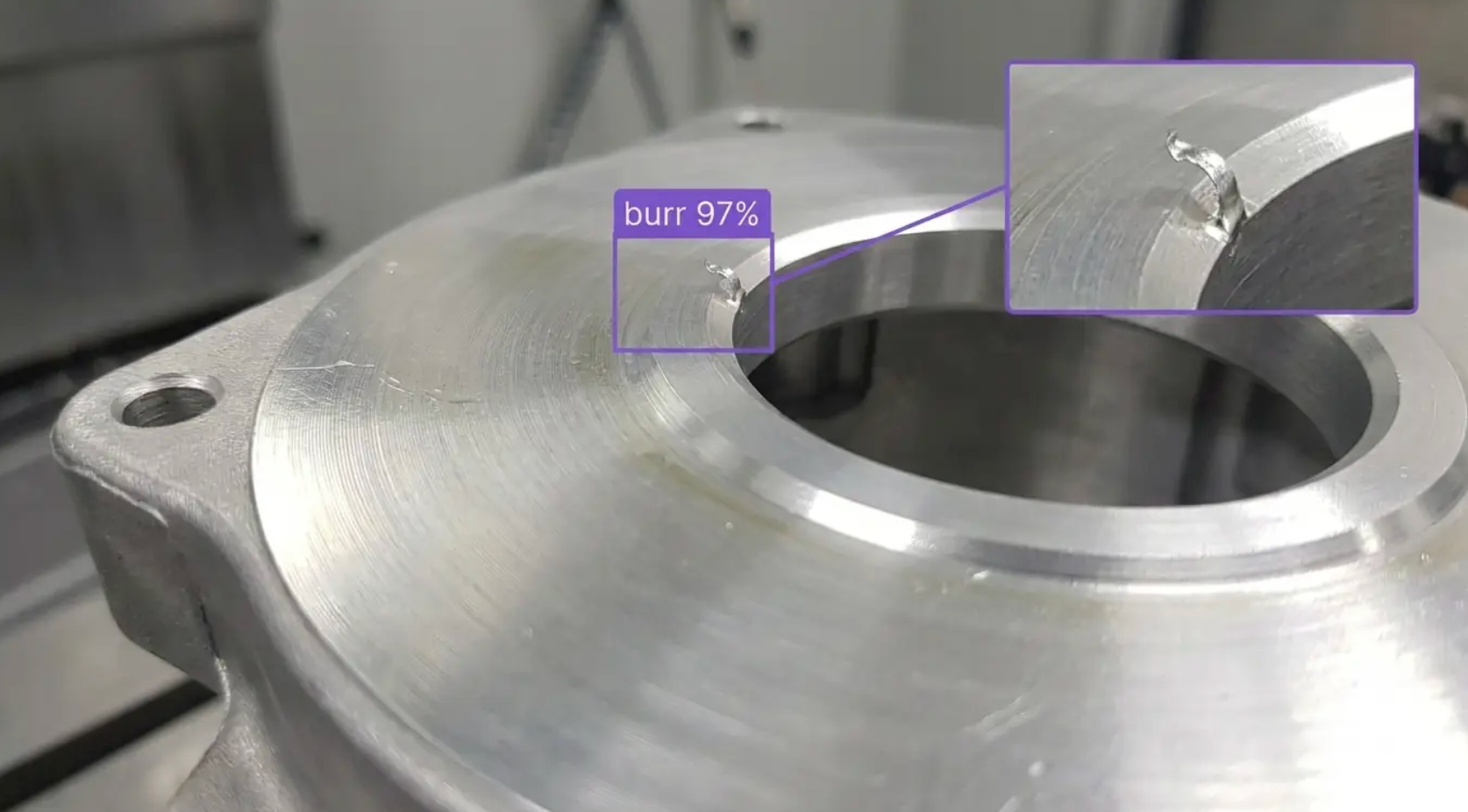
    Burr detection with vision AI uses computer vision models to inspect part edges: burrs on machined faces and chamfers, at drilled holes, and along sheared, stamped, and trim edges, plus clinging chips and slivers, and verification that deburring actually removed them. Models trained on your actual parts and edge specifications inspect every part at cell exit, with per-part records and tool-level trends that support ISO 13715 edge requirements and customer audits.

    Can Vision AI see a hairline burr on a bright metal edge?

    The machined edge is the hard case: a burr the width of a hair made of the same bright metal as the edge it clings to, chamfer glints that mimic it, and coolant residue confusing everything. Deep-learning models trained on your actual parts, edges, and lighting learn the difference between a clean chamfer catching light and a burr breaking the edge line, hold that judgment across features and finishes, and flag borderline edges for a check instead of guessing. For intersections hidden inside cross-drilled bores, borescope imagery feeds the same models, so the edge you can't present to a camera still gets inspected.

    Does burr detection support ISO 13715 and our edge specifications?

    Yes. Roboflow models can run as documented inspection controls against your ISO 13715 edge condition callouts and inside IATF 16949 (automotive), AS9100 (aerospace), and ISO 9001 processes, with per-part inspection records, imagery, model version history, and training data lineage that support PPAP submissions and customer audits. Roboflow is the inspection engine; your engineering team owns the edge specifications and acceptance limits.

    Can it integrate with our machining cells, PLCs, and MES?

    Yes. Roboflow Inference exposes a standard API and supports common industrial protocols, so edge inspection events flow into your existing systems: cell and line PLCs from Allen-Bradley and Siemens, MES and ERP platforms like SAP and Oracle, and SCADA and HMI platforms like Ignition and AVEVA, through REST, MQTT, OPC UA, and direct database writes. PLC-level integration routes a flagged part to deburr the moment an edge fails, and every event carries part, cell, tool where derived, imagery, and disposition, with a full audit trail behind every lot.

    Stay Connected

    Get the Latest in Computer Vision First

    Thank you for subscribing!
    Oops! Something went wrong!.
    Unsubscribe at any time. Review our Privacy Policy.

    Additional resources

    Vision AI is transforming every industry. Let’s transform yours.