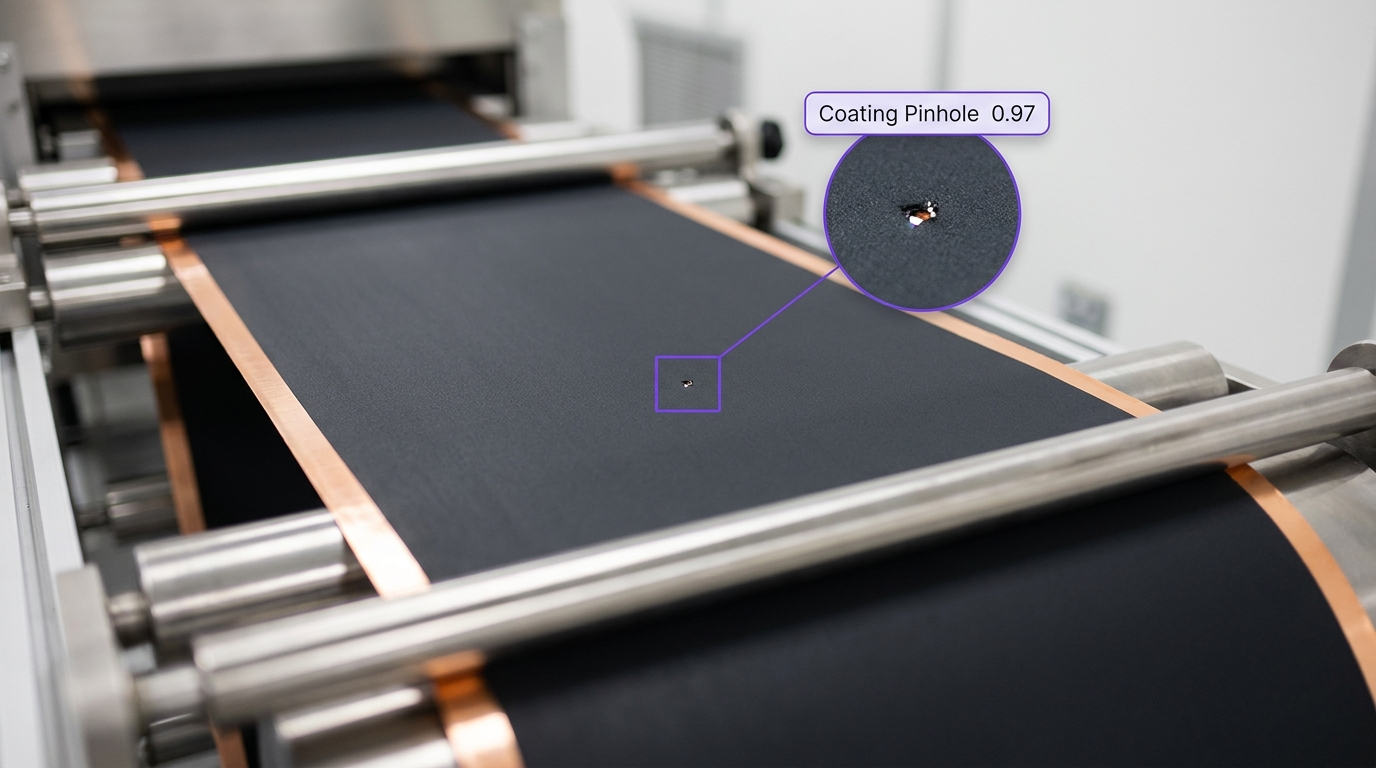
Add a real-time inspection layer to every battery cell on the line with Vision AI for battery cell inspection and quality control. Built for the gigafactory operations where one missed coating pinhole, mis-welded tab, or breached can seal can mean a thermal runaway event in a vehicle, a battery pack failure in a stationary storage installation, or a multi-million-dollar recall. Whether you're inspecting electrode coatings on roll-to-roll lines, slitting and notching edges, stack and winding alignment, tab welds, can or pouch closure welds, crimp seals, marking and serialization, or post-formation cell condition, Roboflow extends your QC coverage to every cell on the line across cylindrical, prismatic, and pouch formats.
Electrode Coating and Cell Assembly Inspection:
- Detect coating pinholes, agglomerates, edge defects, and thickness variations on anode and cathode lines
- Inspect slitting burrs, notching edge quality, and tab geometry before stack or winding
- Verify Z-fold stack alignment, layer count, and jelly-roll winding tension on every cell
Welding, Sealing, and Cell Closure Inspection:
- Verify tab welds, current collector welds, and terminal welds for porosity, fusion, and spatter
- Inspect can closure welds and pouch heat seals for integrity before electrolyte fill
- Catch crimp seal defects, can dents, scratches, and foreign material on finished cells
Marking, Formation, and Final Compliance:
- Read and verify cell serial numbers, 2D codes, and lot markings against your traceability system
- Inspect post-formation cell condition for visible electrolyte leakage, surface anomalies, or color drift
- Maintain validated inspection records per IATF 16949, ISO 9001, IEC 62660, UL 2580, UN 38.3, and customer PPAP submissions
Bring intelligence to every cell today. Stop battery defects from becoming thermal runaway events, vehicle recalls, or pack-level failures in the field.
Frequently asked questions
What is battery cell inspection and quality control with Vision AI?
Battery cell inspection and quality control with Vision AI uses computer vision models to inspect cells at every stage of battery manufacturing, from electrode coating on roll-to-roll lines through slitting, notching, stack and winding, tab welding, electrolyte fill, can closure, marking, formation, and final QC. The system extends QC coverage to every cell on the line, catching coating defects (pinholes, agglomerates, edge irregularities), stack misalignment, tab weld defects, can damage, crimp seal issues, and foreign material across cylindrical, prismatic, and pouch cell formats. Battery manufacturers use it to cut scrap, prevent thermal runaway events from upstream defects, protect first-pass yield in the gigafactory, and document compliance under IATF 16949, ISO 9001, IEC 62660, UL 2580, and UN 38.3.
Can Vision AI inspect electrode coatings at roll-to-roll line speed?
Yes. Electrode coating inspection is one of the highest-stakes tasks in battery manufacturing and exactly where deep learning extends what traditional rule-based vision can catch. A single coating pinhole or agglomerate that survives to a finished cell can become a thermal runaway initiator inside a vehicle pack years after delivery. Roboflow models can be trained on your specific coating acceptance criteria for both anode and cathode lines, including pinhole detection, agglomerate identification, edge defect classification, thickness variation flagging, and foreign material detection at sub-millimeter scale. The system runs at the line speeds modern coating and calendering operations require, with edge-optimized models that flag suspect coating regions for quality engineer adjudication and document every meter of electrode for downstream traceability.
Does battery cell inspection support IATF 16949, IEC 62660, and UL 2580?
Yes. Roboflow models can be trained against your specific IATF 16949 (automotive quality management system), ISO 9001 (general quality management), IEC 62660 (secondary lithium-ion cells for propulsion of electric road vehicles), UL 2580 (batteries for use in electric vehicles), UN 38.3 (transport of lithium batteries), and customer-specific PPAP (Production Part Approval Process) and PPK (Process Performance Index) requirements. The system applies the same pass/fail logic your trained quality engineers use, against your written specifications and customer drawings, and produces a validated inspection record for every cell that supports customer audits, recall investigations, and traceability requirements. Your quality and battery engineering teams own the acceptance criteria; Roboflow provides the inspection engine that enforces them at line speed and across every cell, not just sampled lots.
Can it integrate with our MES, eQMS, traceability, and PLC stack?
Yes. Roboflow Inference (opens in a new tab) exposes a standard API and supports common industrial and battery manufacturing protocols, so Vision AI inspection events flow into your existing MES, eQMS, traceability platform, ERP, and validation workflow. Customers integrate with SAP, Oracle, Ignition, Wonderware, AVEVA, MasterControl, Sparta TrackWise, and custom battery MES platforms through REST, MQTT, OPC UA, and direct database writes, with PLC-level integration to coating lines, slitting cells, stacking equipment, tab welders, can closure stations, and formation racks where pass/fail decisions need to drive line behavior or cell routing. Models are validatable with full IQ/OQ/PQ documentation, audit trails for training data, model versions, and inspection results that support customer PPAP submissions and traceability requirements.