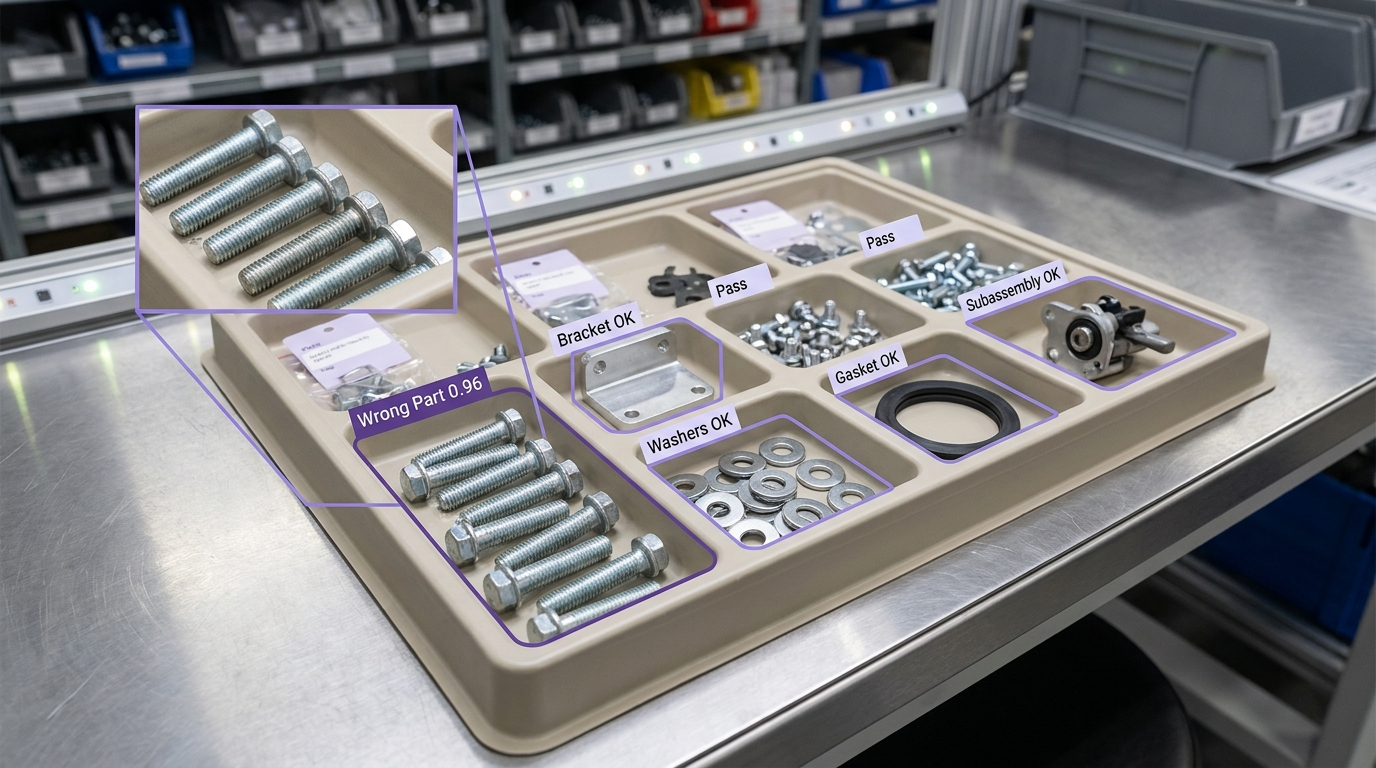
Add a real-time inspection layer to every build station and kit bay on the line with Vision AI for assembly inspection and kitting manufacturing. Whether you're verifying sub-assemblies at the build station, completing kits at the bay, validating final builds at end of line, or running multi-SKU changeover without rebuilding PLC logic, Roboflow extends your QC coverage to every unit on the line.
Assembly Inspection at the Build Station:
- Confirm every required part is present, in the right variant, and oriented correctly for the build
- Verify fasteners, screws, bolts, clips, and clamps are present and engaged
- Inspect wire harness routing, clip locations, connector seating, and cable management against build specs
Kitting Manufacturing and Pre-Assembly Verification:
- Verify kit completeness, count, and the correct variant of every part in the kit
- Catch wrong-part-in-kit, missing parts, and out-of-sequence kits before they leave the bay
- Validate kit packaging, tray seating, label placement, and traceability codes for downstream consumption
Multi-SKU Changeover and In-Line Deployment:
- Switch inspection logic with new SKUs in minutes, not days, by swapping models instead of rewriting PLC rules
- Run on existing station cameras, robotic arms, or pick-and-place vision, on the edge if you need it
- Surface only the builds and kits that need a second look so operators and quality engineers focus where it counts
Bring intelligence to every station and every kit today. Stop assembly and kitting errors from creating rework, warranty exposure, or downstream line stoppages.
Frequently asked questions
What is assembly inspection and kitting manufacturing with Vision AI?
Assembly inspection and kitting manufacturing with Vision AI uses computer vision models to verify two related but distinct tasks. Assembly inspection confirms that products being built on the line are assembled correctly, with the right parts, in the right orientation, with every fastener engaged and every harness routed per spec. Kitting manufacturing verifies that the kits being prepared upstream for those assembly stations are complete, accurate, and in the right build sequence before they reach the line. The system extends QC coverage to every build and every kit, catching missing parts, wrong variants, misoriented components, mis-routed cables, kit shortages, and out-of-sequence kits across SKUs that change daily. Manufacturers use it to cut rework, prevent downstream line stoppages from short kits, reduce warranty claims, and document compliance under IATF 16949, AS9100, and ISO 9001.
Can Vision AI verify assembly and kitting on multi-SKU lines without rebuilding logic for every product?
Yes, and this is exactly where deep learning extends what traditional rule-based assembly vision can do. Rule-based machine vision systems excel at high-volume verification on stable SKUs, but they typically require rules to be retuned or rewritten when new SKUs or variants enter the line, often taking days or weeks per product. Roboflow models can be trained on new SKUs in hours and updated over-the-air to every camera in your fleet, so SKU changeover means swapping a model instead of rewriting PLC logic. The system handles the variability and morphology-based detection (parts in different orientations, color variations across batches, novel SKU introductions) that rule-based systems struggle with. Roboflow extends your team's coverage to every kit and every build across every SKU running on the line.
Does assembly inspection and kitting support IATF 16949, AS9100, and ISO 9001 acceptance criteria?
Yes. Roboflow models can be trained against your specific IATF 16949 (automotive quality management), AS9100 (aerospace quality management), ISO 9001 (general quality management), ISO 13485 (medical device QMS where assembly applies), and customer-specific PPAP (Production Part Approval Process) and APQP (Advanced Product Quality Planning) acceptance criteria. The system applies the same pass/fail logic your trained inspectors and kit-bay leads use, against your written specifications and build drawings, and produces a validated inspection record for every assembly and every kit. That record supports your quality system audits, customer PPAP submissions, and traceability requirements. Your quality and manufacturing engineering teams own the acceptance criteria; Roboflow provides the inspection engine that enforces them at line speed and kit speed.
Can it integrate with our pick-to-light, WMS, MES, eQMS, and PLC stack?
Yes. Roboflow Inference (opens in a new tab) exposes a standard API and supports common industrial protocols, so vision AI inspection events flow into your existing pick-to-light systems, WMS, MES, eQMS, ERP, and validation workflow. Customers integrate with SAP, Oracle, Ignition, Wonderware, AVEVA, MasterControl, Sparta TrackWise, and custom MES platforms through REST, MQTT, OPC UA, and direct database writes, with PLC-level integration to assembly cells, kit-bay stations, conveyors, and downstream sorting where pass/fail decisions need to drive line behavior. Models are designed to be validatable for regulated assembly environments (medical device, aerospace) with FDA 21 CFR Part 11 audit trails and IQ/OQ/PQ documentation when applicable. The system fits the assembly line stack your team already operates, no proprietary middleware required.