Kitting Verification AI
Confirm every kit holds the right parts in the right quantity, matched to the order and the label, before it leaves the kitting cell or reaches the assembly station.
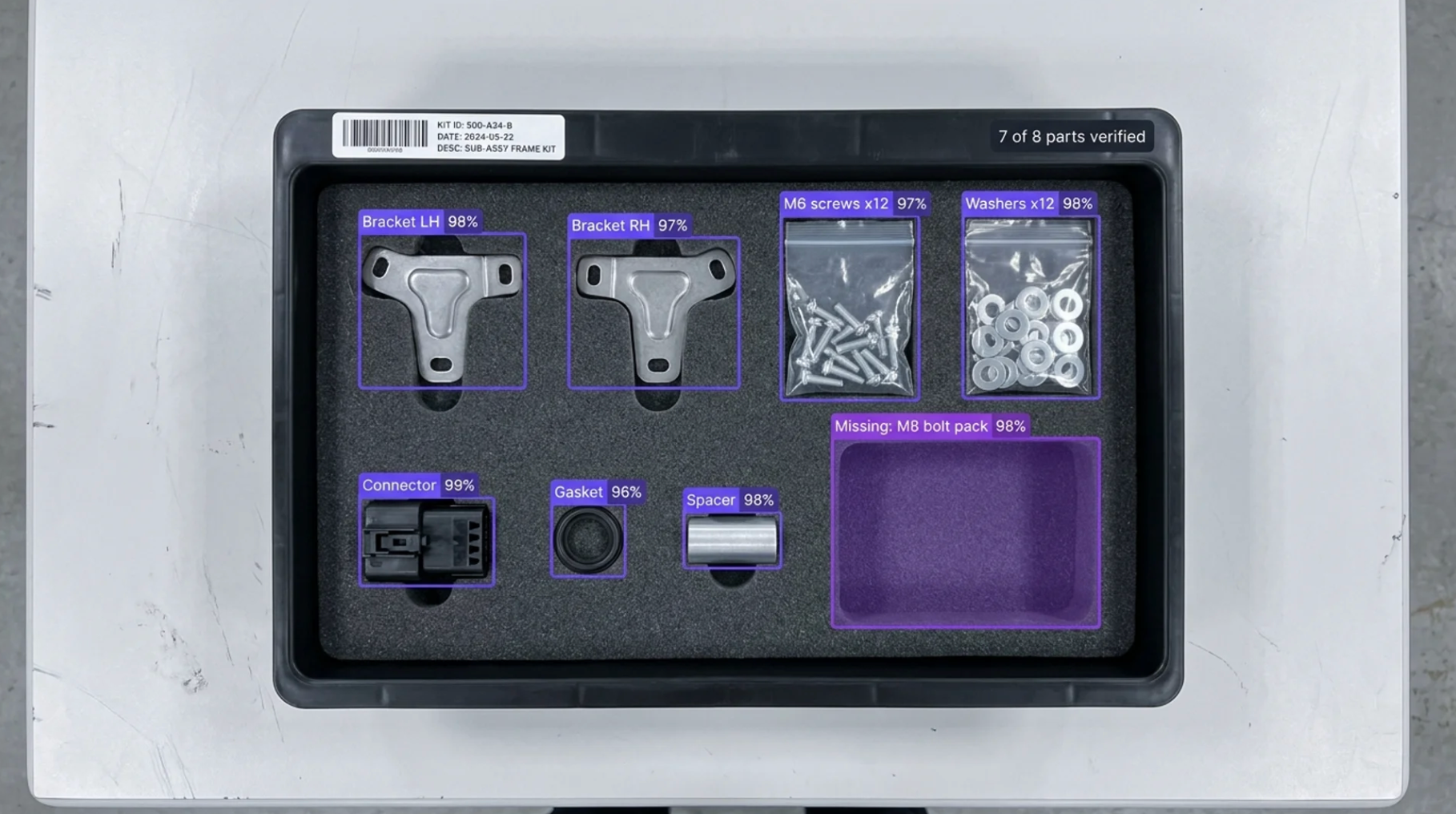
Kitting Verification AI Across Part Presence, Quantity Counts, and Kit-to-Order Matching
Deploy Anywhere, Run Everywhere
Run kitting verification on kitting bench cameras, pack-out stations, the edge, on-prem, in your VPC, or via API.
One Platform, Full Adoption
Tools every manufacturing and fulfillment team can adopt, no separate ML team required to ship and own verification models.
Secure, Compliant, and Audit-Ready
Data stays safe with SOC 2 Type II compliance, encrypted data, HIPAA compliance, and an uptime SLA.
- Missing & Wrong Parts in the Kit
- Quantity Verification & Over-Pick
- Kit-to-Order & Pick List Matching
- Surgical & Procedure Kit Contents
- End-of-Line Label & Shipping Label Verification
- Line-Side, CKD & Spare-Parts Kit Completeness
“We wanted to develop models using data we owned, have the ability to scale usage, leverage state-of-the-art AI capabilities, and along the way ensure the privacy of our users’ personal health information. That’s what we found in Roboflow.”
Alec Zopf
Co-founder and Chief AI & Automation Officer, Wellth
Talk to a Vision AI engineer who's shipped in kitting and contract manufacturing.
Bring us your toughest kitting verification problem and we'll map a working solution.
Ask us about:
- Solution architecture that fits ISO 9001, IATF 16949, ISO 13485, and GDP documentation and traceability
- A live demo on your own kits, part images, and pick lists
- Deployment options: edge, on-prem, air-gapped, VPC, bench-mounted cameras, pack-out station integration, and robot-cell mounting
- ROI modeling against short-shipment chargebacks, customer line stoppages, rework and re-kitting labor, returns, and warranty exposure
Over 16,000 organizations build with Roboflow.
- Rivian
- Pella
- Chobani
- USG Corporation
- BNSF Railway
- American Woodmark
Vision AI is transforming businesses
Customers across the board are solving complex challenges and driving meaningful impact.
- Automotive customer
$10 million
Saved by automatically detecting defects on the production line
- Logistics & freight company
90%
Less time spent manually tracking shipping inventory
- Building materials supplier
60%
Lower customer return rate with improved product quality