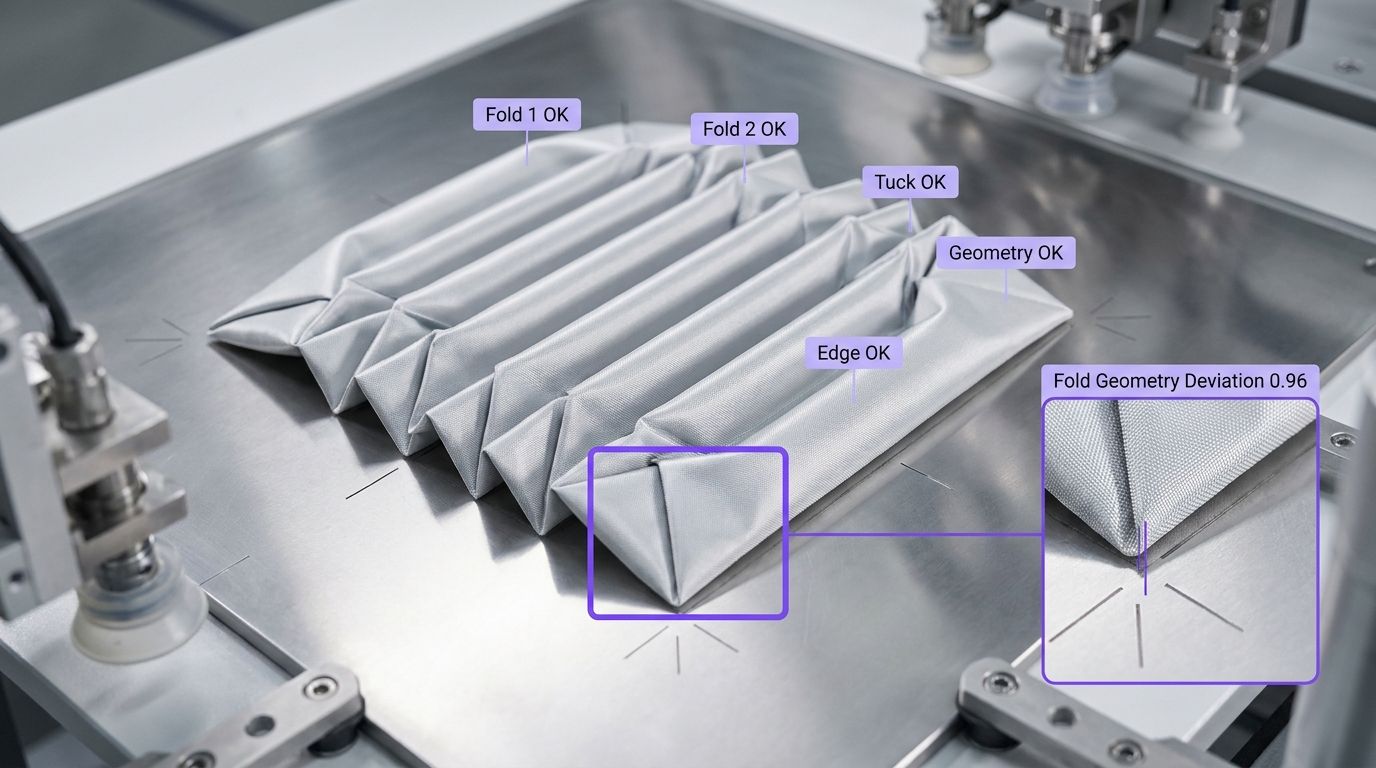
Add a real-time inspection layer to every airbag on the line with Vision AI for airbag manufacturing inspection. Built for the operations where one load-bearing seam failure, mis-installed inflator, incorrect fold pattern, or untorqued module mounting bolt can mean a non-deployment in a crash event, a cushion rupture during inflation, an FMVSS recall on a deployed vehicle program, or a passenger injury that ends in NHTSA litigation. Whether you're inspecting woven nylon cushion fabric coming off the loom, load-bearing seams at inflation chambers, inflator housings and labels before integration, folding patterns at the folding station, or finished modules before they ship to your OEM, Roboflow extends your QC coverage to every airbag on the line.
Cushion, Seam, and Coating Inspection:
- Inspect woven nylon 6,6 cushion fabric for weave defects, coating uniformity, and color consistency across every meter coming off the loom or one-piece woven (OPW) jacquard
- Verify load-bearing seams and stitches at inflation chambers per FMVSS 208 strength requirements for both cut-and-sew and OPW cushion construction
- Catch coating voids, thin spots, frayed edges, and weave anomalies before cushions move to inflator integration
Inflator and Module Assembly Verification:
- Verify inflator housing integrity, regulatory label readability, lot codes, and date codes against pyrotechnic device shipping classification and FMVSS requirements
- Inspect module assembly for correct inflator variant, correct cushion variant, correct cover, and properly torqued mounting fasteners
- Validate connector seating, igniter circuit integrity indicators, and tear seam geometry on every module
Folding, Final Assembly, and Compliance:
- Verify folding pattern, fold geometry, and module envelope match the OEM build specification for each airbag program (driver, passenger, side curtain, knee, far-side)
- Read and verify FMVSS regulatory labels, DOT certifications, UN pyrotechnic device shipping classifications, and customer-specific identification on every module
- Maintain validated inspection records that support customer PPAP submissions, FMVSS compliance documentation, NHTSA recall traceability, and pyrotechnic device transport documentation
Bring intelligence to every airbag today. Stop manufacturing defects from becoming warranty claims, FMVSS recalls, or passenger injuries.
Frequently asked questions
What is airbag manufacturing inspection with Vision AI?
Airbag manufacturing inspection with Vision AI uses computer vision models to inspect automotive airbag modules at every stage of manufacturing, from woven nylon cushion fabric coming off the loom or one-piece woven (OPW) jacquard through load-bearing seam verification, inflator assembly and labeling, fold pattern verification at the folding station, module assembly with mounting fastener torque verification, tear seam inspection, connector seating, and final regulatory label and shipping classification verification. The system extends QC coverage to every airbag module on the line, catching cushion weave defects, coating voids, load-bearing seam failures, inflator label errors, fold pattern deviations, missing or incorrect components in module assembly, untorqued mounting fasteners, tear seam geometry errors, and label or lot code mismatches across multiple OEM-specific airbag programs (driver, passenger, side curtain, knee, far-side).
Can Vision AI verify load-bearing seams and fold pattern geometry per FMVSS 208?
Yes. Load-bearing seam verification and fold pattern geometry verification are the two highest-stakes tasks in airbag manufacturing because a single failed inflation-chamber seam can mean the cushion ruptures at deployment pressure (a catastrophic safety failure), and an incorrect fold pattern can mean the cushion fails to deploy correctly, exiting the module in the wrong direction during a crash event. FMVSS 208 specifies inflation pressure containment requirements, cushion deployment behavior, and module installation criteria, and OEM customer specifications define the exact fold pattern, fold sequence, and module envelope geometry for each airbag program.
Roboflow models can be trained on your specific FMVSS 208 acceptance criteria for seam stitch count, stitch pattern, OPW weave integrity, seam geometry, and inflation chamber boundary integrity, plus your customer-specific fold pattern verification rules covering fold sequence, fold geometry, module envelope, and the position of fold features within the module housing.
Does airbag manufacturing inspection support FMVSS 208, FMVSS 226, ECE R94, and IATF 16949?
Yes. Roboflow models can be trained against your specific FMVSS 208 (Occupant Crash Protection, the US federal motor vehicle safety standard covering frontal airbag deployment, inflation pressure, cushion behavior, and module installation), FMVSS 226 (Ejection Mitigation, covering side curtain airbag requirements), ECE R94 (European frontal impact regulation, equivalent scope to FMVSS 208), ECE R95 (European side impact regulation), IATF 16949 (automotive quality management system), ISO 9001 (general quality management), and customer-specific PPAP (Production Part Approval Process) and APQP (Advanced Product Quality Planning) acceptance criteria, plus UN 0503 / UN 3268 pyrotechnic device shipping classification documentation required for inflator transport under ADR and IATA.
The system applies the same pass/fail logic your trained quality engineers use, against your written specifications and OEM customer drawings, and produces a validated inspection record for every airbag module that supports customer audits, FMVSS recall investigations, NHTSA inquiries, pyrotechnic device shipping documentation, and traceability requirements. Your quality and FMVSS compliance teams own the acceptance criteria and OEM-specific configurations; Roboflow provides the inspection engine that enforces them at line speed across every module.
Can it integrate with our PLC, MES, eQMS, inflator test equipment, and torque tool stack?
Yes. Roboflow Inference (opens in a new tab) exposes a standard API and supports common automotive manufacturing protocols, so Vision AI airbag manufacturing inspection events flow into your existing build PLC, MES, eQMS, ERP, torque tool stack, inflator test equipment, and traceability platforms. Customers integrate with SAP, Oracle, Ignition, Wonderware, AVEVA, Atlas Copco and Bosch Rexroth torque controllers, specialty pyrotechnic test equipment (Daicel test cells, specialty inflator validation equipment), and custom automotive MES platforms through REST, MQTT, OPC UA, and direct database writes, with PLC-level integration to cushion line monitors, inflator assembly cells, folding stations, module assembly checkpoints, and final QC stations where pass/fail decisions need to drive line behavior or downstream sorting. Models support full IQ/OQ/PQ documentation, audit trails for training data, model versions, and inspection results that pass customer PPAP submissions, FMVSS compliance documentation, NHTSA recall investigation requirements, and pyrotechnic device shipping documentation under UN ADR and IATA classification.