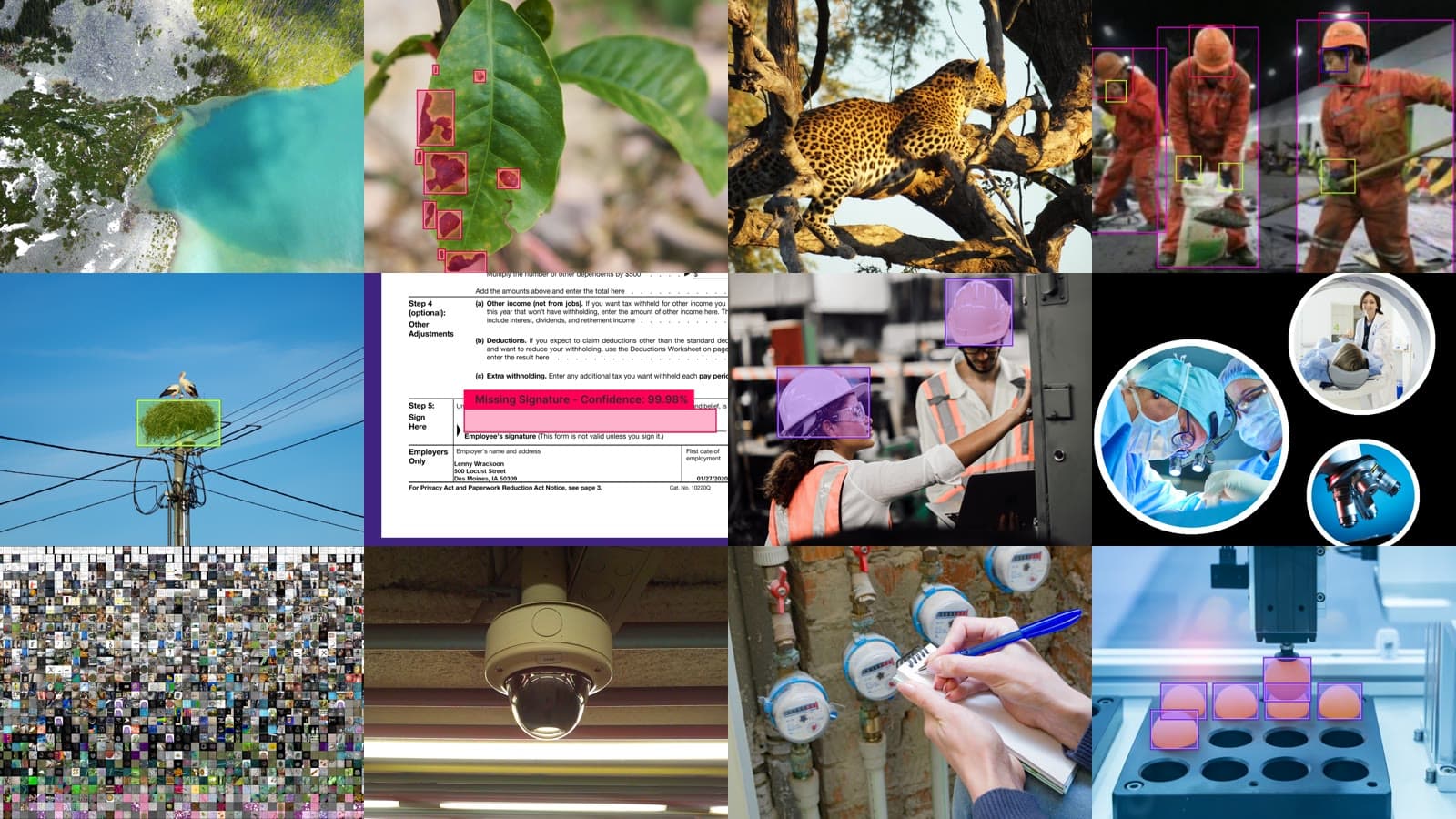
When it comes to comparing Roboflow and Scale AI, Scale AI offers labeling services powered by a large external workforce. Engineering teams that want more control, speed, and data privacy often choose Roboflow.
With Roboflow, teams can label data in-house with AI assistance, iterate quickly, and maintain full ownership of their datasets and models. Roboflow also provides an end-to-end computer vision platform, from labeling and preprocessing to training, deploying, and improving models, so engineers don't need to rely on third-party services for critical parts of their workflow. Teams use Roboflow because it enables faster development, tighter feedback loops, and complete control over the entire vision pipeline.
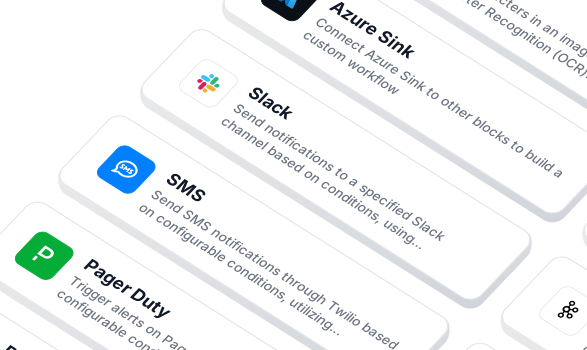
Ultimately, teams use Roboflow because it provides enterprise-grade stability, the option to deploy on anything from an NVIDIA Jetson at the edge to high-scale cloud clusters via Roboflow Cloud, and the ability to build complex application logic (like model chaining and industrial PLC triggers) through a visual drag-and-drop canvas with Roboflow Workflows.
Roboflow
End-to-end, enterprise computer vision platform
Scale AI
Managed data-labeling service and AI evaluation / agents company
Scale & Ecosystem
Roboflow
- 1,000,000+ developers on the platform
- 1,000,000+ public datasets on Roboflow Universe
- 100,000+ pre-trained models hosted publicly
- 25,000+ organizations building with the platform, including more than half of the Fortune 100 (publicly cited: Rivian, Chobani, USG, Pella)
- Self-serve sign-up; teams can begin annotating, training, and deploying without a services contract
Scale AI
- ~$29B valuation following Meta's $14.3B investment in June 2025; Meta holds an approximately 49% stake, and founder Alexandr Wang left to lead Meta's superintelligence effort, with Jason Droege now CEO
- Approximately 400+ enterprise clients; publicly cited customers include Mayo Clinic, BP, Allianz, the U.S. Department of War
- After the Meta deal, OpenAI dropped Scale as a data provider and Google, reported as its largest customer, was reported to be winding down; Scale laid off 200 employees in July 2025
- No public catalog of community-contributed datasets or pre-trained models comparable to Roboflow Universe
- Default delivery model is a managed engagement with Scale's annotation workforce, not pure self-serve
Image Annotation & Labeling
Roboflow
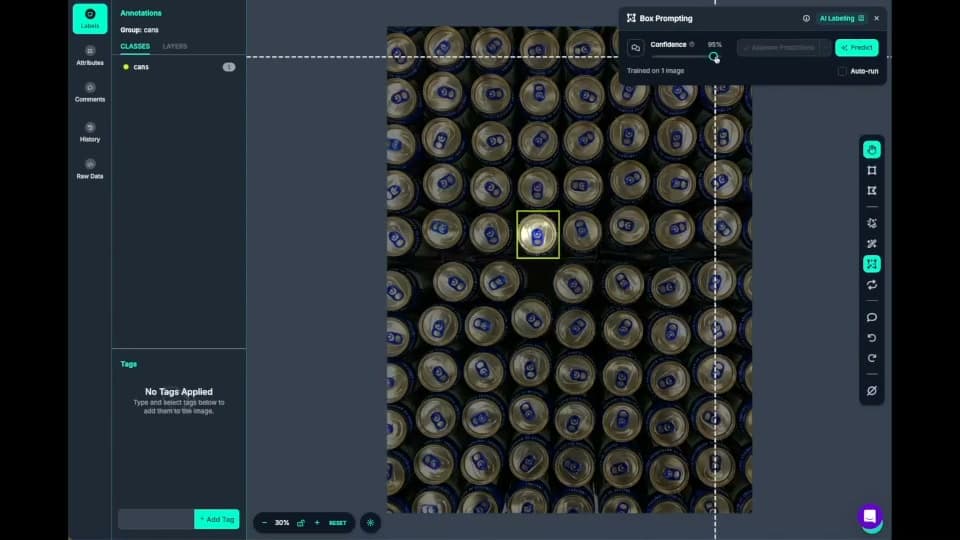
- Auto Label uses foundation models (Grounding DINO, SAM 3) to label images for classes you define in a text prompt; label 1,000 images in under ten minutes
- Label Assist pre-annotates new images with your own trained models, and Smart Polygon creates one-click polygon annotations
- End-to-end platform: dataset management, annotation, model training, hosted inference, and deployment
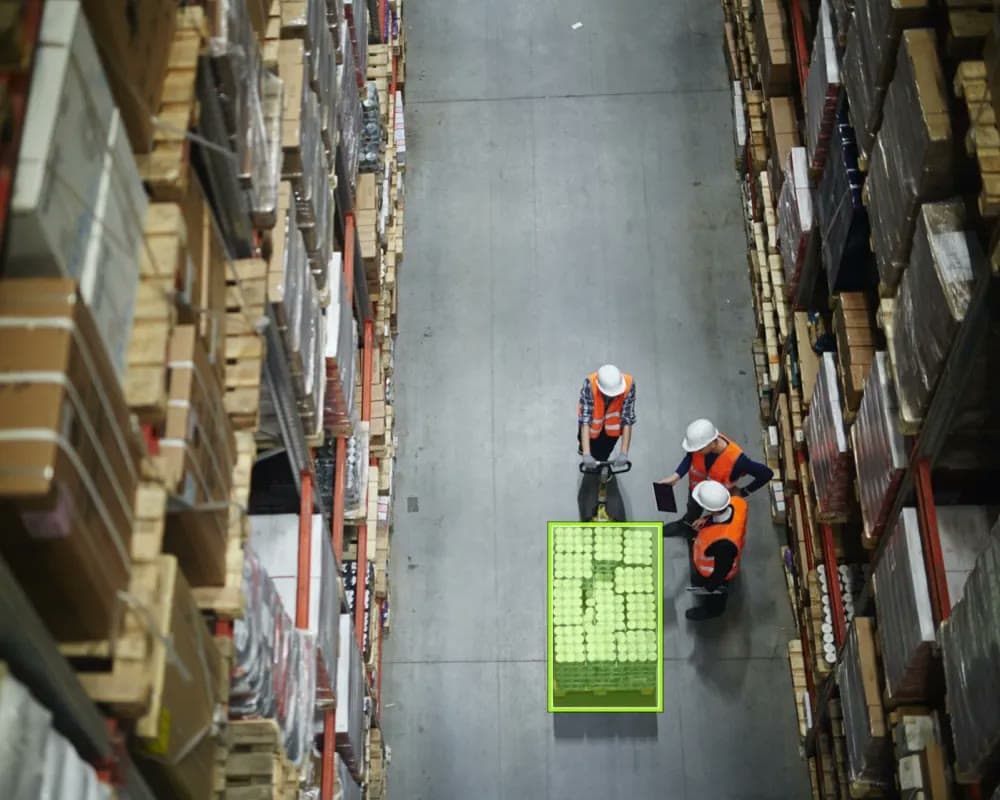
- Native support for object detection, instance and semantic segmentation, image classification, keypoint detection, OCR, depth estimation, and multimodal tasks
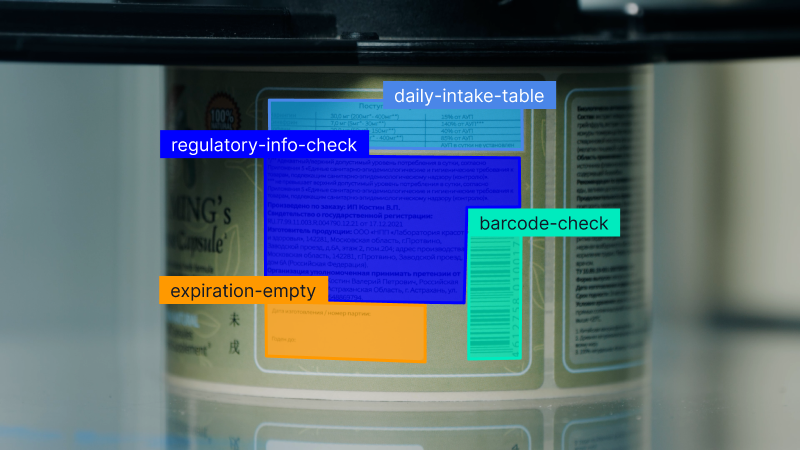
- Roboflow Workflows for chaining detection, classification, OCR, and business logic into a single pipeline
- Active model registry covering RF-DETR, YOLO (v8 / v11 / v26), Detectron2, and other current architectures
Scale AI
- Product lines: Scale Rapid (managed-workforce labeling), Scale Studio (BYO workforce on Scale's tooling), Nucleus (dataset management, acquired), Donovan (defense), Scale GenAI Platform, RL Environments, and Scale Labs
- Reliable AI systems for the world's most important decisions
- Image annotation is delivered primarily through managed workforce engagements rather than self-serve AI-assisted tooling
- No publicly documented, native end-to-end training and hosted inference layer purpose-built for the CV task list above; CV deployment is typically routed through Scale Launch or external infrastructure
Developer Experience
Roboflow
- Open-source supervision library - model-agnostic utilities for detections, tracking, annotation, and evaluation
- Open-source inference server - self-hostable HTTP inference for custom and foundation models
- Native integrations with Hugging Face Transformers, MMDetection, and the broader open-source CV stack
- Python SDK plus REST/HTTP APIs; standardized I/O lets teams swap model weights without changing application code
Scale AI
- Multiple official Python SDKs: scaleapi-python-client, nucleus-python-client, launch-python-client, agentex-sdk
- REST API across product lines
- Open-source Scale Agentex framework for agent development
- No comparable open-source CV utility library or self-hostable inference server in mainstream community use; SDKs primarily orchestrate Scale's hosted services
Enterprise & Security
Roboflow
- SOC 2 Type II compliant
- HIPAA-compliant infrastructure with BAAs available
- PCI DSS (SAQ A and AOC) compliance
- Deployment options: managed cloud, customer VPC, on-premises, and fully air-gapped / offline (Docker-based) for firewalled environments
- Training and inference can run on customer-owned bare metal or in the customer's own cloud account
- Independent ownership; no controlling investor with competing AI products
Scale AI
- Holds enterprise security attestations consistent with serving U.S. defense workloads; Donovan platform is positioned for government / defense use cases
- Default delivery model relies on Scale-managed infrastructure and, in many cases, Scale's external annotation workforce
- Customer-VPC and fully air-gapped self-serve deployments are not publicly documented as standard offerings for the core data engine
- Meta's approximately 49% ownership stake and the public departure of customers citing data-confidentiality concerns are factors that enterprise security and procurement teams have publicly weighed in vendor decisions since June 2025
Sources: roboflow.com, docs.roboflow.com, security.roboflow.com, universe.roboflow.com, github.com/roboflow, scale.com, scale.com/blog, scale.com/docs, github.com/scaleapi, techcrunch.com, seekingalpha.com, tomshardware.com, forbes.com, en.wikipedia.org/wiki/Scale_AI, sacra.com. Figures reflect publicly available information as of August 2026.