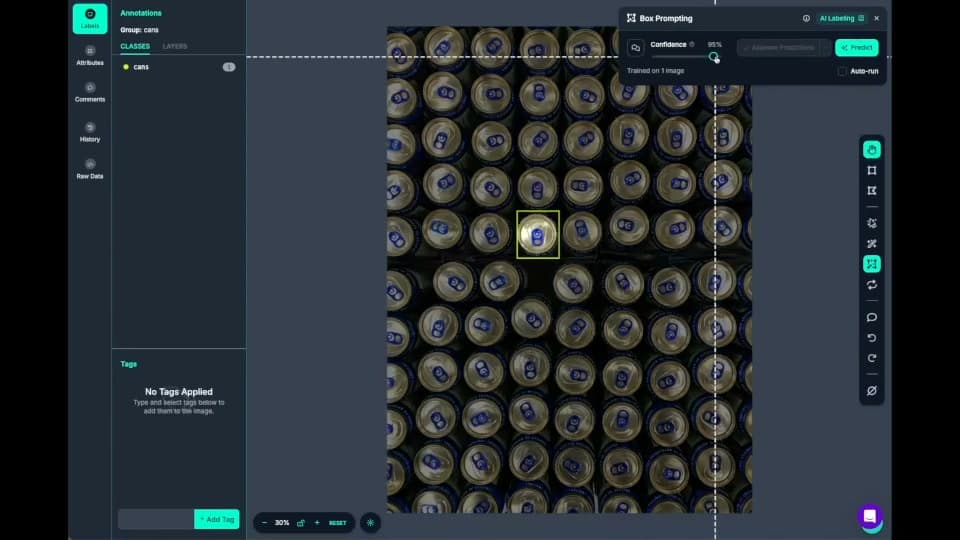
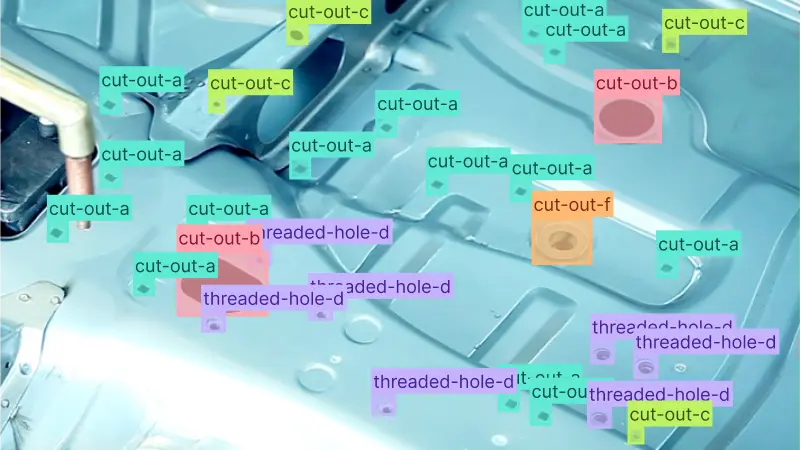
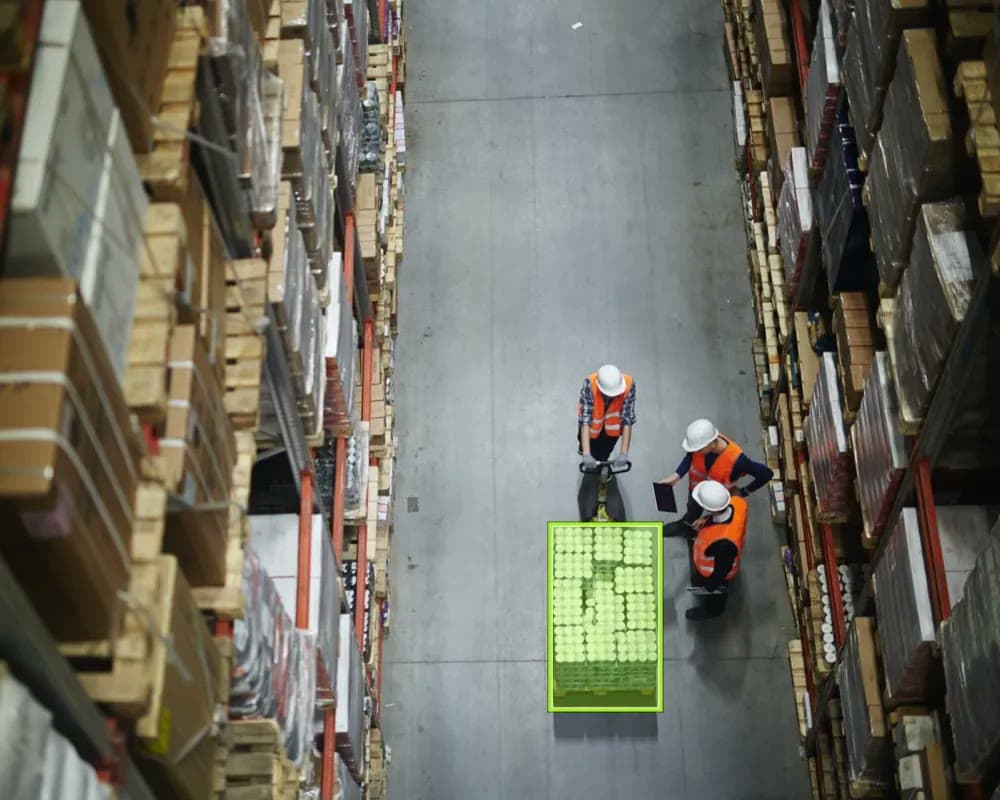
Azure Machine Learning Data Labeling is the annotation feature inside Azure ML studio. It handles image classification, bounding boxes, polygons, and a preview of semantic segmentation, with ML-assisted pre-labeling once you have hand-labeled a few hundred items and a GPU cluster running. The labels then export to COCO or an MLTable for AutoML, and Microsoft's docs note that authoring AutoML vision models is currently supported through the Python SDK rather than the UI. So the no-code path ends at labeling. Teams that want to label, train, and deploy without leaving one tool often choose Roboflow. Roboflow adds foundation-model auto labeling, video support, hosted training with a model registry, and deployment to cloud, edge, or your own Azure account. Engineers and enterprises choose Roboflow because the same person who labels the data can train and ship the model before the compute cluster would have finished spinning up.
Azure ML Data Labeling vs Roboflow Annotate: feature by feature
Both tools cover image classification, bounding boxes, and segmentation. They differ in automation, video and keypoint support, and how much of the path from labels to a deployed model happens in the same place.
The key differences
Azure ML Data Labeling is a solid fit if your data already lives in Azure Blob Storage and your team is comfortable in Azure ML studio. It covers the core image tasks and plugs into Azure RBAC and Entra ID out of the box. Roboflow Annotate covers those tasks plus video and keypoints, adds foundation-model auto labeling, dataset analytics, annotation history, and augmentation, and hands the labeled data straight to training, deployment, and app building without switching services.
- Setup: Roboflow Annotate is ready in the browser after sign-up. Azure needs an ML workspace, a Blob datastore, and a GPU cluster before ML-assisted labeling turns on.
- Automation: Roboflow's Auto Label labels a dataset from a text prompt on day one. Azure's pre-labeling waits until you have hand-labeled a few hundred items, then trains its own model on them.
- Coverage: Roboflow labels images and video with boxes, polygons, masks, and keypoints. Azure has no video project type and no keypoint or OCR labeling.
- End-to-end integration: Roboflow runs from labeling to training to deployment in one tool. Azure exports labels to AutoML, where Microsoft's docs say computer vision model authoring is supported through the Python SDK rather than the UI.
Azure ML Data Labeling fits teams standardized on Azure who want labels inside their existing ML workspace. Roboflow Annotate fits teams that want fast, automated labeling that feeds directly into integrated vision workflows, with deployment to the cloud, the edge, or your own Azure account.
Roboflow
End-to-end computer vision platform (annotate, train, deploy)
Azure ML Data Labeling
Image and text labeling projects inside Azure Machine Learning studio
Scale & Ecosystem
Roboflow
- 2,000,000+ developers on the platform
- 1,000,000+ public datasets on Roboflow Universe
- 100,000+ pre-trained models hosted publicly
- 25,000+ organizations building with the platform, including more than half of the Fortune 100 (publicly cited: Rivian, Chobani, USG, Pella)
- Self-serve sign-up; teams can begin annotating, training, and deploying without a services contract
Azure ML Data Labeling
- A feature of Azure Machine Learning rather than a standalone product; no separate charge beyond the Azure storage and compute it consumes
- Labeling workforce is your own team (added through Azure RBAC, with external labelers invited as Entra ID guest users) or a vendor company contracted directly through Azure Marketplace (named vendors: iSoftStone, Quadrant Resource)
- Projects are capped at 500,000 files; files beyond that limit are not loaded
- Azure Custom Vision, Microsoft's separate no-code CV training service, is retiring with support for existing customers until September 25, 2028
- No public catalog of community-contributed labeled datasets or CV models comparable to Roboflow Universe; the Azure model catalog is a foundation-model hub, and Azure Open Datasets lists no image datasets
Product Capabilities (Computer Vision)
Roboflow
- End-to-end platform: dataset management, annotation, model training, hosted inference, and deployment
- Auto Label uses foundation models (GPT-6 Astra, Gemini) to label images for classes you define in a text prompt; label 1,000 images in under ten minutes
- Label Assist pre-annotates new images with your own trained models, and Smart Polygon creates one-click polygon annotations powered by Meta AI's Segment Anything
- Native support for object detection, instance and semantic segmentation, image classification, keypoint detection, OCR, depth estimation, and multimodal tasks
- Roboflow Workflows for chaining detection, classification, OCR, and business logic into a single pipeline
- Active model registry covering RF-DETR, YOLO (v8 / v11 / v26), Detectron2, and other current architectures
Azure ML Data Labeling
- Five image project types: multi-class classification, multi-label classification, bounding box, polygon instance segmentation, and semantic segmentation (preview); supports JPEG, PNG, BMP, TIFF, and DICOM inputs
- No video labeling project type; no keypoint, OCR, or 3D annotation
- ML-assisted labeling (clustering, then pre-labeling) typically activates after roughly 300 manually labeled items, requires a GPU cluster (Azure auto-creates a Standard_NC6s_v3 cluster), and is not supported when storage sits behind a virtual network
- Exports to CSV, COCO, or an Azure ML MLTable data asset; semantic segmentation exports only as an MLTable
- Training happens in separate Azure ML AutoML jobs; Microsoft's docs state that authoring AutoML computer vision models is currently supported through the Python SDK, and the UI does not launch automatic sweeps
Developer Experience
Roboflow
- Open-source supervision library - model-agnostic utilities for detections, tracking, annotation, and evaluation
- Open-source inference server - self-hostable HTTP inference for custom and foundation models
- Native integrations with Hugging Face Transformers, MMDetection, and the broader open-source CV stack
- Python SDK plus REST/HTTP APIs; standardized I/O lets teams swap model weights without changing application code
Azure ML Data Labeling
- Project creation, labeling, review, and export are documented only through the Azure ML studio UI
- A labelingJobs ARM/REST resource exists, but every listed API version through 2024-04-01-preview is preview; no stable version is published
- No labeling-project API is documented in the current azure-ai-ml Python SDK v2; the SDK v1 labeled-dataset path was retired March 31, 2025
- Source images must live in an Azure Blob Storage datastore; exports land in the workspace default blob store for AutoML and pipelines
- No open-source CV utility library or self-hostable inference server comparable to Roboflow's tooling
Enterprise & Security
Roboflow
- SOC 2 Type II compliant
- HIPAA-compliant infrastructure with BAAs available
- PCI DSS (SAQ A and AOC) compliance
- Deployment options: managed cloud, customer VPC, on-premises, and fully air-gapped / offline (Docker-based) for firewalled environments
- Training and inference can run on customer-owned bare metal or in the customer's own cloud account, including Azure
Azure ML Data Labeling
- Inherits Azure and Azure Machine Learning compliance (SOC 1/2/3, ISO, HIPAA/HITRUST, PCI DSS, FedRAMP High for Azure ML in Azure Public); no Data Labeling-specific compliance statement is published
- Images stay in the customer's own Azure Blob Storage; exports are written to the workspace's default storage
- ML-assisted labeling is unavailable when the default storage account is behind a virtual network
- Pricing: no separate charge for labeling; customers pay for storage and for the GPU compute used by ML-assisted labeling, and pay vendor labeling companies directly
- No currently published Microsoft retirement notice for Data Labeling; a third-party retirement post dated October 2025 has since been withdrawn
Sources: roboflow.com, docs.roboflow.com, security.roboflow.com, universe.roboflow.com, github.com/roboflow, learn.microsoft.com, azure.microsoft.com. Figures reflect publicly available information as of September 2026.