Visual Intelligence Summit: Oct 22 in San Francisco Get your ticket

Dataloop just stores data, Roboflow helps turn data into AI

Dataloop vs. Roboflow? Over 1 million engineers create datasets, train models, and deploy to production with Roboflow.
Why are companies choosing Roboflow?

The turnkey solution for vision AI. Create datasets, train models, and deploy to production.

  • End-to-End Vision, One Platform

    From labeling to deployment - build, train, and launch with ease.

  • Built for Builders, Ready for Anything

    Interoperable infrastructure for developers to create custom vision solutions.

  • AI at the Edge, Without Limits

    Deploy seamlessly to any edge device and power real-time vision AI.

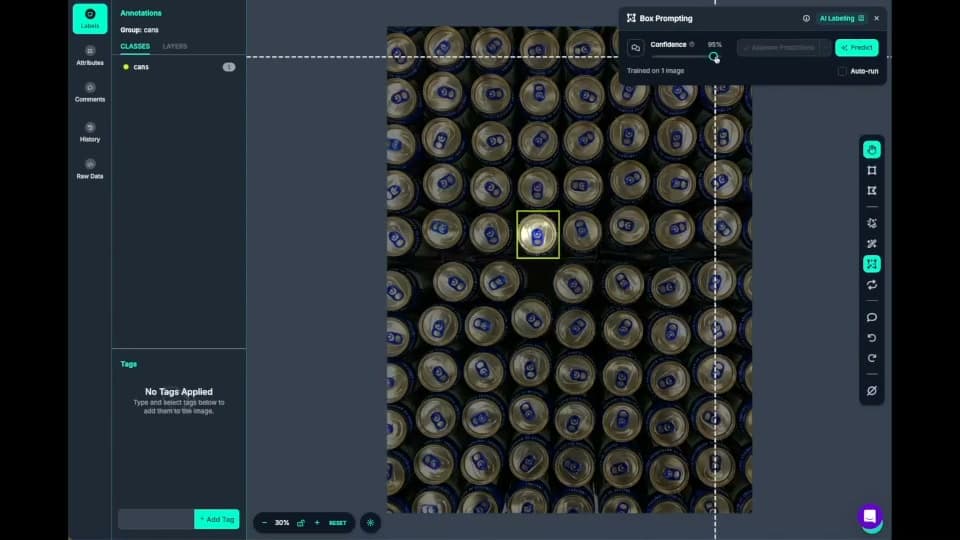
  • Roboflow Annotate labeling cans with AI box prompting

    Fast data labeling

    Label data quickly with a suite of AI-assisted annotation tools to augment human labeling or fully automate your data labeling pipeline.
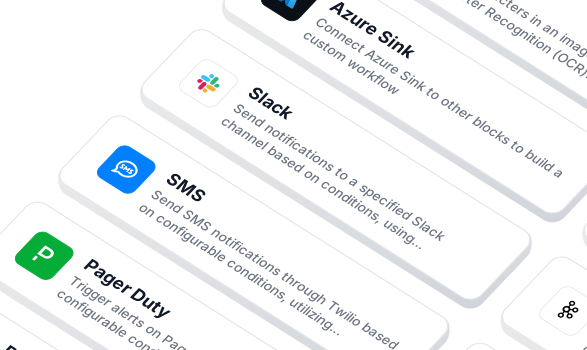
  • Workflow blocks for notifications and integrations

    Build vision AI applications with ease

    Use a low-code open source platform to simplify building and deploying vision AI applications.
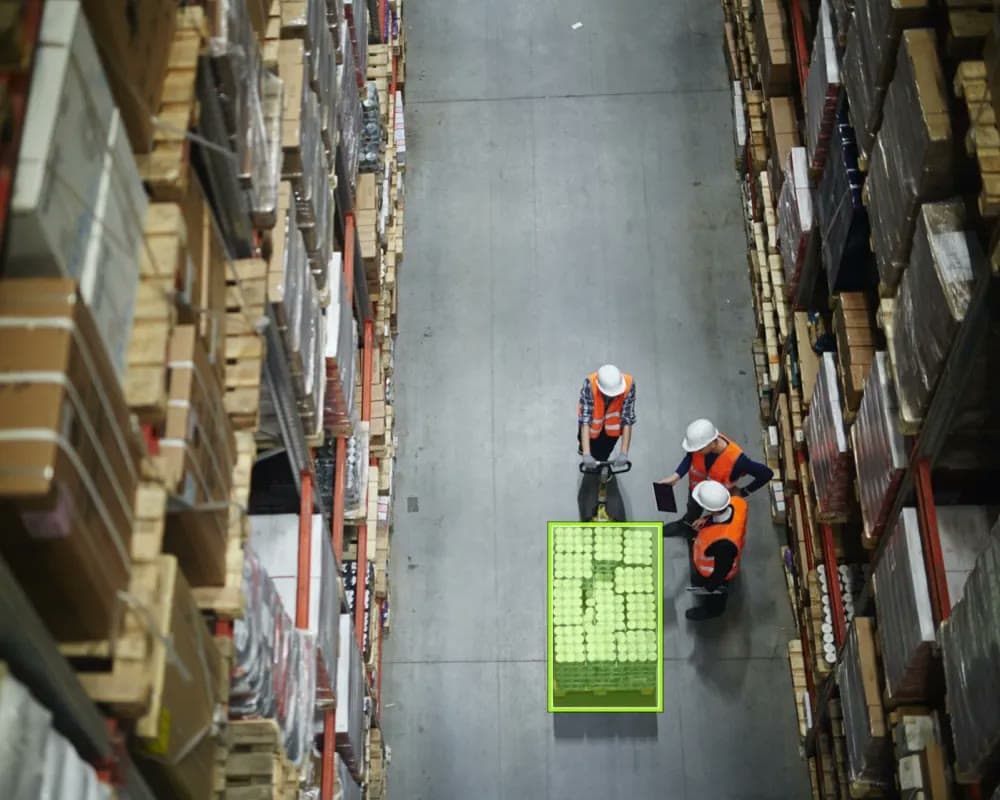
  • A team reviewing a detected pallet in a warehouse aisle

    Machine learning expertise, always

    Work with account-dedicated AI specialists and Field Engineers to accelerate development and optimize performance.
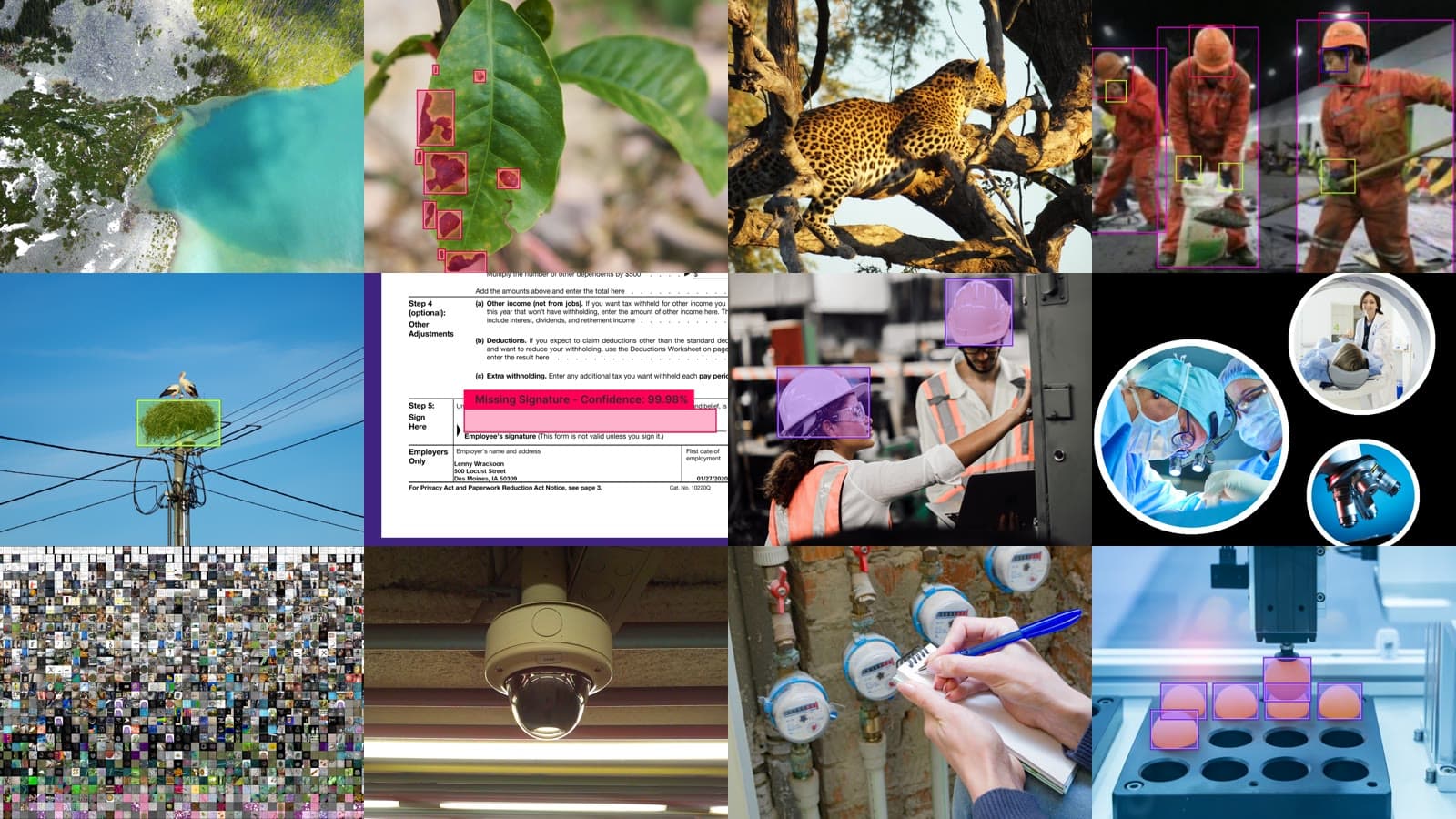
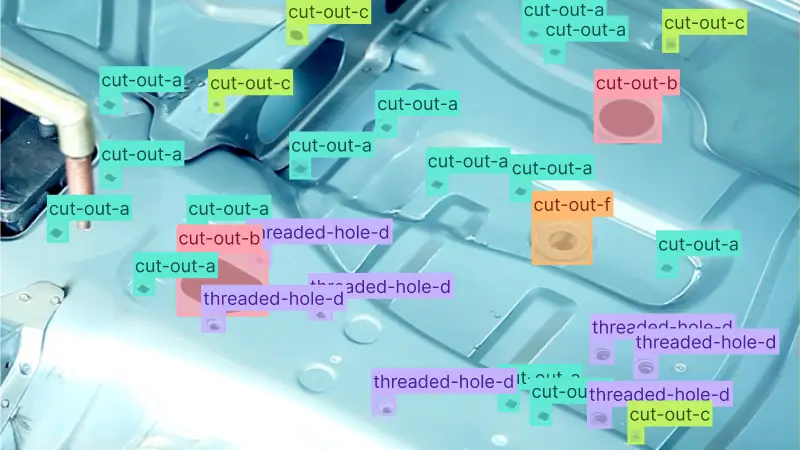
  • Photos from datasets across industries

    Datasets and models for every industry

    Access thousands of datasets and pre-trained models to kickstart your computer vision projects.
  • Logos of OpenAI, Microsoft, Meta, Anthropic, Google and Qwen

    Flexible model licensing

    Choose from a range of licensing options to fit your needs, whether for commercial use, private deployment, or collaboration across teams.

Want to migrate from Dataloop to Roboflow?

  • Import images to Roboflow

    Bring data from Dataloop to Roboflow for model training.

  • Deploy with Roboflow

    No matter where you train your model, use Roboflow's trusted deployment solutions.

  • Automate data labeling

    Use AI labeling in Roboflow to automate 90% of human labeling.

OK I’m ready, how do I use Roboflow?

Roboflow makes it easy to build, train, and deploy custom computer vision models, even if you’re not a machine learning expert.

Speak with an AI expert

Our team will help you start solving business problems on the first call.

Ask us about:

  • Solution architecting
  • Live demonstration
  • Pricing and specifications
  • Feasibility assessment

Over 16,000 organizations build with Roboflow.

  • Rivian
  • Pella
  • Chobani
  • USG Corporation
  • BNSF Railway
  • American Woodmark
Start where you are
Stay connected

Get the Latest in Computer Vision First

Unsubscribe at any time. Review our Privacy Policy.

Compare Dataloop and Roboflow

When it comes to comparing Roboflow and Dataloop, Dataloop provides pipelines to move data between various applications. Teams looking for a developer-friendly, end-to-end solution often choose Roboflow. Roboflow enables engineers to manage their entire computer vision pipeline, from labeling and preprocessing to model training, deployment, and active learning, all within a single platform. With Roboflow, teams can start instantly, maintain full control over their data and models, and scale from prototype to production without relying on external services or complex infrastructure. Engineers use Roboflow because it is purpose-built for computer vision: start fast, keep control, and scale to production.

Roboflow

End-to-end computer vision platform (annotate, train, deploy)

Dataloop

Data management, annotation, and pipeline orchestration platform

Scale & Ecosystem

Roboflow

  • 1,000,000+ developers on the platform
  • 1,000,000+ public datasets on Roboflow Universe
  • 100,000+ pre-trained models hosted publicly
  • 25,000+ organizations building with the platform, including more than half of the Fortune 100 (publicly cited: Rivian, Chobani, USG, Pella)

Dataloop

  • Homepage showcases enterprise logos with customer testimonials from Elbit and iMerit
  • Publicly states "hundreds" of customers across retail, agriculture, robotics, autonomous vehicles, and construction
  • Internal model marketplace; no public, browsable catalog of community-contributed datasets and pre-trained models comparable to Roboflow Universe

Product Capabilities (Computer Vision)

Roboflow

  • End-to-end platform: dataset management, annotation, model training, hosted inference, and deployment
  • Auto Label uses foundation models (Grounding DINO, SAM 3) to label images for classes you define in a text prompt; label 1,000 images in under ten minutes
  • Label Assist pre-annotates new images with your own trained models, and Smart Polygon creates one-click polygon annotations
  • Native support for object detection, instance and semantic segmentation, image classification, keypoint detection, OCR, depth estimation, and multimodal tasks
  • Roboflow Workflows for chaining detection, classification, OCR, and business logic into a single pipeline
  • Active model registry covering RF-DETR, YOLO (v8 / v11 / v26), Detectron2, and other current architectures

Dataloop

  • Annotation coverage for bounding boxes, polygons, keypoints, semantic segmentation, 3D cuboids (LiDAR), polylines, splines, plus text and audio
  • Active Learning Pipelines and serverless function nodes for chaining annotation, model inference, and quality control steps
  • Does not include a native, hosted training-to-inference layer for the broad CV task list; documented architecture relies on plugging external models into pipelines (model marketplace) rather than a built-in training service per task
  • No public registry of swappable model weights comparable to Roboflow's model registry

Developer Experience

Roboflow

  • Open-source supervision library, model-agnostic utilities for detections, tracking, annotation, and evaluation
  • Open-source inference server, self-hostable HTTP inference for custom and foundation models
  • Native integrations with Hugging Face Transformers, MMDetection, and the broader open-source CV stack
  • Python SDK plus REST/HTTP APIs; standardized I/O lets teams swap model weights without changing application code

Dataloop

  • Open-source Python SDK and CLI (dtlpy) on GitHub; JavaScript SDK also published
  • Apps framework lets developers package custom logic with Docker images or codebases referenced from GitHub
  • REST API covering data, annotation, pipeline, and model operations
  • No comparable open-source CV utility library or self-hostable inference server in mainstream community use; SDK is oriented to data and pipeline operations rather than model serving

Enterprise & Security

Roboflow

  • SOC 2 Type II compliant
  • HIPAA-compliant infrastructure with BAAs available
  • PCI DSS (SAQ A and AOC) compliance
  • Deployment options: managed cloud, customer VPC, on-premises, and fully air-gapped / offline (Docker-based) for firewalled environments
  • Training and inference can run on customer-owned bare metal or in the customer's own cloud account

Dataloop

  • Security page states SOC 2 Type II compliance, adherence to ISO 27001 and ISO 27701, and GDPR compliance
  • HIPAA and PCI DSS compliance are not publicly documented
  • Kubernetes-based on-premises and private storage deployments referenced; fully air-gapped deployment is not publicly documented as a standard offering
  • Cloud storage integrations available so raw data can remain in the customer's own cloud provider

Sources: roboflow.com, docs.roboflow.com, security.roboflow.com, universe.roboflow.com, github.com/roboflow, dataloop.ai, dataloop.ai/security, docs.dataloop.ai, github.com/dataloop-ai, crunchbase.com, pitchbook.com, tracxn.com. Figures reflect publicly available information as of August 2026.