Use Gemini 4 Argon to Build Computer Vision Applications
 Patrick DescherePublished Oct 13, 2026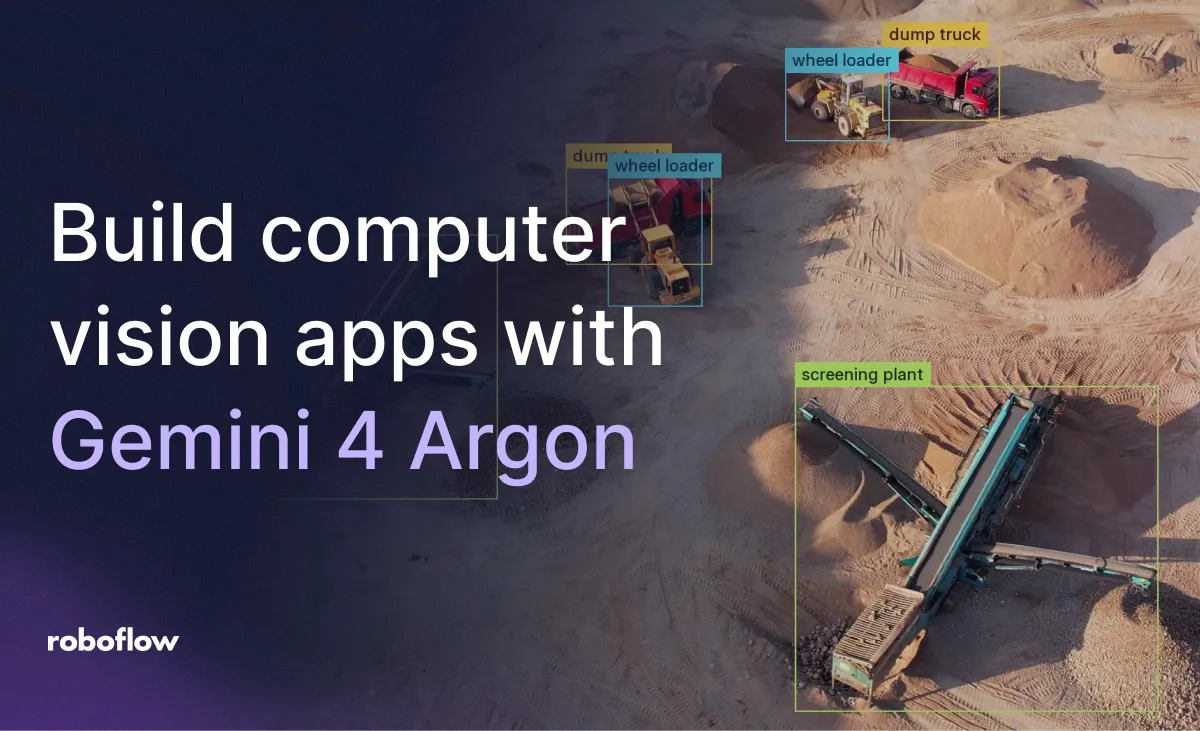
Today we added Gemini 4 Argon, Google’s newest multimodal model, to Roboflow. As of this writing, it ranks first on Roboflow Playground, where we compare vision models on real-world tasks, for object detection, counting, and text extraction.
Roboflow is a platform for building computer vision applications, from labeling images and training models to deploying them in the cloud or on your hardware. With Gemini 4 Argon in Roboflow, you can label hundreds of images automatically to train a model that’s fast enough for live video, or use Argon as one step in an application that combines several models.
What is Gemini 4 Argon?
Gemini 4 Argon is the newest multimodal model from Google. You give it an image and instructions in plain language, and it returns text, structured data, or bounding boxes around the objects you ask for. In our evaluations, it’s especially good at three tasks that come up often in vision applications: finding objects, counting them, and reading text in real-world images from manufacturing, logistics, and aerial imagery.
Build vision applications that advance with the frontier
Every advance in frontier models expands what’s possible with computer vision. Gemini 4 Argon is another step toward applications that understand more of the world, solve more ambitious problems, and improve as the underlying models improve.
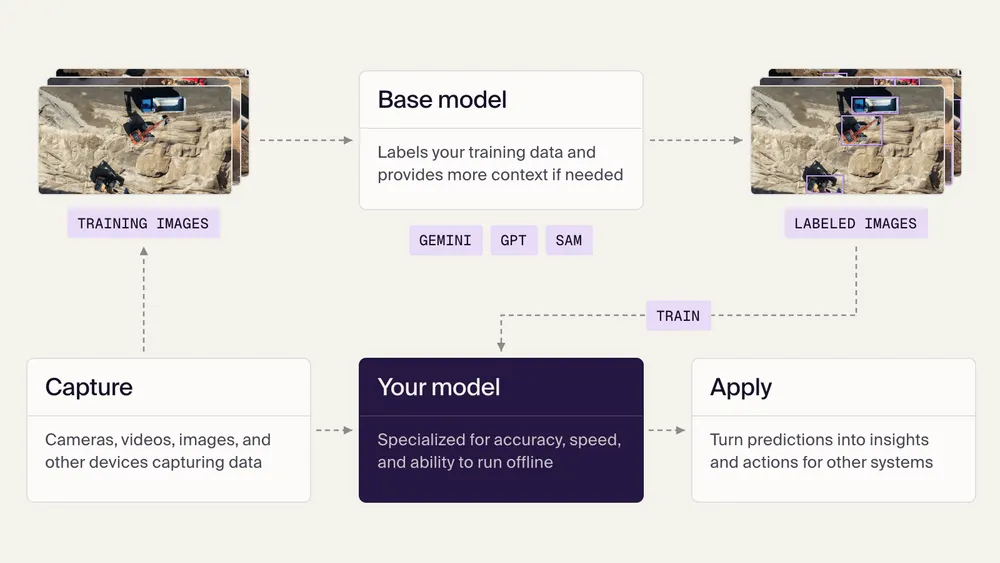
Our vision for Roboflow is to be the vision harness that turns those advances into better applications: a foundation for evaluating new capabilities, combining frontier and specialized models, and routing each task to the right model. The goal is to keep customers at the frontier of what’s possible across accuracy, speed, and cost, with the freedom to adopt better models from any provider, without vendor lock-in.
Auto Label and Workflows are two starting points, which you can use to build vision systems that keep getting better: stronger evaluations, more capable reasoning, and better ways to put each new breakthrough to work.
Auto label data with Gemini 4 Argon
Auto Label draws labels on a whole batch of images for you. You list the objects you want labeled, with a short description of each, and Gemini 4 Argon finds every match and draws a bounding box around it. That way, you can label hundreds of images without drawing each box by hand and spend your time reviewing the results instead.
Those labels become training data for a specialized model. Gemini 4 Argon can find objects from a written description, but a model of its size is too slow and costly to run on every frame of a live video. A model like RF-DETR, trained on your images, runs in real time on edge devices like NVIDIA Jetson. With Auto Label, Argon labels the training data, and RF-DETR runs on your cameras in production.
For example, let’s say you operate a quarry and want to know how your equipment is used across a shift, like how many loads each wheel loader moves and how long dump trucks wait to be filled. You pull a few hundred frames from drone footage of the site, list classes like haul truck, dump truck, wheel loader, excavator, and screening plant, and run Auto Label with Gemini 4 Argon. After you review the labels, you train an RF-DETR model that tracks every vehicle on the site, frame by frame.
Gemini 4 Argon is available in Auto Label on object detection projects, in Label Assist in the annotation editor, and through Roboflow Agent. You can also start Auto Label jobs with it from the Roboflow API, the Roboflow MCP server, and the Python SDK by setting the model type to gemini-4-argon-boxes. On paid plans, it’s now the default model for object detection labeling, so Auto Label selects it for you.
Use Gemini 4 Argon in your Workflows
Workflows are how you build vision applications in Roboflow. You connect models and logic as steps, then run the result in the cloud or on your hardware. Some use cases might need more than a detector can provide, like reading a serial number or answering a question about what’s happening in a scene. Gemini 4 Argon is now a model option in the Google Gemini block, so you can add those steps to your Workflows.
A large multimodal model takes longer and costs more per image than a specialized detector, so it pays to use it selectively. A common pattern is to run an efficient detector like RF-DETR on every frame of a video, then send Argon only the frames where a product is in position under the camera, or crops of the specific components you need to verify. That way, the detector covers every frame at full speed, and Argon reads and reasons only where your application needs it.
For example, let’s say you inspect motherboards after assembly and need to confirm that every capacitor matches the bill of materials (BOM). A detection model finds each capacitor on the board, and a Dynamic Crop step cuts each one out of the image. Gemini 4 Argon reads the capacitance and voltage rating printed on each capacitor and returns them as JSON fields. A final step compares the values against the BOM, flags the board for rework when a capacitor has the wrong rating, and sends it to a technician when a marking isn’t readable.
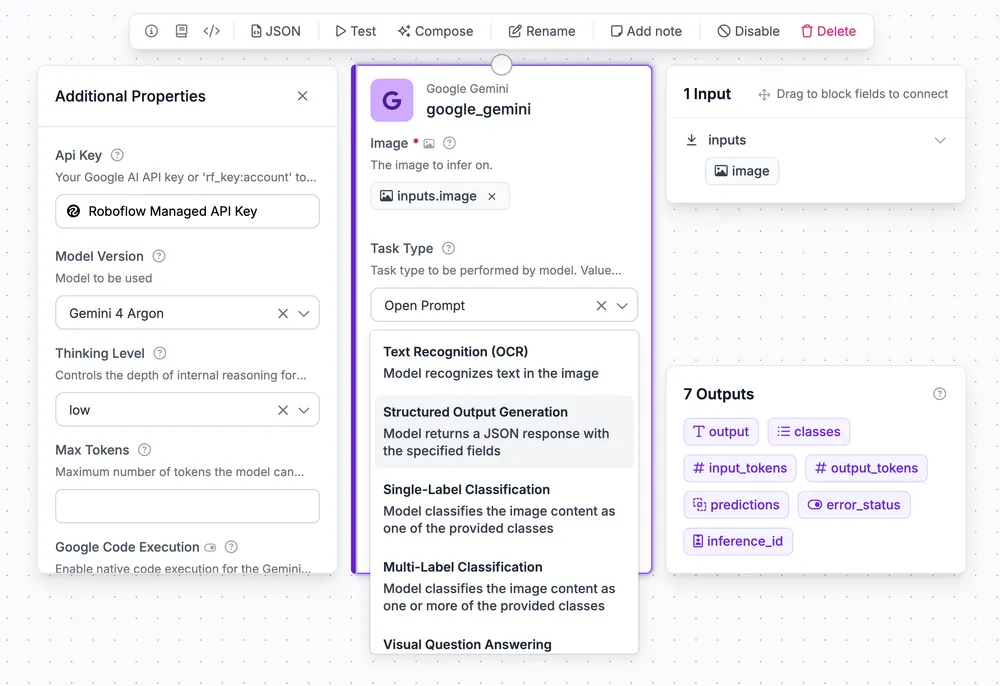
The Google Gemini block supports these task types with Gemini 4 Argon:
- Object Detection: Argon returns bounding boxes for the classes you list.
- Text Recognition (OCR): Argon reads the text in an image.
- Structured Output Generation: Argon returns JSON with the fields you define, like a capacitance value and a voltage rating.
- Single-Label and Multi-Label Classification: Argon assigns an image one or more of the classes you provide.
- Visual Question Answering: Argon answers a question you ask about the image.
- Captioning: Argon writes a short or detailed description of the image.
- Open Prompt: Argon follows the prompt you write and returns its response as text.
Detection and classification results use the same format as other Roboflow models, so they connect directly to blocks like visualizations, counting, and filters. You can also set a thinking level for each step, using a low level for quick answers and a high level when a task needs more reasoning.
Workflows with Gemini 4 Argon run in the Roboflow cloud starting today, through the Serverless API. Support for self-hosted inference servers will follow in an upcoming release of Roboflow Inference. By default, the block uses Roboflow’s managed key and bills Gemini token use to your Roboflow credits. You can also provide a Google AI API key and pay Google directly.
Get started with Gemini 4 Argon
Gemini 4 Argon lets you describe what you need in plain language and get back boxes, counts, and text. In Roboflow, you can put that to work in two ways: labeling the training data for a fast, specialized model, or handling the steps in a Workflow that need to read and reason about what your cameras capture. Whether you’re tracking equipment across a quarry or verifying components on a production line, you can now bring the right models for the job to each step.
Log in to Roboflow to try Gemini 4 Argon in Auto Label, or add the Google Gemini block to a Workflow. To see how Argon compares with other models, read Piotr’s post and explore the results on Roboflow Playground.