PP-YOLO Strikes Again - Record Object Detection at 68.9FPS
 Jacob SolawetzPublished May 11, 2021

Object detection research is white hot! In the last year alone, we've seen the state of the art reached by YOLOv4, YOLOv5, PP-YOLO, and Scaled-YOLOv4. And now Baidu releases PP-YOLOv2 (opens in a new tab), setting new heights in the object detection space.
State of the art object detection architectures are designed with practical application in mind - that is, researchers must weigh the tradeoffs of inference speed with prediction accuracy. The faster and more accurate you can infer the better.

In terms of speed and accuracy, PP-YOLOv2 is the new best model for object detection.
A Brief History of YOLO
YOLO (You Only Look Once) is a family of object detection models, so named because they predict an object's bounding box and the object's class in a single forward pass through the network. YOLO models have absolutely dominated the object detection scene because of the accuracy they produce for relatively low compute requirements during training and inference.
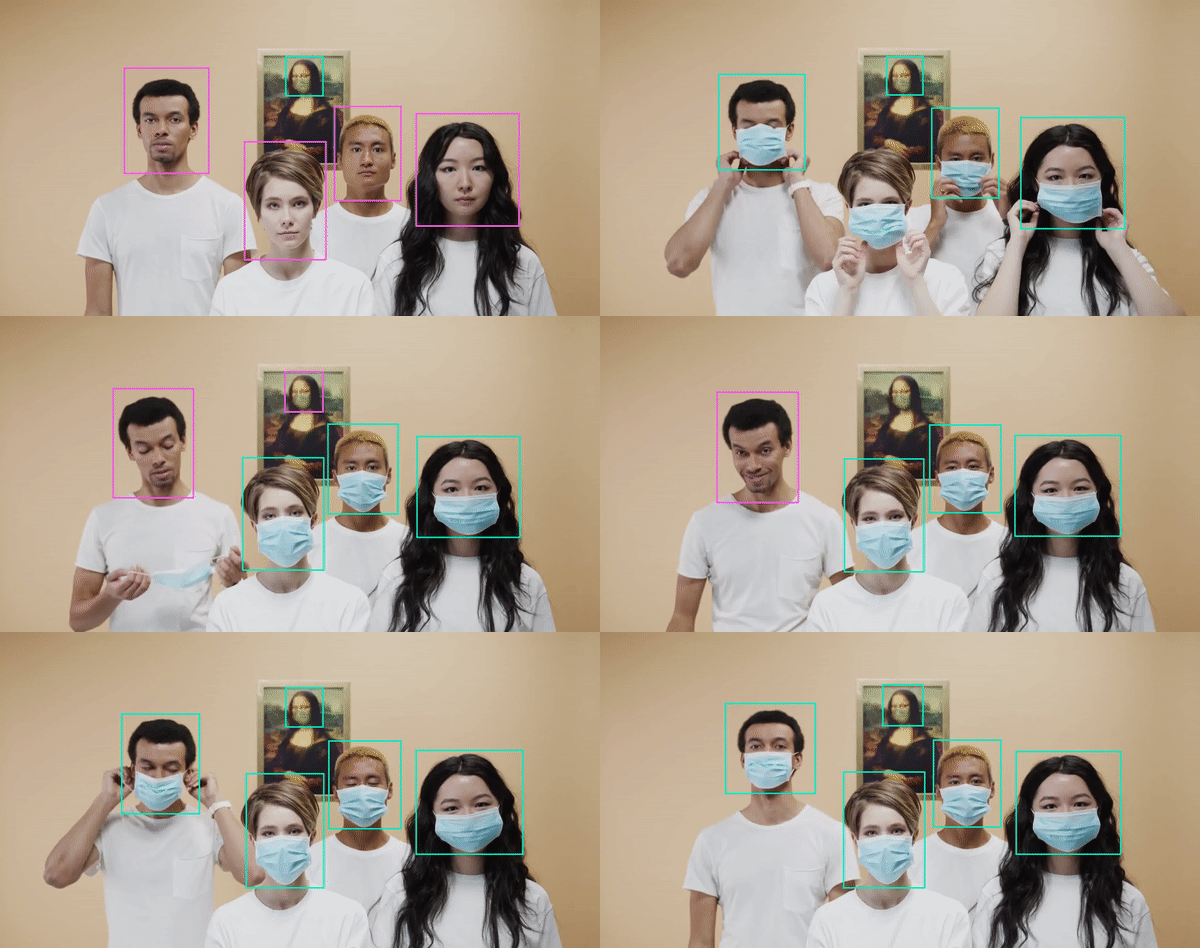
YOLO was originally written in the Darknet framework (opens in a new tab) by Joseph Redmon (github moniker pjreddie (opens in a new tab)). He took YOLO to YOLOv2 and YOLOv3, eventually leaving the game due to ethical concerns.
Joseph Redmon passed the baton (opens in a new tab) to AlexeyAB (opens in a new tab) who leveled the Darknet (opens in a new tab) network up to YOLOv4 and YOLOv4-tiny.
To the benefit of many ML practitioners, Glenn Jocher (github moniker glenn-jocher (opens in a new tab)) ported YOLOv3 out of Darknet and into PyTorch, and while doing so, released the fastest training and very accurate YOLOv5.
The YOLOv5 framework was scaled up by WonKinYiu (opens in a new tab) to produce the most accurate object detector in the game, Scaled YOLOv4 (opens in a new tab).
Meanwhile, in the Baidu world, Baidu researchers have been working on their own version of YOLO in the Paddle Paddle deep learning farmework.
Enter PP-YOLO and enter PP-YOLOv2.
What Does PP Stand For?
PP is short for PaddlePaddle, a deep learning framework written by Baidu.

If PaddlePaddle is news to you, then we are in the same boat.
PP-YOLOv2 Research Contributions

PP-YOLOv2 builds on the research advancements made by PP-YOLO. PP-YOLO took the YOLOv3 network and made iterative improvements in training and and architecture by adding a Resnet backbone, DropBlock regularization, IoU loss, Grid Sensitivity, Matrix NMS, CoordConv, SPP layers, and a better ImageNet pretraining checkpoint.

To build on this progress, PP-YOLOv2 adds a few known techniques to the object detector, carefully experimenting with what changes work well together on the COCO dataset.

The PP-YOLOv2 authors first add the Path Aggregation Network to the neck of their object detector. Then they add the mish activation function (opens in a new tab) to the neck of their object detector (but not to the backbone, preferring to use the ImageNet pretrained backbone). Next, they increase image input size, drawing uniformly across different input sizes [320, 352, 384, 416, 448, 480, 512, 544, 576, 608, 640, 672, 704, 736, 768]. Finally, the authors tune YOLO's loss function to make it more aware of the overlap between bounding boxes (IoU Aware).
Using these techniques, the authors compare their newly forged PP-YOLOv2 against other similar object detection models (opens in a new tab) in deployment conditions.

For the evaluation they evaluate on the well-known Microsoft Common Objects in Context dataset. Inference time is measured as the time it takes to infer against a single frame on a Tesla V100 GPU. Inference speeds are measured both with and without TensorRT acceleration.
PP-YOLOv2 Take the Plunge?
You may be wondering (as am I) if its time to take the plunge into the Paddle Paddle framework to train PP-YOLOv2. If you decide to give it a whirl, the code and training routines are all open source in the PaddleDetection repository (opens in a new tab).
Before you train PP-YOLOv2 on your own custom data, you should first gather images, label them (opens in a new tab), and export to the Pascal VOC dataset format.
A note on licensing: YOLOv5 is released under AGPL-3.0, which affects commercial use:
- On Roboflow cloud: a commercial license is included for every user, including the free plan.
- Self-hosted: you need an Enterprise license add-on, or you must open-source your application under AGPL-3.0.
- Permissive alternative: RF-DETR (opens in a new tab) is Apache 2.0, free for commercial use anywhere.
Stay tuned by subscribing in the top right for future updates on how to train PP-YOLOv2!
You can also consider abstracting the training with Roboflow's one-click training solution (opens in a new tab).
Happy training - and most importantly, happy inferencing!