Introducing Public Datasets
 Joseph NelsonPublished Jan 27, 2020
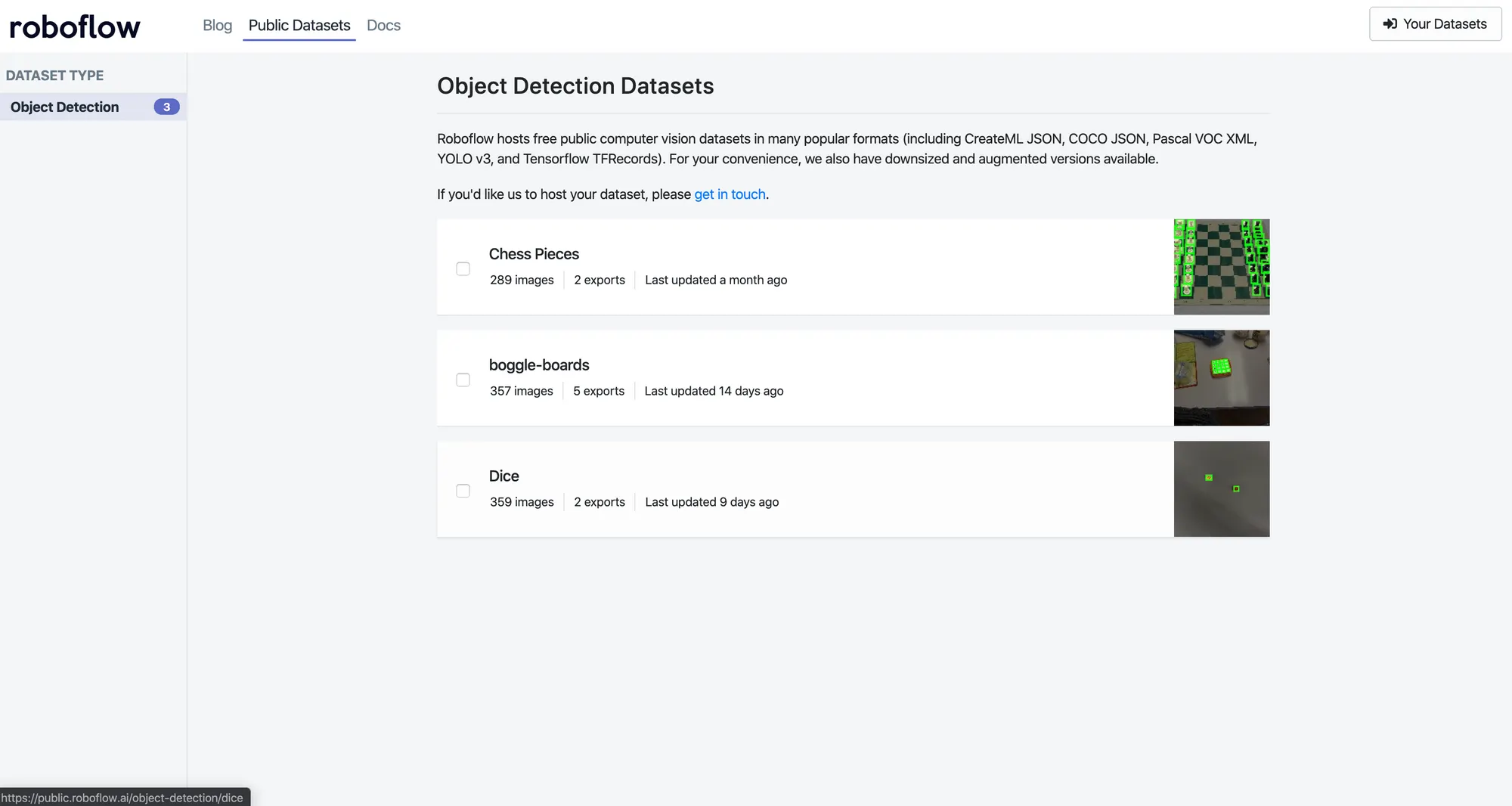
One of the most painstaking components of getting started with computer vision is getting access to clean, labeled data. For example, when the Roboflow team built BoardBoss (opens in a new tab), we painstakingly collected hundreds of Boggle board images (opens in a new tab) from various devices (iPhone 7, iPhone X, iPhone 11…) and then labeled each individual letter tile (at least 16 per image!). Many lessons of that problem are now Roboflow features.
Now, you may not be building a Boggle solver app (opens in a new tab) as we were. But you may be simply looking for a place to start. And an object detection (opens in a new tab) problem like Boggle is reminiscent of an object detection version of MNIST (opens in a new tab).
So, we’re releasing our Boggle images (opens in a new tab) — all 357 images and 7110 labels across those images — under public license. Free to use, but we welcome attribution! 😉
Welcome to public.roboflow.com
In fact, we’re releasing many datasets, and we encourage you to do the same, when applicable.
Roboflow Public Datasets (opens in a new tab) is a space for anyone to find and share datasets for computer vision (opens in a new tab). Each dataset includes details about its contents (like how many images and when was it uploaded), the license for reuse, and any Roboflow exports the original author published with the dataset. You can freely download images and annotations in any format: VOC XML, COCO JSON, YOLOv3 flat text files, even TFRecords.

License permitting, anyone is free to fork a given dataset to their own account and apply different preprocessing/augmentation techniques. If you have a dataset you’d like to share with the public, let us know (opens in a new tab).
We’ll be adding our own datasets and datasets from the community across a wide array of domains: animals (opens in a new tab), board games (opens in a new tab), self driving cars (opens in a new tab), medicine (opens in a new tab), thermal imagery, aerial drone images (opens in a new tab), and even synthetically generated data (opens in a new tab). If you’d like to be aware of these, subscribe to our newsletter.