Computer Vision API Pricing: What You Can Do Free, and What It Costs as You Scale
 Lake Giffen-HunterPublished Nov 22, 2026
Typically computer vision API pricing pages answer one question: what does a single call cost? That matters, but it isn't the full picture most teams need to know when they decide whether a project is affordable. You want to know what you can test for free, what the first few months will cost, and whether the bill stays reasonable once a model runs on every camera.
Now that all plans have access to private projects and data for free, it is easier than ever for businesses to get started with Roboflow. This guide walks through the computer vision cost of a Roboflow project at three stages: free, getting started, and at scale. Every number comes from Roboflow's published credit rates, and we show the math so you can redo it for your own volumes.
For the story behind the September 2026 pricing changes, read the launch post, Making It Easier & Cheaper to Deploy with Roboflow. This post is the practical follow-up: what those changes mean in dollars as you test and pilot, and when it's time to bring in Enterprise support.
All examples use RF-DETR Nano, Roboflow's real-time vision model. On the Serverless API it costs 0.125 credits per 1,000 images.
What you get for $0 on Roboflow's free plan
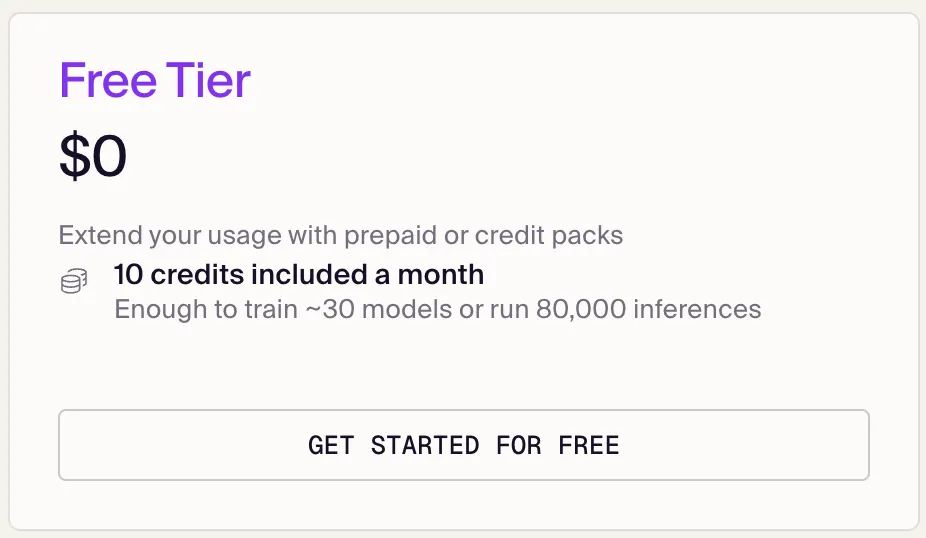
Roboflow's Core plan now starts with a Free Tier. It costs $0, needs no credit card, and includes 10 credits that refresh every month. Credits are how Roboflow meters usage: storing and labeling images, training models, and running models on Roboflow Cloud each use credits at a published rate.
The Free Tier isn't a trial. It includes:
- 10 credits a month, which reset each month and don't roll over
- Private projects, so your datasets and models aren't published to Roboflow Universe unless you choose to share them
- Unlimited admin seats, so your whole team can work in one workspace
- Model training, model evaluation, and neural architecture search
- The Serverless API, Workflows, and Vision Events
- Model weights download for supported models, through the Roboflow Inference package, the Roboflow Python SDK, or the Roboflow MCP server (downloading directly in the app is an Enterprise feature)
- Self-hosted inference with the open-source Roboflow Inference (opens in a new tab) package, for testing, research, and getting started, with no per-image credit charge
- Up to 20 projects
The free computer vision tools are all you need for an initial POC. You can upload your own images, train a custom model, and call it from your application without entering payment details.
Real examples of what you can do with the 10 free credits
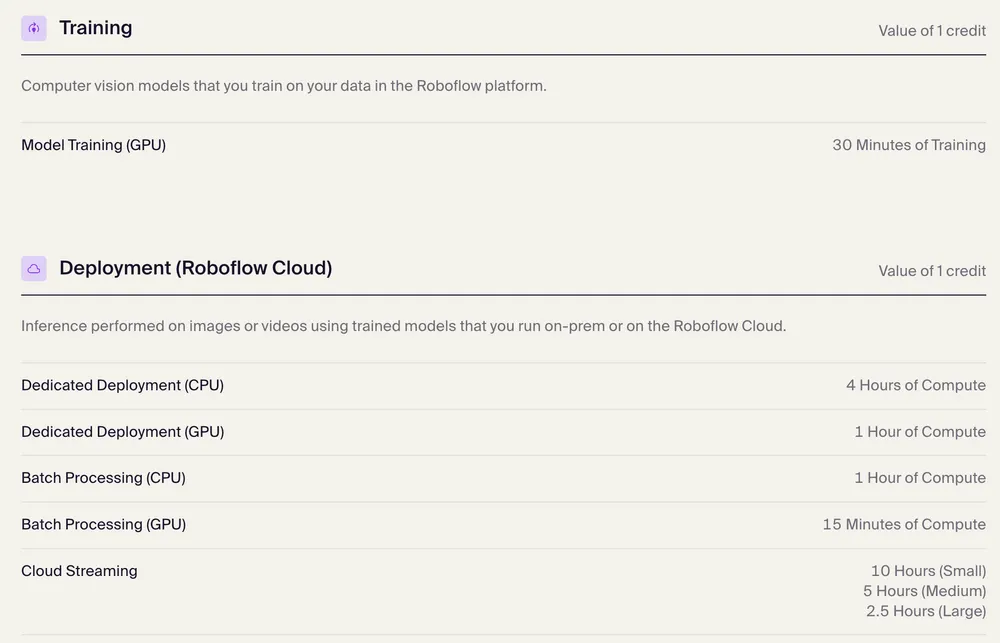
Ten credits is easier to picture as work. Here's what 10 credits buy at Roboflow's published rates if you spend all of them on one activity:
| Activity | Rate | What 10 credits buy |
|---|---|---|
| Serverless inference, RF-DETR Nano | 0.125 credits per 1,000 images | 80,000 images |
| Model training (GPU) | 1 credit per 30 minutes | 5 GPU hours (Roboflow estimates ~30 training runs) |
| Image storage | 1 credit per 5,000 images per month | 50,000 images stored for a month |
| Image uploads | 1 credit per 10,000 images | 100,000 images uploaded |
| Auto Label | 1 credit per 1,000 images | 10,000 images labeled |
| Interactive AI labeling | 1 credit per 100 images | 1,000 images labeled |
| Dataset versions | 1 credit per 20,000 images created | 200,000 version images |
The inference math is simple: 10 credits ÷ 0.125 credits per 1,000 images = 80 × 1,000 = 80,000 images.
A realistic first month
Real projects mix these activities. Say a team wants to detect damaged boxes on a conveyor and starts with 1,000 images. A first month might look like this, using the rates on Roboflow's credits page:
| Step | Math | Credits |
|---|---|---|
| Upload 1,000 images | 1,000 ÷ 10,000 | 0.10 |
| Store them for the month | 1,000 ÷ 5,000 | 0.20 |
| Auto Label all 1,000 | 1,000 ÷ 1,000 | 1.00 |
| Create a dataset version with augmentations (~3,000 images) | 3,000 ÷ 20,000 | 0.15 |
| Train RF-DETR Nano twice, ~1 GPU hour each | 2 hours × 2 credits per hour | 4.00 |
| Test on 20,000 images via the Serverless API | 20,000 × 0.125 ÷ 1,000 | 2.50 |
| Total | 7.95 of 10 |
That leaves about 2 credits of headroom, and the 10 credits reset next month. If you run your test images on your own machine with Roboflow Inference instead of the Serverless API, the 2.5 inference credits drop to zero.
Can I use the free plan commercially, and are my projects private?
These are the two questions we hear most from teams evaluating the Free Tier, so here are direct answers.
Commercial use
Yes. Every Roboflow cloud-hosted model comes with a commercial license on every plan, including the Free Tier. If your application calls RF-DETR, YOLO26, or any another model through the Serverless API, you can use it in a commercial product.
Self-hosting is where licenses differ by model:
- RF-DETR Nano through Large, and RF-DETR Seg, are Apache 2.0. You can run them commercially anywhere, including on your own hardware, with no license fee.
- YOLO models (such as YOLO26, YOLO11, and YOLOv8) and RF-DETR Atto, Femto, Pico, XL, and 2XL need Roboflow's Enterprise add-on for commercial self-hosted use.
For the details, see RF-DETR Is Free to Use Commercially and Roboflow's model licensing page.
Private projects
Yes. Every Core workspace, including the Free Tier, keeps projects private: your datasets and models aren't published to Roboflow Universe unless you choose to share them.
Private projects aren't the same as contractual commitments. If your organization needs organizational controls and contractual commitments, such as a custom MSA or DPA, a security review (opens in a new tab), an uptime SLA, data residency in the US or EU, or a HIPAA BAA, those require an Enterprise license.
When you outgrow free: credit packs
When 10 credits a month isn't enough, you can add a monthly credit pack. Each pack's total already includes your 10 free credits. Credits have a baseline price of $4, and packs cost less per credit: the bigger the pack, the lower the price per credit.
| Monthly price | Total credits | Price per added credit | RF-DETR Nano cost per 1,000 images |
|---|---|---|---|
| $39 | 20 | $3.90 | $0.49 |
| $89 | 35 | $3.56 | $0.45 |
| $139 | 50 | $3.48 | $0.43 |
| $229 | 80 | $3.27 | $0.41 |
| $349 | 120 | $3.17 | $0.40 |
| $589 | 200 | $3.10 | $0.39 |
| $999 | 350 | $2.94 | $0.37 |
| $1,399 | 500 | $2.86 | $0.36 |
The last column is 0.125 credits × the price per credit. At the $39 pack, that's 0.125 × $3.90 = about $0.49 per 1,000 images, or about $0.0005 per image. That's the computer vision cost per image at standard rates, before the per-image volume discounts covered in the next section.
The $39 pack is the usual next step after a successful free test. Its 20 credits cover 160,000 RF-DETR Nano images a month, or a mix of retraining and a small pilot. Two other credit options exist:
- Prepaid credits are for one-off spikes, like a big labeling month. They start at $4 per credit and expire a year after purchase.
- Flex credits keep your workloads running if a paid pack runs out mid-month. They cost $6 per credit and have a default cap of $100 a month that you can change in your Plan & Billing settings page. The Free Tier doesn't include flex credits: when you run out, features that use credits pause until your credits reset or you buy prepaid credits.
See the pricing page for current prices and Pricing & Billing in the docs (opens in a new tab) for how credits are used.
At scale: per-image API pricing and volume discounts
Serverless API pricing is per image. Each model has a fixed credit rate per 1,000 images, whatever the image size and however long inference takes, so a forecast is images × rate.
Above 250,000 images a month, per-image volume discounts apply on the Free and Core plans. They're separate from credit pack pricing. Bands count all images in your workspace for the calendar month, and each rate applies only to the images inside its band, like tax brackets. Here are the bands for RF-DETR Nano, from the Serverless API model pricing docs (opens in a new tab):
| Images this month | Discount | RF-DETR Nano credits per 1,000 images |
|---|---|---|
| First 250,000 | Standard | 0.125 |
| 250,000 to 500,000 | 25% off | 0.0938 |
| 500,000 to 1M | 50% off | 0.0625 |
| 1M to 2M | 60% off | 0.05 |
| 2M to 5M | 70% off | 0.0375 |
| Over 5M | 80% off | 0.025 |
Here's what that means for monthly RF-DETR Nano model inference credits on a self-serve plan. The Credits column applies the per-image bands above, and the pack column shows the smallest monthly credit pack that covers those credits:
| Images per month | Credit math | Credits | Smallest pack that covers it | All-in cost per 1,000 images |
|---|---|---|---|---|
| 100,000 | 100K × 0.125 | 12.5 | $39/m (20 credits) | $0.39 |
| 1,000,000 | 31.25 + 23.44 + 31.25 | 85.9 | $349/m (120 credits) | $0.35 |
| 2,592,000 (one camera, 1 frame per second, 30 days) | 135.94 + 22.20 | 158.1 | $589/m (200 credits) | $0.23 |
| 5,000,000 | 135.94 + 112.50 | 248.4 | $999/m (350 credits) | $0.20 |
| 10,000,000 | 248.44 + 125.00 | 373.4 | $1,399/m (500 credits) | $0.14 |
Two separate savings show up in this table: per-image volume discounts lower the credits you use, and bigger packs lower the price of each credit. "All-in" means the full pack price divided by the images processed, so it's conservative. The credits left in each pack go to training, storage, and labeling. Past the largest pack, or once you're rolling out across sites, Enterprise adds contracted volume pricing alongside edge deployment, support, and compliance.
If you're weighing this against running your own GPU instances on GCP, AWS, or Azure, our serverless GPU inference cost comparison benchmarks Roboflow Serverless against each of them.
Running on your own hardware: basic self-hosted inference and Enterprise edge
On every plan, basic self-hosted inference with the open-source Roboflow Inference package has no per-image or per-frame credit charge. You run models and Workflows on your own hardware, such as a Jetson, a Raspberry Pi, or a GPU server. Basic self-hosting is for testing, research, and getting started. Serious commercial edge deployments, like a model running on a production line, generally need an Enterprise contract: talk to sales.
Most edge deployment features require a Roboflow Enterprise license. These edge features are Enterprise-only:
- Deployment Manager, to control model versions across your edge devices, with remote fleet management and live camera views
- Secure Gateway, plus offline mode in Inference containers and air-gapped deployment
- Industrial integrations: MQTT, OPC, and PLC triggers, and industrial camera frame-grabbers
- Operational Insights (HMI)
- Managed hardware
- Kubernetes deployment advice, the Parallel HTTP API, and the Stream Management API
- TensorRT-optimized model packages for private models when you self-host
- Commercial self-hosting licenses for models that need them, such as YOLO26 and YOLO11
To add them, talk to our sales team or see Roboflow Enterprise for more information.
Licensing matters here too. RF-DETR Nano through Large are Apache 2.0, so they need no model license add-on for commercial self-hosting. All other models, such as RF-DETR XL, RF-DETR NAS and YOLO models like YOLO26, YOLO11, and YOLOv8, need the Enterprise add-on.
A simple rule: the Serverless API is the easiest choice for tests, pilots, and moderate volumes, or when you don't want to manage hardware. Basic self-hosting suits testing, research, and getting started on your own hardware, including high-frame-rate video. Once a model runs in commercial production on the edge, or you need fleet management or plant-floor integrations, plan for an Enterprise contract.
Conclusion
Computer vision API pricing doesn't have to be a guess. With per-image rates you can price the early stages before you run them: test on the Free Tier, then pilot a line for the cost of a $39 credit pack, with per-image volume discounts and cheaper-per-credit packs as your usage grows. When a pilot moves into production, even on one line, that's the time for an Enterprise conversation about edge fleet management, integrations, and support.
The best way to check the numbers for your own use case is to try it. Create a free Roboflow account, upload a few hundred of your own images, train RF-DETR Nano, and run your first test on the 10 free credits. No credit card is needed.
Have more questions? The Roboflow FAQ covers credits, data, and deployment. If you're still comparing providers, our guide to object detection APIs walks through the options. Ready to take a line to production, or planning a rollout across sites? Talk to sales about Enterprise.