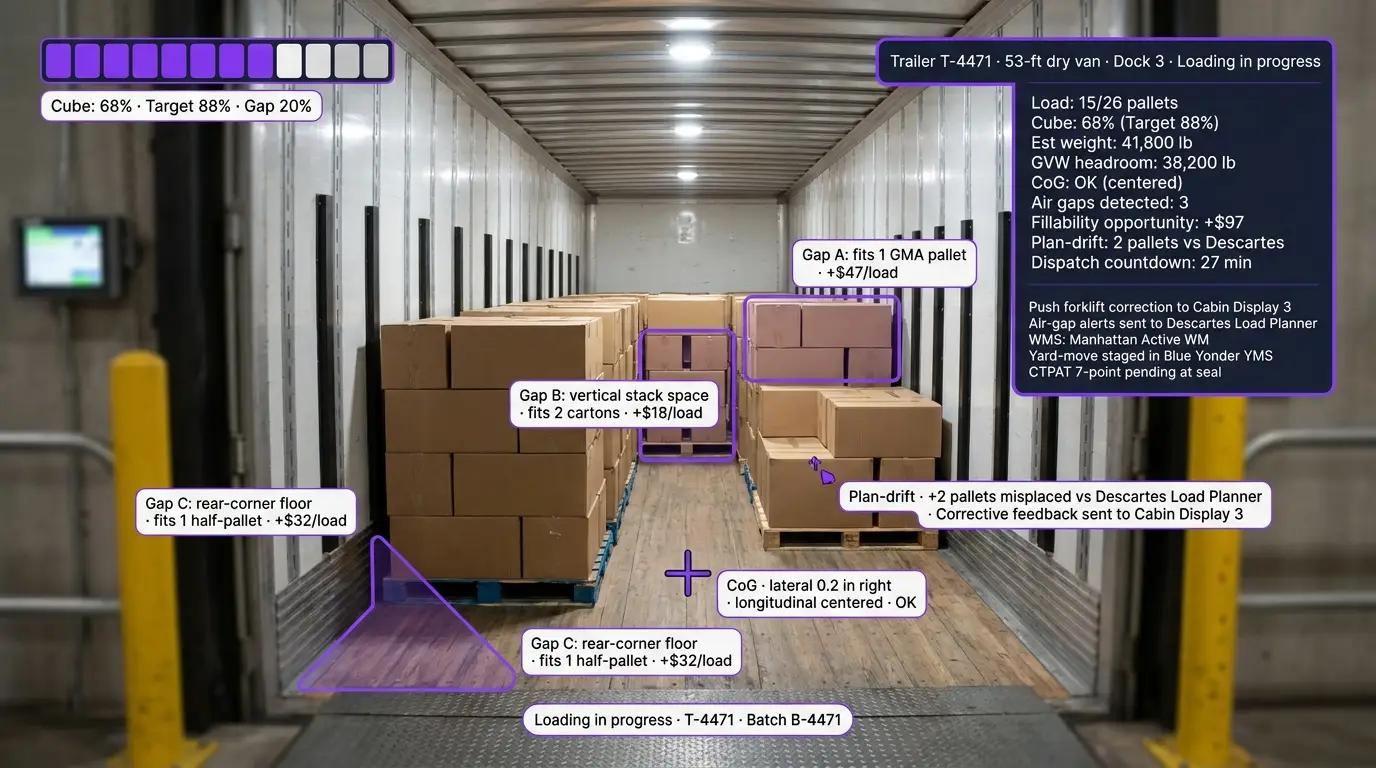
Add a real-time load-optimization layer to every trailer at every dock door with Vision AI for truck load optimization. Roboflow extends load-optimization coverage to every trailer at every dock door, on the dock-side cameras, in-trailer LED-lit stereo rigs, forklift-mounted cameras, gantry cameras, and drone-based aerial rigs your operations already run, validatable under FMCSA, DOT Bridge Formula, CVSA out-of-service criteria, state and federal axle weight limits, NIST Handbook 44, NMFTA NMFC, CTPAT 7-point trailer inspection, EU 96/53/EC, IMDG, IATA DGR, and 49 CFR hazmat regulations.
Real-Time Trailer Fill, Air-Gap Detection, and Cube Utilization:
- Visualize trailer fill in real time as loading progresses with an in-trailer LED-lit stereo-depth camera looking down the load from the roof-mounted position, computing cube utilization percentage against the trailer interior, and flagging cube-utilization gaps in real time so the load planner or dock supervisor can add more freight before the trailer seals
- Detect air gaps (empty pockets between pallets, unused vertical space above short pallets, gap behind the rear-most pallets before the door) at the individual pallet-position level, with the model classifying each air-gap region by fillability (can this specific gap accept another pallet or handful of cartons) and estimating the freight-cost savings of filling it before dispatch
- Track cube-out versus weight-out state for every trailer under load, distinguishing the trailers that hit the 80,000-pound gross vehicle weight limit before running out of cube (weight-out) from the trailers that fill the cube before hitting weight (cube-out), and routing which SKUs go on which trailer at cross-dock so the fleet mix optimizes total loaded weight and cube across the outbound schedule
Load Planning, Stacking, and Center-of-Gravity:
- Verify load stacking against the plan (right pallet in the right slot per the MaxLoad Pro, Cube-IQ, CargoWiz, or Descartes Load Planner output), catching misplaced pallets, wrong-orientation loads, and load-plan drift as the loading progresses, feeding corrections back to the forklift operator through the dock-side display before the mistake compounds
- Estimate load center-of-gravity in real time from the depth-map of the loaded freight, flagging trailers where the center of gravity is too high (rollover risk), too far forward (steering axle overload), too far rear (trailer sway on empty steering axle), or laterally off-center (uneven tire wear and lane-departure risk on rural curves)
- Model axle-weight distribution against the DOT Bridge Formula (W = 500 [((LN / (N-1)) + 12N + 36]) and state and federal axle-weight limits (typically 20,000 lb steer axle, 34,000 lb drive tandem, 34,000 lb trailer tandem, 80,000 lb gross for interstate operation), plus stricter state limits (California, Oregon, Michigan legal-load weight formulas differ), catching axle-weight violations before the trailer rolls onto the scale house and hits a CVSA out-of-service order under 49 CFR 393 or 49 CFR 396
WMS/TMS/YMS Integration, Compliance, and Freight-Billing:
- Integrate with WMS (Manhattan Active WM, Blue Yonder WMS, Softeon, SAP Extended Warehouse Management, Körber HighJump, Oracle WMS Cloud), TMS (Blue Yonder TMS, Manhattan TMS, Descartes MacroPoint and Aljex, project44, MercuryGate, Oracle Transportation Management), YMS (Blue Yonder YMS, C3 Solutions, Descartes yard-management), load-planning software (MaxLoad Pro from TOPS Software, Cube-IQ from MagicLogic, CargoWiz from Softtruck, Descartes Load Planner, Load Xpert from Cetus Corporation), dock-scheduling systems (Descartes Dock Scheduling, C3 Solutions, One Network), fleet telematics (Samsara, Motive formerly KeepTruckin, Geotab, Verizon Connect, Omnitracs), and ERP (SAP, Oracle, Microsoft Dynamics, Infor) via OPC UA, MQTT, REST, EDI (Electronic Data Interchange 204 motor carrier load tender, 210 motor carrier freight invoice, 214 transportation carrier shipment status, 990 response to load tender, 856 advance ship notice, 940 warehouse shipping order), and direct database writes
- Support FMCSA regulations, DOT Bridge Formula, CVSA out-of-service criteria (including load securement per 49 CFR 393.100 through 393.136), state and federal axle-weight limits, NIST Handbook 44 weight verification, NMFTA NMFC LTL freight-class calculation, CTPAT 7-point trailer inspection (front wall, left side, right side, floor, ceiling and roof, inside/outside doors, outside/undercarriage), C-TPAT trailer physical inspection, EU 96/53/EC max dimensions for European operations, UK Construction and Use Regulations, IMDG Code (International Maritime Dangerous Goods) for ocean container loading, IATA DGR (Dangerous Goods Regulations) for air freight, 49 CFR Parts 100-185 (US DOT Hazardous Materials Regulations, including HM-215K International Harmonization), and FMCSA Hours of Service optimization through load-plan efficiency
- Log every trailer-loading event with per-pallet confidence, image crop and depth map, computed cube utilization percentage, computed loaded weight, per-axle weight estimate, center-of-gravity coordinates, air-gap fillability estimates, load-securement observations, CTPAT 7-point inspection results, hazmat placard verification, timestamp, dock door ID, trailer license-plate barcode, tractor unit ID, driver ID, and load-plan version for FMCSA CSA (Compliance, Safety, Accountability) records, CVSA roadside inspection prep, freight-billing dispute reconciliation, cargo claim defense, on-time-in-full (OTIF) scorecard evidence for Walmart-class and Amazon-class retail chargebacks, and MES/WMS/TMS/YMS/telematics integration
Bring intelligence to every trailer today. Stop under-loaded cube, overweight axles, and shifted loads from becoming freight-cost hits, CVSA out-of-service orders, cargo claims, or retail-scorecard OTIF failures.
More About Truck Load Optimization
What is truck load optimization with Vision AI?
Truck load optimization with Vision AI uses cameras inside trailers and around the dock to show trailer fill in real time as loading happens, calculate how much of the trailer is being used, spot air gaps between pallets, check loading against the plan, and estimate weight distribution across axles. It connects to your WMS, TMS, YMS, load-planning software, and fleet telematics through standard integrations. Shippers use it to lift trailer cube utilization by 5-10%, cut deadhead miles, avoid CVSA out-of-service orders, reduce cargo-claim damage, and protect OTIF scores at Walmart-class and Amazon-class inbound.
Can Vision AI show trailer fill, catch air gaps, and model axle weights in real time?
Yes. Dedicated trailer-scanning systems measure the cube after the load is sealed, and standalone load-planning software (MaxLoad Pro, Cube-IQ, CargoWiz, Descartes Load Planner) plans before loading starts, but neither closes the loop during loading. Roboflow checks the trailer view every 10-30 seconds while loading is in progress, shows running cube utilization and open pallet-position air gaps, verifies the load against the plan, and feeds actionable guidance to the forklift operator on a dock-side display before the mistake compounds. For axle weight, Roboflow combines the in-trailer depth-map with per-pallet weights from the WMS to estimate axle loads and flag trailers approaching state or federal limits before they leave the yard.
Does truck load optimization support FMCSA, DOT Bridge Formula, CVSA, CTPAT, and 49 CFR hazmat?
Yes. Roboflow supports fleet, DC, and cross-dock operations under FMCSA regulations, the DOT Bridge Formula, CVSA roadside inspection standards and out-of-service criteria, state and federal axle-weight limits, NIST Handbook 44, NMFTA NMFC, CTPAT 7-point trailer inspection, IMDG, IATA DGR, 49 CFR hazmat, ISO 9001, IATF 16949, and AS9100. Every loading event is logged with the depth-map, cube utilization, estimated per-axle weight, air-gap notes, CTPAT results, hazmat placard verification, and load-plan version, ready for FMCSA CSA audits, CVSA inspection prep, cargo-claim defense, and retail OTIF scorecard evidence.
Can it integrate with our WMS, TMS, YMS, load-planning software, and telematics?
Yes. Roboflow Inference (opens in a new tab) exposes a standard API that connects to WMS (Manhattan, Blue Yonder, Softeon, SAP EWM, Körber, Oracle), TMS (Blue Yonder, Manhattan, Descartes, project44, Oracle OTM), YMS (Blue Yonder, C3 Solutions, Descartes), load planners (MaxLoad Pro, Cube-IQ, CargoWiz, Descartes Load Planner), fleet telematics (Samsara, Motive, Geotab, Verizon Connect, Omnitracs), and ERP (SAP, Oracle) through OPC UA, MQTT, REST, EDI (204, 210, 214, 856, 940, 945), and direct database writes. Deployments run on-prem, on the edge next to the dock door, in a VPC, or air-gapped, with real-time drift alerts to the forklift operator display and axle-weight risk flags before dispatch.