Track Buckle Defect Detection AI
Find sun kinks, alignment deviations, and the ballast and anchor gaps that let continuous welded rail buckle.
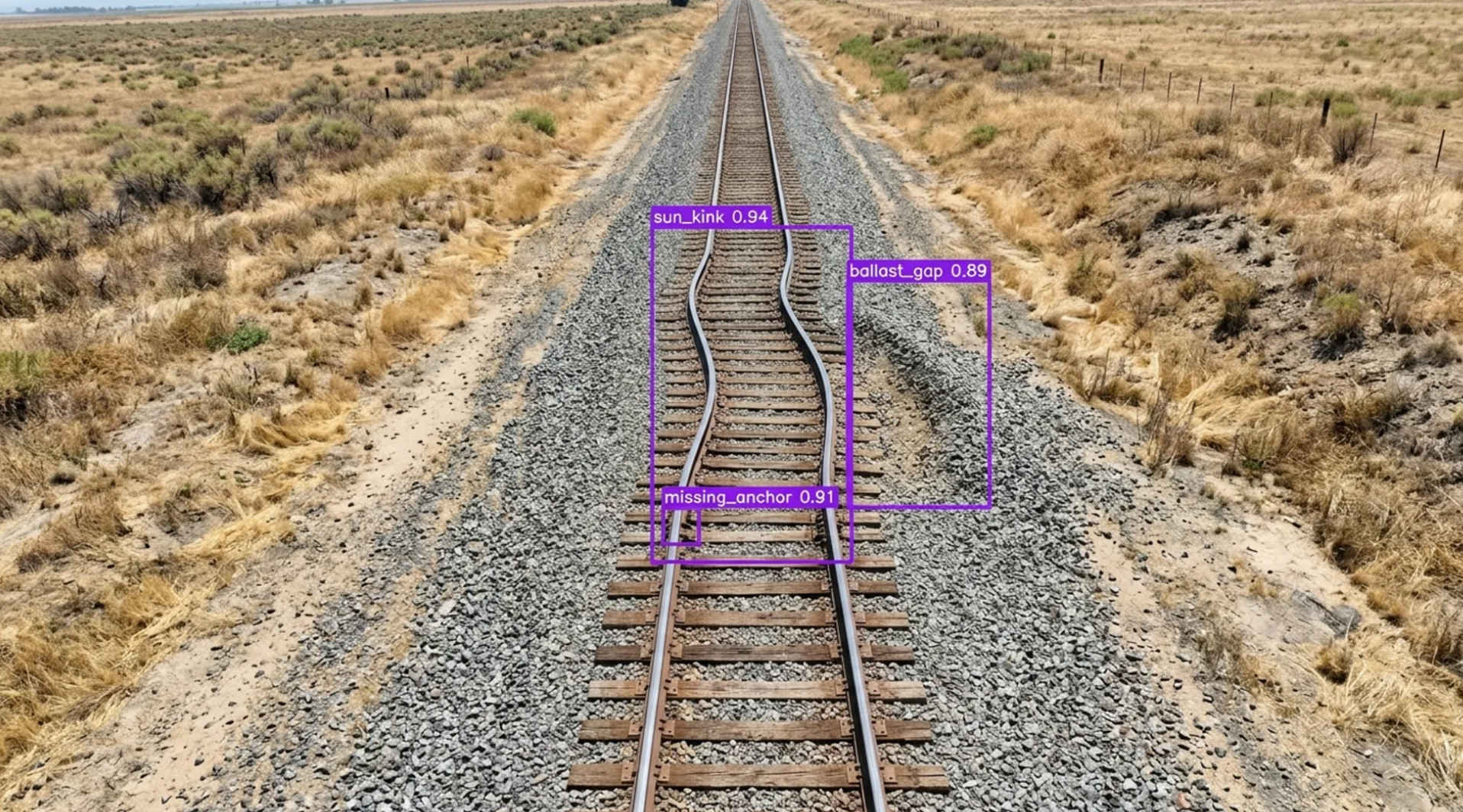
Track Buckle Detection AI for the Toughest Curves, Bridges, and Hot-Weather Territory
Deploy Anywhere, Run Everywhere
Run buckle checks on drone, hi-rail, and wayside camera imagery on the edge, on-prem, in your VPC, or via API.
One Platform, Full Adoption
Tools every track and engineering team can adopt, from track inspectors to roadmasters and bridge engineers, no separate ML team required.
Secure, Compliant, and Audit-Ready
Data stays safe with SOC 2 Type II compliance, encrypted data, HIPAA compliance, and an uptime SLA.
- Sun Kink & Alignment Detection
- Ballast Shoulder & Crib Checks
- Rail Anchor Inspection
- Tie-End Void Detection
- Disturbed Track Follow-Up
- Heat Patrol Prioritization
“Roboflow has been instrumental in accelerating our deployment of innovative AI solutions.”
Travis Turnbull
Vice President & CIO, Pella Corporation
Talk to a Vision AI engineer who's shipped in rail.
Bring us your toughest track inspection problem and we'll map a working solution.
Ask us about:
- Solution architecture that fits your CWR plan, inspection program, and track data systems
- A live demo on your own drone, hi-rail, or wayside imagery
- Deployment options: edge, on-prem, air-gapped, VPC, or on the hi-rail vehicles and drones your team already runs
- ROI modeling against slow orders, patrol hours, emergency repairs, and derailment risk
Over 16,000 organizations build with Roboflow.
- Rivian
- Pella
- Chobani
- USG Corporation
- BNSF Railway
- American Woodmark
Vision AI is transforming businesses
Customers across the board are solving complex challenges and driving meaningful impact.
- Automotive customer
$10 million
Saved by automatically detecting defects on the production line
- Logistics & freight company
90%
Less time spent manually tracking shipping inventory
- Building materials supplier
60%
Lower customer return rate with improved product quality
Catch Buckle-Prone Track Before the Heat Does
Add a buckle-prevention layer to every mile of continuous welded rail with Roboflow vision AI. Track buckles typically come from high compressive force in the rail, weakened track, and train loads acting together, and they usually start at small alignment deviations. Roboflow finds those deviations and the ballast and anchor conditions behind them, alongside railway track inspection for rail surface defects, ties, and fasteners.
Alignment and sun kink detection:
- Flag the S-shaped kinks that form on tangent track and the C-shaped kinks that form in curves, in forward-facing hi-rail or drone footage.
- Tag each detection with a location from drone or hi-rail GPS data, so crews go straight to the milepost.
- Prioritize bridges, grade crossings, and turnouts, where anchoring and ballast matter most for lateral strength.
Ballast, anchor, and tie checks for lateral resistance:
- Segment the ballast shoulder and cribs to flag thin or missing ballast beside and between the ties.
- Detect missing or displaced rail anchors and check each section against your anchoring pattern.
- Spot voids at tie ends and fouled, mud-covered ballast, early signs that the track is shifting sideways.
Disturbed track and hot-weather follow-up:
- Confirm ballast is restored after tamping, surfacing, tie renewal, or rail repair, the recently disturbed track your CWR plan calls out.
- Rank segments for heat patrols and slow orders, and send alerts to the roadmaster when a high-risk location turns up.
- Keep a timestamped image record of each condition and its repair for inspection and maintenance records.
Bring intelligence to every mile of continuous welded rail today.
Frequently asked questions
What causes a track buckle?
Continuous welded rail builds compressive force as it heats. A buckle forms when that force combines with weakened track, such as missing ballast, loose anchors, or recently disturbed track, and with the loads of passing trains. Buckles usually start at small alignment deviations, and the rail neutral temperature, the temperature at which the rail is neither in compression nor tension, tends to drift lower over time with maintenance and rail movement.
Which cameras and platforms work for track buckle detection?
Drone imagery, forward-facing cameras on hi-rail vehicles, and fixed wayside cameras at bridges, crossings, and curves all work. Run models on an NVIDIA Jetson on the vehicle or in the cloud, and send detections, locations, and images to your track data systems over REST or MQTT.
How does this fit our CWR plan?
FRA rules under 49 CFR 213.119 require every CWR plan to include inspection procedures that identify buckling-prone conditions and say when inspections happen and what remedial action follows. Roboflow gives your inspectors a consistent, image-backed list of those conditions by location, so they spend their time on the segments that need it.
Roboflow serves as the vision engine, and your track and engineering teams own the CWR plan, inspection procedures, slow orders, and repair decisions.
How do we get started?
Start with the inspection footage you already have. Label examples of kinks, ballast gaps, missing anchors, and tie-end voids, train a model, or start from one of the computer vision models available today, then deploy it to your drones, hi-rail vehicles, or wayside cameras ahead of the hot season.