Visual Intelligence Summit: Oct 22 in San Francisco Get your ticket

Railway Track Inspection AI

Inspect every foot of track from the cameras on your hi-rail trucks and maintenance-of-way machines, catching rail surface defects, missing spikes and clips, failing ties, and vegetation encroachment at track speed, with records that map to FRA Part 213.
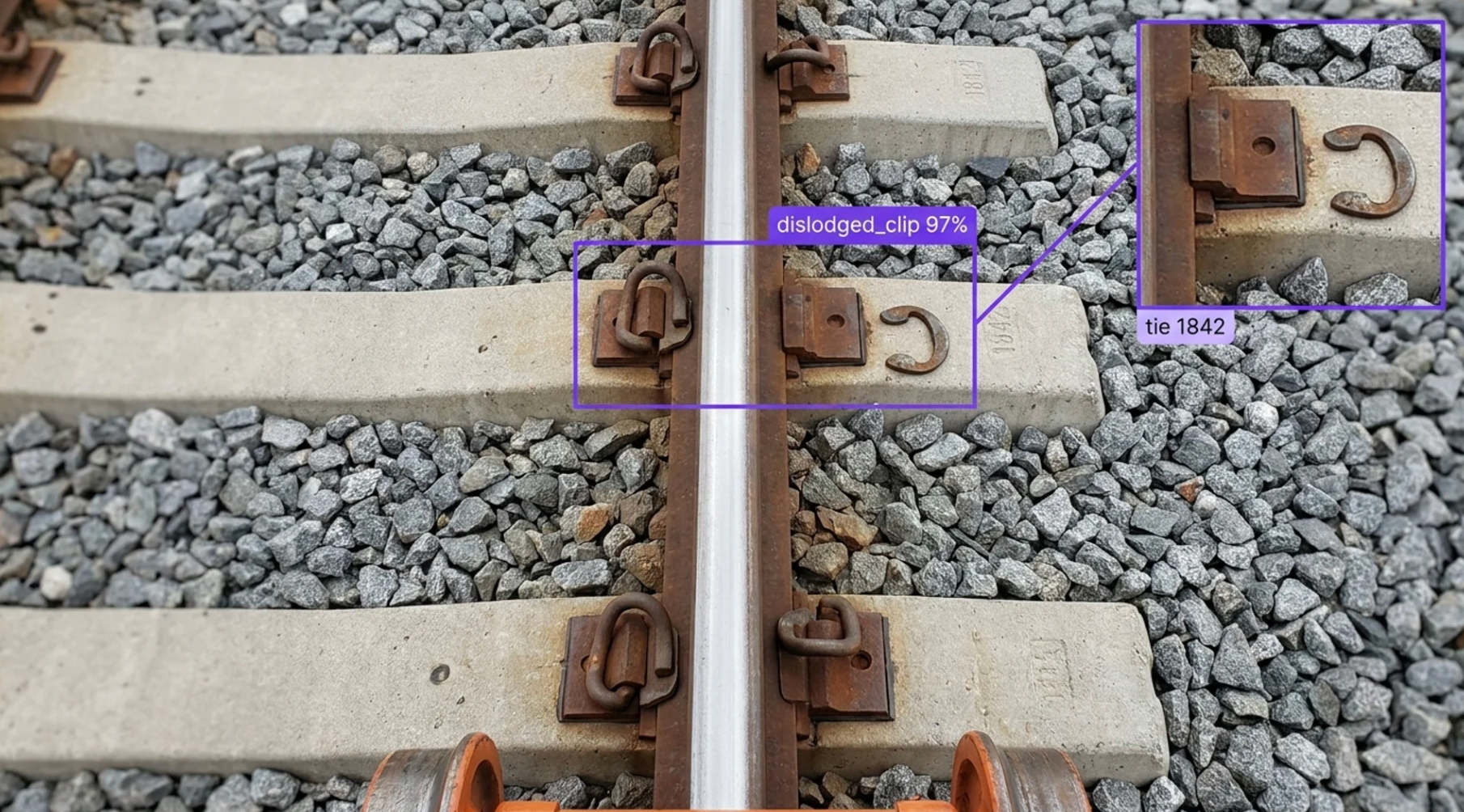
Railway Track Inspection AI Across Rail, Fasteners, Ties, and Maintenance Machines

  • Deploy Anywhere, Run Everywhere

    Run railway track inspection on hi-rail truck cameras, spike pullers and tie inserters, tampers and ballast regulators, geometry cars, yard gantries, drones, the edge, on-prem, in your VPC, or via API.

  • One Platform, Full Adoption

    Tools every railroad and MoW team can adopt, from track supervisors and roadmasters to MoW equipment engineers, no separate ML team required to ship and own inspection models.

  • Secure, Compliant, and Audit-Ready

    Data stays safe with SOC 2 Type II compliance, encrypted data, HIPAA compliance, and an uptime SLA, with inspection records that support FRA Track Safety Standards (49 CFR Part 213).

  • Rail Surface Defects & Head Checks
  • Missing & Loose Spikes and Clips
  • Tie & Sleeper Condition
  • Ballast, Mud Spots & Joint Bars
  • Spike Extraction & Insertion Confirmation
  • Vegetation Encroachment & Yard Checks
“Achieving positive results using AI in a lab environment is easy, but the real challenge comes when scaling the solution across a network like ours without disrupting day-to-day operations. Our partnership with Roboflow is allowing us to do just that.”

Asim Ghanchi

AVP of Technology, BNSF

Talk to a Vision AI engineer who's shipped in rail.

Bring us your toughest railway track inspection problem and we'll map a working solution.

Ask us about:

  • Solution architecture for FRA 49 CFR Part 213 track inspection records, Part 215 freight car inspection, AREMA practices, and APTA transit standards
  • A live demo on your hi-rail, MoW machine, or yard camera footage, including a camera and lighting scoping guide for your equipment
  • Deployment options: edge on hi-rail and MoW machines, on-prem at the yard, air-gapped, drone, VPC
  • ROI modeling against slow orders, track time, MoW rework, FRA defect exposure, yard dwell, and derailment cost

Over 16,000 organizations build with Roboflow.

  • Rivian
  • Pella
  • Chobani
  • USG Corporation
  • BNSF Railway
  • American Woodmark
Start where you are

Vision AI is transforming businesses

Customers across the board are solving complex challenges and driving meaningful impact.

  • Automotive customer

    $10 million

    Saved by automatically detecting defects on the production line

  • Logistics & freight company

    90%

    Less time spent manually tracking shipping inventory

  • Building materials supplier

    60%

    Lower customer return rate with improved product quality

Bring Vision AI to Every Mile of Track, from Rail Surface to Right-of-Way

Bring real-time intelligence to every mile of track and every MoW pass with Roboflow vision AI for railway track inspection.

Track components at track speed:

  • Detect rail surface defects including head checks, shelling, squats, corrugation, and running surface cracks from downward-facing cameras on hi-rail trucks and inspection vehicles
  • Find missing, loose, raised, and broken spikes, e-clips, and Pandrol clips, and count fastener state per tie so a section with a pattern of missing fasteners gets flagged, not just the single worst tie
  • Grade tie and sleeper condition (plate cutting, splitting, decay, skewed ties) and spot ballast problems such as mud spots, fouling, and low shoulders, plus cracked or missing joint bars and bolts

Maintenance-of-way machine confirmation:

  • Confirm spike extraction and insertion state on spike pullers, spike drivers, and tie inserters in real time, so the machine and the operator know each spike came out or went in before the gang moves on
  • Verify anchor, clip, and plate placement after tie replacement and surfacing, with per-tie images retained as the work record for the roadmaster
  • Add depth or stereo capture where a flat image is not enough, for example confirming a spike is fully seated versus proud, and scope the camera, lens, lighting, and mounting for the machine and the speed it runs at

Right-of-way, yard, and railcar checks:

  • Detect vegetation encroachment on the track structure and in signal and crossing sight lines from hi-rail or drone passes, and prioritize spray and cutting crews by segment
  • Run daily yard checks on Class I terminals from fixed gantries and portals: car ID and reporting mark OCR, open doors and hatches, leaning loads, and cars in the wrong track
  • Extend the same platform to railcar and wheel inspection, from broken and thin-flange wheels to missing brake components, under FRA Part 215

Bring intelligence to every mile of track today.

‍

Frequently asked questions

What is railway track inspection with Vision AI?

Railway track inspection with Vision AI uses cameras mounted on hi-rail trucks, maintenance-of-way machines, inspection vehicles, drones, and yard gantries to detect and classify track and right-of-way conditions automatically: rail surface defects, missing or loose spikes and clips, tie and sleeper condition, ballast and drainage problems, joint bar cracks, vegetation encroachment, and the state of MoW work such as spike extraction and insertion. Models train on your own track footage, so they learn your fastener types, tie materials, and lighting, and results are geotagged to milepost and track so track supervisors can act on them. It adds a continuous inspection layer alongside the walking and hi-rail inspections your program already runs, with records that map to FRA 49 CFR Part 213 and AREMA practices.

Can Vision AI confirm a spike is fully extracted or seated on a moving MoW machine?

Yes. Vision AI handles the detection part with object detection and keypoint models, trained on images from the machine's own camera position, classifying each spike as absent, extracted, partially extracted, seated, or proud.

Does railway track inspection with Vision AI support FRA Part 213 and AREMA?

Yes. FRA Track Safety Standards (49 CFR Part 213, covering track classes, roadbed, track geometry, track structure including ties, rail, fasteners, and joints, and inspection frequency and recordkeeping) and AREMA (the American Railway Engineering and Maintenance-of-Way Association manual of recommended practices for track design and maintenance) define what counts as a defect and how often track must be inspected; FRA 49 CFR Part 215 covers freight car safety standards for railcar checks, and APTA standards cover transit rail. R

Can it integrate with our track asset management, MoW machine controls, and yard systems?

Yes. Roboflow Workflows delivers results over REST APIs, MQTT, OPC UA, or direct database writes into the systems railroads already run: enterprise asset management and track inspection platforms such as SAP, IBM Maximo, Bentley, and Trimble rail products, GIS and linear asset systems keyed to milepost and track ID, and the MoW machine's own PLC or controller where a spike state result should stop the cycle or alert the operator. For yards, results join yard management and car location systems so a car ID read, an open door, or a leaning load becomes a work item on the right track. Models run on edge hardware on the truck or machine, on a server at the yard, or in your VPC, and inspection images are retained per location so an FRA defect record has the picture behind it.

‍

Stay connected

Get the Latest in Computer Vision First

Unsubscribe at any time. Review our Privacy Policy.