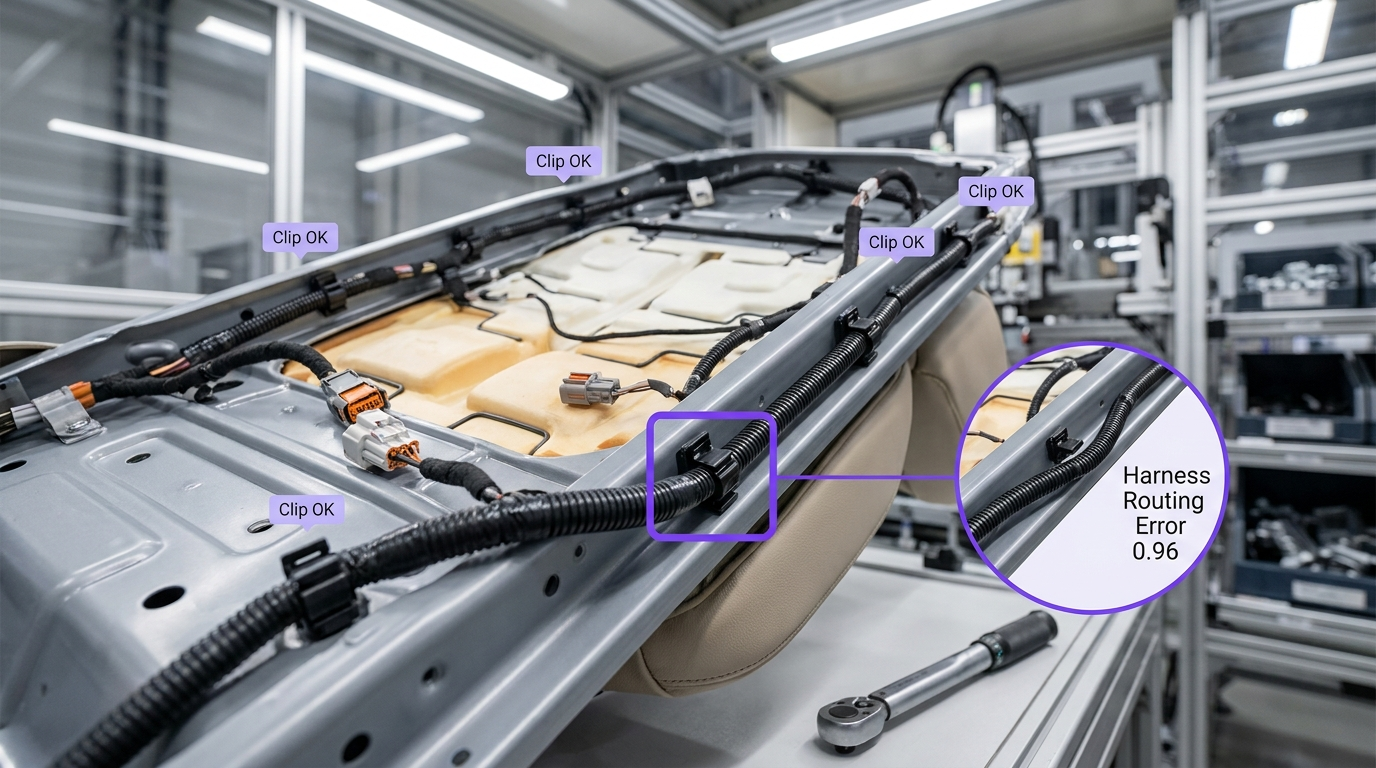
Add a real-time inspection layer to every seat on the assembly line with Vision AI for seat assembly inspection. Built for the operations where one misrouted harness, missing seatbelt anchor bolt, mis-aligned foam, or skipped stitch on a leather seat can mean a warranty claim from the field, a customer rejection at OEM receiving, an OEM chargeback, or a FMVSS recall on a deployed vehicle program. Whether you're building front seats, rear bench seats, premium massage-and-ventilation seats, or specialty configurations across multiple trim variants and OEM programs, Roboflow extends your QC coverage to every seat on the line.
Component Presence and Assembly Verification:
- Verify every required motor, sensor, airbag module, seatbelt anchor, ISOFIX anchor, and adjustment mechanism is present and correctly installed
- Catch missing fasteners, mis-torqued bolts (visual torque-witness indicators), and unseated connectors on every seat
- Validate recliner mechanisms, slide tracks, lumbar supports, and memory adjustment hardware before downstream assembly
Wire Harness Routing and Electrical Verification:
- Verify wire harness routing path, clip locations, and color-coded connector seating across complex seat electrical systems
- Inspect heating element, ventilation, massage, lighting, and occupancy detection wiring against build drawings
- Catch routing errors, missed clips, and pinch-point violations that cause field electrical failures months after delivery
Trim, Stitching, and Cosmetic Inspection:
- Inspect stitching defects (skipped stitches, broken thread, loose ends, wrong thread color, pattern deviations) on every seat
- Verify trim cover fit, foam alignment, wrinkles, puckering, and cosmetic finish across leather, vinyl, and fabric variants
- Catch surface defects (scratches, stains, color drift, marks) on premium materials before the seat ships to the OEM
Bring intelligence to every seat today. Stop assembly errors from becoming warranty claims, OEM chargebacks, or FMVSS recalls.
Frequently asked questions
What is seat assembly inspection with Vision AI?
Seat assembly inspection with Vision AI uses computer vision models to inspect automotive seats at every stage of assembly, from frame and foam build through trim covering, stitching, wire harness routing, motor and mechanism installation, and final QC. The system extends QC coverage to every seat on the line, catching missing components (motors, sensors, airbag modules, seatbelt anchors, ISOFIX hardware), mis-routed wire harnesses, unseated connectors, stitching defects on leather and fabric, trim wrinkles, foam misalignment, and surface defects on premium materials across multi-variant seat programs and OEM-specific configurations.
Can Vision AI inspect complex wire harness routing across multi-variant seat programs?
Yes. Wire harness routing inspection is one of the hardest tasks in automotive seat manufacturing and exactly where deep learning extends what rule-based vision systems can do. A modern automotive seat contains 50 to 200 feet of wiring serving heating, ventilation, massage, power adjustment, memory, lumbar support, occupancy detection, airbag deployment, lighting, and infotainment integration, with color-coded connectors that must seat in specific positions and harness routes that must follow specific clip locations to avoid pinch points and EMI interference. A misrouted harness can pass visual sampling at end-of-line and only surface as a field electrical failure six months into vehicle ownership.
Roboflow models can be trained on your specific harness routing acceptance criteria for each seat program and trim variant, including routing path verification, connector color and seating verification, clip location confirmation, and pinch-point avoidance. The system handles the variability (different OEM programs, different trim levels, different option packages) that makes rule-based harness inspection brittle, and updates models per new seat program in hours instead of weeks of rule rewriting.
Does seat assembly inspection support IATF 16949, FMVSS 207, FMVSS 208, and PPAP?
Yes. Roboflow models can be trained against your specific IATF 16949 (automotive quality management system), ISO 9001 (general quality management), FMVSS 207 (Seating Systems, the US federal motor vehicle safety standard for seat anchorage and strength), FMVSS 208 (Occupant Crash Protection, covering seatbelts and restraint systems), ECE R17 (European seat regulations), ECE R21 (interior fittings), ISO 6549 (seat reference point), and customer-specific PPAP (Production Part Approval Process) and APQP (Advanced Product Quality Planning) acceptance criteria. The system applies the same pass/fail logic your trained quality engineers use, against your written specifications and OEM customer drawings, and produces a validated inspection record for every seat that supports customer audits, recall investigations, and traceability requirements. Your quality and manufacturing engineering teams own the acceptance criteria and OEM-specific configurations; Roboflow provides the inspection engine that enforces them at line speed across every seat.
Can it integrate with our build PLC, MES, eQMS, and torque tool stack?
Yes. Roboflow Inference (opens in a new tab) exposes a standard API and supports common automotive manufacturing protocols, so Vision AI seat inspection events flow into your existing build PLC, MES, eQMS, ERP, torque tool stack, and traceability platforms. Customers integrate with SAP, Oracle, Ignition, Wonderware, AVEVA, Atlas Copco and Bosch Rexroth torque controllers, and custom automotive MES platforms through REST, MQTT, OPC UA, and direct database writes, with PLC-level integration to build stations, sewing cells, foam alignment cells, and final QC checkpoints where pass/fail decisions need to drive line behavior or downstream sorting. Torque tool data correlation is supported so visual verification can be tied to torque events for complete assembly traceability. Models support full IQ/OQ/PQ documentation, audit trails for training data, model versions, and inspection results that pass customer PPAP submissions and OEM traceability requirements.