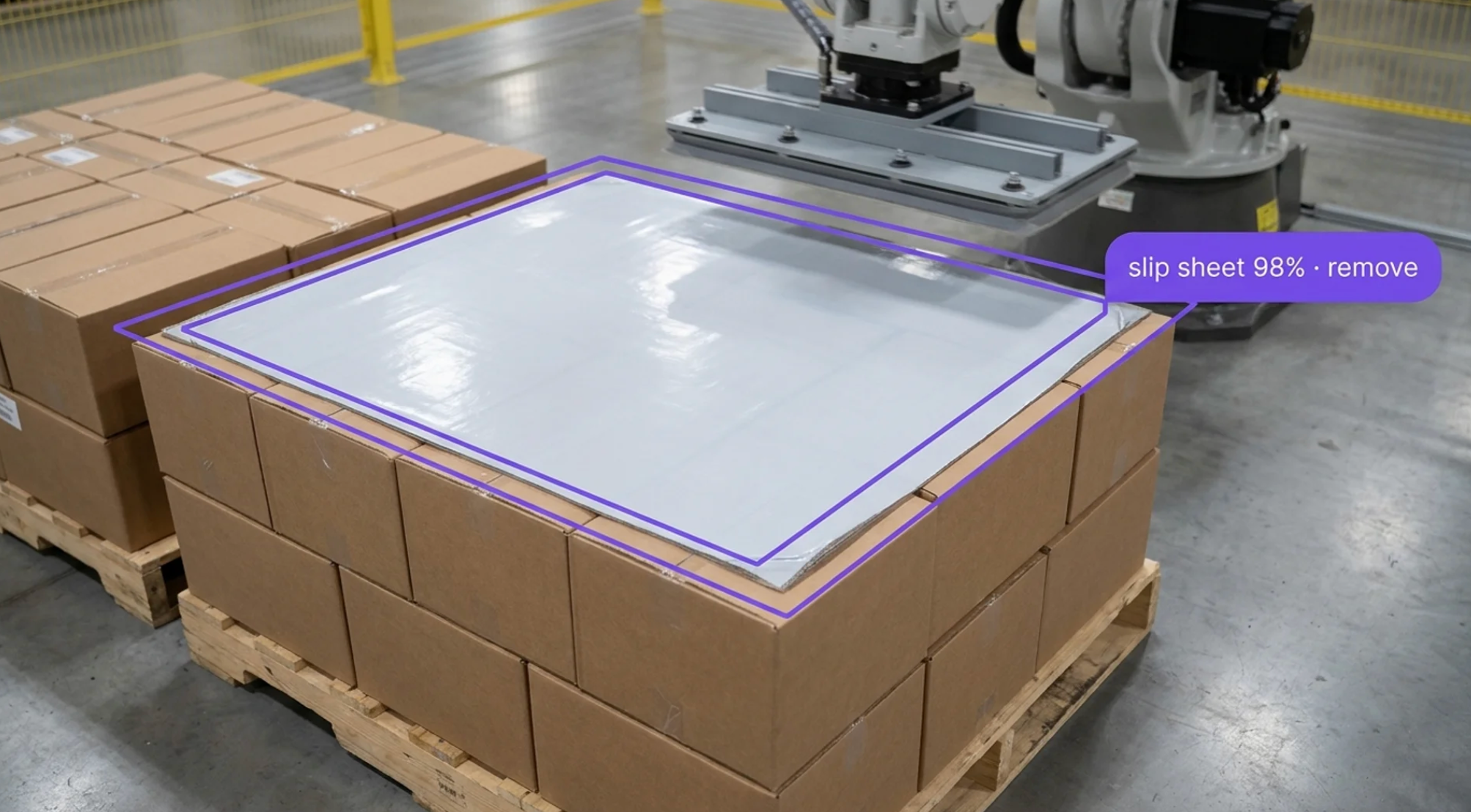
Give your depalletizing robot the eyes to unload any pallet with a robotic depalletizing vision system built on vision AI. Built for the operations where a mixed-SKU inbound pallet stops the cell because the robot only knows one case size, a slip sheet the camera did not see gets picked as a case and dropped on the conveyor, and the leaning top layer that a person would have restacked in ten seconds takes the robot twenty minutes and a recovery. Whether you're unloading mixed pallets at a distribution center inbound dock, feeding case conveyors at a bottling or food plant, or depalletizing bags, trays, and totes in a manufacturing cell, Roboflow finds every case on the top layer, hands the robot a pick point and a pose, and keeps the cell running on pallets it has never seen.
Case Detection and Pick Points:
- Segment every case, bag, tray, and tote on the top layer, whatever the size, print, or orientation, and return a pick point, footprint, and pose to the robot for each one
- Handle mixed-SKU and rainbow pallets with no recipe, so the cell unloads what arrives instead of waiting for a pattern file
- Detect tight-packed and touching cases, overhangs, and rotated units that break pattern-based logic, and pick them in the right order
Slip Sheets, Layers, and Exceptions:
- Detect slip sheets, tier sheets, and shrink wrap remnants between layers, so the robot removes the sheet instead of picking it as a case
- Read layer height and pallet state, so the robot knows when a layer is clear, when the pallet is empty, and when a case is standing where it should not be
- Flag leaning, crushed, open, and collapsed cases before the pick, and route the exception to a person while the rest of the layer keeps moving
Cells, Cameras, and Systems Integration:
- Run on 2D and 3D cameras from Zivid, Photoneo, Basler, Intel RealSense, and others, mounted overhead or on the arm, with models trained on your actual cases and lighting
- Integrate with FANUC, ABB, KUKA, Yaskawa, and Universal Robots controllers and with your cell PLC, delivering pick poses at cycle rate on an edge device inside the cell
- Keep a per-pick record with imagery, so throughput, mispicks, and exceptions are trended by pallet, SKU, and shift, and every drop has a picture behind it
Bring intelligence to every pallet today. Stop mixed pallets, missed slip sheets, and leaning layers from becoming stopped cells, dropped cases, and a depalletizer that only runs on the pallets it was programmed for.
More About Robotic Depalletizing Vision Systems
What is a robotic depalletizing vision system?
A robotic depalletizing vision system uses cameras and computer vision models to see the pallet a robot is unloading: segmenting every case, bag, tray, or tote on the top layer, computing a pick point and pose for each, detecting slip sheets and shrink wrap between layers, reading layer height and pallet state, and flagging damaged or unstable units before the pick. Deep-learning models trained on the operation's actual cases and lighting let the robot unload mixed-SKU and unknown pallets with no pattern file, and integrate with FANUC, ABB, KUKA, Yaskawa, and Universal Robots controllers and the cell PLC through an edge device inside the cell, with a per-pick image record behind every cycle.
Can Vision AI depalletize mixed-SKU pallets the robot has never seen?
The mixed pallet is the hard case: cases of different sizes packed tight enough that the seams between them are a millimeter wide, printed graphics that look like edges, shrink wrap that reflects the cell lighting, and a layer that is never quite level. Rule-based and pattern-based depalletizers need a recipe per pallet type, which is why they stall on inbound docks and mixed loads. Deep-learning segmentation models trained on your actual cases, packaging, and cell lighting learn to find each case boundary regardless of size or print, fuse that with 3D depth to compute a graspable pick point and pose, and pick in an order that keeps the layer stable. Where a unit is ambiguous, leaning, or damaged, the system flags it for a person rather than guessing, so the cell keeps running on the units it is sure about. Camera choice, mounting, and lighting are sized to your case mix, layer height, and cycle time during solution design.
Does this work with the robot and cameras we already have?
Usually. The vision system is robot-agnostic and camera-agnostic: it takes images from the cameras already in the cell (or a single overhead camera added for the purpose), runs the models on an edge device, and returns pick poses to the robot controller over its standard interface. Existing FANUC, ABB, KUKA, Yaskawa, and Universal Robots cells keep their controllers, grippers, and safety systems, and the cell's ISO 10218 and ANSI/RIA R15.06 safety design is unchanged, since the vision system only supplies where to pick, not whether it is safe to move. Retrofitting a pattern-based depalletizer typically means adding a camera and the edge device and training on a few hundred images of your pallets.
Can it integrate with our robot controllers, PLCs, and WMS?
Yes. Roboflow Inference (opens in a new tab) runs on an edge device in the cell and exposes a standard API and common industrial protocols, so pick poses and events flow to and from your existing systems: robot controllers from FANUC, ABB, KUKA, Yaskawa, and Universal Robots over their native interfaces or through the cell PLC, PLCs from Allen-Bradley and Siemens for cell sequencing and exceptions, WMS and WCS platforms like Manhattan, Blue Yonder, SAP EWM, and Dematic for pallet and case data, and SCADA and HMI platforms like Ignition and AVEVA, through REST, MQTT, OPC UA, and direct database writes. PLC-level integration holds the cell and calls a person when an exception is flagged, and every pick carries pallet ID, layer, case position, pose, timestamp, and imagery, with a full record behind every cycle.