Rail Turnout Defect Detection AI
Catch switch point gaps, chipped points, worn frogs, loose heel bolts, and blocked flangeways at every turnout.
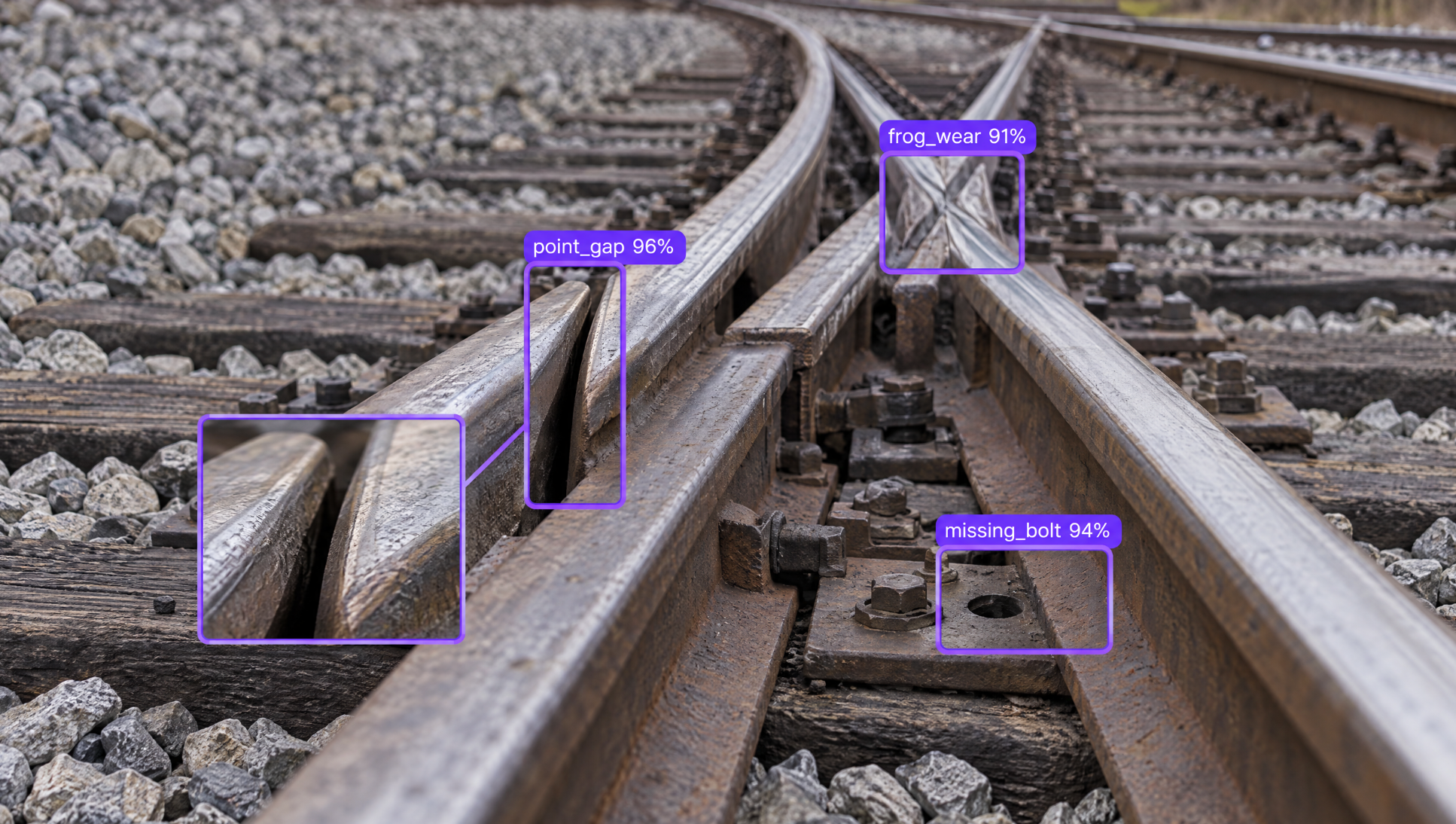
Rail Turnout Defect Detection AI for the Toughest Yards, Interlockings, and Mainline Switches
Deploy Anywhere, Run Everywhere
Run turnout defect detection on hi-rail truck cameras, fixed cameras at switches, yard gantries, drones, the edge, on-prem, in your VPC, or via API.
One Platform, Full Adoption
Tools every track and signal team can adopt, from track inspectors and roadmasters to signal maintainers, no separate ML team required.
Secure, Compliant, and Audit-Ready
Data stays safe with SOC 2 Type II compliance, encrypted data, HIPAA compliance, and an uptime SLA, with inspection records that support FRA Track Safety Standards (49 CFR Part 213).
- Switch Point Gaps & Fit
- Chipped & Worn Switch Points
- Frog Point & Tread Wear
- Guard Rail Condition & Flangeway Obstructions
- Loose & Missing Bolts and Fasteners
- Obstructions, Snow & Ice in Switches
“Roboflow has been instrumental in accelerating our deployment of innovative AI solutions.”
Travis Turnbull
Vice President & CIO, Pella Corporation
Talk to a Vision AI engineer who's shipped in rail.
Bring us your toughest turnout inspection problem and we'll map a working solution.
Ask us about:
- Solution architecture for FRA 49 CFR Part 213 switch, frog, and guard rail requirements and your track inspection records
- A live demo on your own hi-rail, drone, or fixed switch camera footage
- Deployment options: edge on hi-rail trucks, fixed cameras at switches, on-prem at the yard, air-gapped, VPC
- ROI modeling against slow orders, switch failures, track time, FRA defect exposure, and derailment cost
Over 16,000 organizations build with Roboflow.
- Rivian
- Pella
- Chobani
- USG Corporation
- BNSF Railway
- American Woodmark
Vision AI is transforming businesses
Customers across the board are solving complex challenges and driving meaningful impact.
- Automotive customer
$10 million
Saved by automatically detecting defects on the production line
- Logistics & freight company
90%
Less time spent manually tracking shipping inventory
- Building materials supplier
60%
Lower customer return rate with improved product quality
Inspect Every Turnout, from the Switch Points to the Frog
Add a continuous inspection layer to every turnout with Roboflow vision AI for rail turnout defects. Built for yards, interlockings, and mainline switches, where a gapped switch point, a chipped point, or a worn frog can lead to a split switch or a derailment, and where FRA Part 213 sets specific requirements for switches, frogs, and guard rails.
Switch points and stock rails:
- Detect gaps between the switch point and the stock rail in each closed position, so a point that is not fitting its stock rail is flagged before the next train.
- Find chipped, broken, and worn switch points and the metal flow that keeps a point from closing, the conditions FRA requires to be repaired or replaced.
- Check heel blocks, heel bolts, switch rods, and rail braces for loose, cracked, or missing parts, and confirm stock rails are seated in their switch plates.
Frogs, guard rails, and flangeways:
- Spot chipped or broken frog points, tread wear, and cracks in frog castings, and trend wear by frog so replacement is planned around track time.
- Inspect guard rails and wing rails for loose bolts, missing clips, and damage, with the same approach as railway track inspection.
- Flag ballast, debris, snow, and ice in flangeways and between the switch points, since FRA requires every switch, frog, and guard rail to be kept free of obstructions.
Fasteners, ties, and the switch stand:
- Grade turnout ties and count missing or loose spikes, plates, and bolts through the turnout, where FRA calls for more ties per segment than on plain track.
- Check that the switch stand, connecting rod, and switch position indicator are in place, and that the indicator is clearly visible.
- Send findings to track supervisors as work orders tied to milepost and switch number, and trend wear by turnout to plan repairs, as part of predictive maintenance.
Bring intelligence to every turnout today. Catch a gapped point, a chipped frog, or a packed flangeway before it becomes a slow order or a derailment.
Frequently asked questions
What is rail turnout defect detection with Vision AI?
Rail turnout defect detection with Vision AI uses cameras on hi-rail trucks, track inspection vehicles, drones, and fixed mounts at switches with a trained computer vision model to find defects in switch points, stock rails, heel assemblies, frogs, guard rails, and turnout fasteners, and to flag obstructions in flangeways. Models train on images of your own turnouts, and every finding is tied to a switch number and milepost. It works alongside railway track inspection and railcar inspection on the same platform.
Why inspect turnouts continuously?
Turnouts have more moving parts and wear surfaces than plain track, and FRA Part 213 sets specific requirements for them: switch points must fit their stock rails, unusually chipped or worn points must be repaired or replaced, a frog with a badly worn point or tread is limited to 10 mph, and every switch, frog, and guard rail must be kept free of obstructions. FRA also requires CWR joints in switches and turnouts to be inspected on foot at least monthly. Cameras add a check between those inspections, with an image for every finding.
Does it work alongside walking inspections and track geometry cars?
Yes. Walking inspections and geometry cars measure gage, guard check gage, and frog wear with tools and sensors. Cameras add a visual check of every turnout between those inspections, with an image behind every finding, so inspectors spend their time at the switches that need it.
Roboflow serves as the inspection engine, and your track and signal teams own the inspection criteria, alert thresholds, and repair decisions.
Can it integrate with our track asset management and maintenance systems?
Yes. Roboflow writes findings to a PLC tag over OPC UA, Modbus TCP, or MQTT, and sends results and images over REST or to a database for asset management platforms such as SAP and IBM Maximo and GIS systems keyed to milepost and switch number, where they become work orders and alerts. Models run on edge hardware on the truck, on a server at the yard, or in your VPC.