Powder Coating Inspection AI
Catch holidays, orange peel, and craters coming off the cure oven, before the part reaches pack-out.
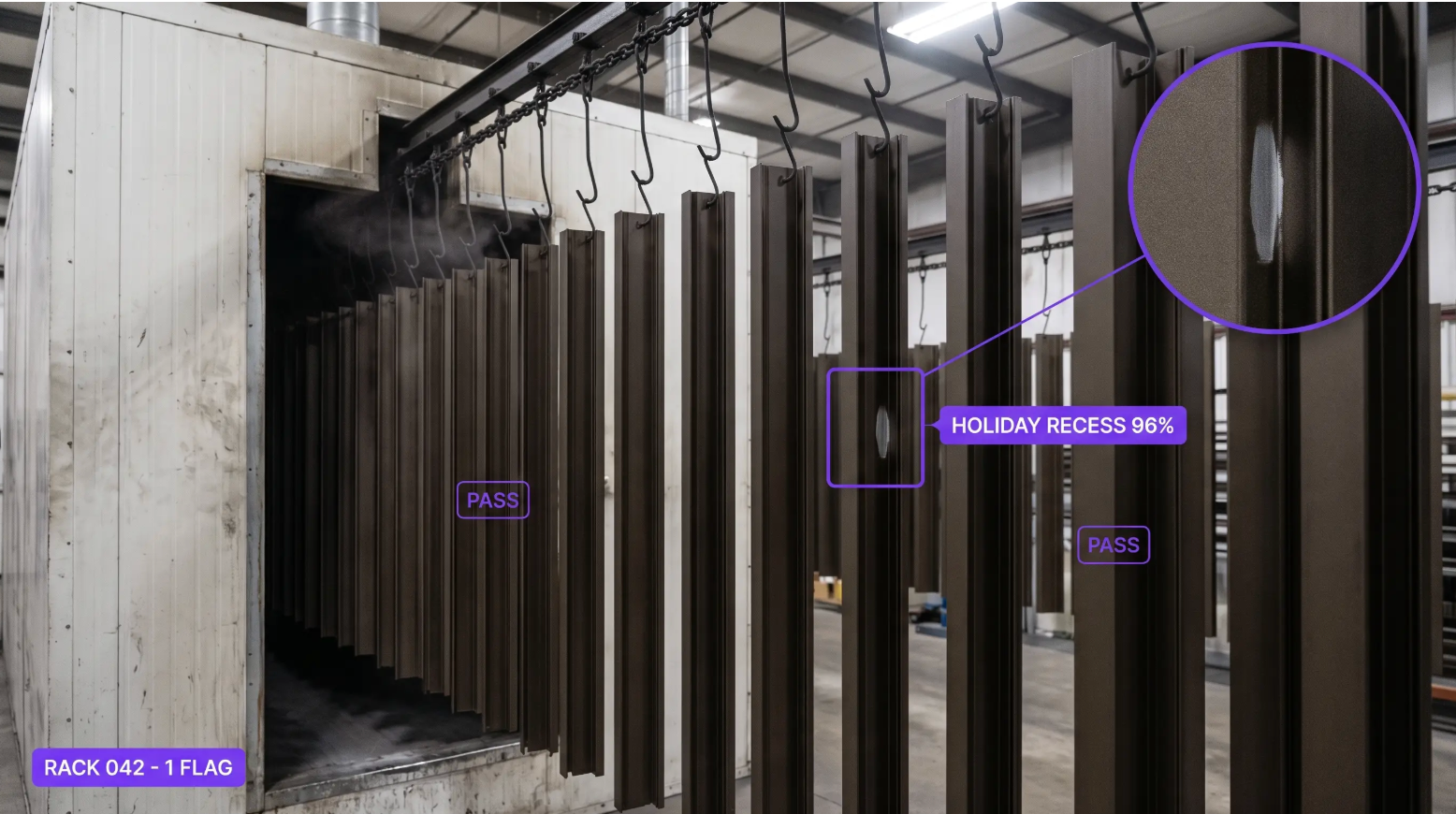
Powder Coating Inspection AI Across Furniture, Equipment, Appliance, and Architectural Finishing
Deploy Anywhere, Run Everywhere
Run powder coating inspection on booth-exit cameras, cure-oven exit conveyors, the edge, on-prem, in your VPC, or via API, wherever your finishing line, rack, and pack-out stations need it.
One Platform, Full Adoption
Tools every finishing organization can adopt, from line supervisors and finishing engineers to quality leads and paint shop maintenance, no separate ML team required to ship and own inspection models.
Secure, Compliant, and Audit-Ready
Data stays safe with SOC 2 Type II compliance, encrypted data, and an uptime SLA, with per-part records that support AAMA 2603, 2604, and 2605 architectural specifications, Qualicoat, and ISO 9001 quality programs.
- Holidays & Uncoated Areas
- Orange Peel & Texture Variation
- Faraday Cage & Recess Coverage
- Craters, Fisheyes & Contamination
- Pinholes & Outgassing on Castings
- Color & Gloss Consistency
“Roboflow has been instrumental in accelerating our deployment of innovative AI solutions.”
Travis Turnbull
Vice President & CIO, Pella Corporation
Talk to a vision AI engineer who's shipped powder coating inspection on live finishing lines.
A single holiday inside a corner the gun never reached, a crater blooming where oil survived the washer, or a rack of castings that outgassed pinholes through the topcoat can mean a full strip and rehang, a warranty claim on a finish that fails in year two, or a rejected architectural lot that misses the glazing schedule. Bring us your toughest powder coating inspection problem and we'll map a working solution.
Ask us about:
- Solution architecture for AAMA 2603, 2604, and 2605 architectural specifications, Qualicoat, ISO 9001, and ISO 12944 corrosion programs
- Live demo on your own booth-exit and oven-exit imagery, across your actual color and substrate mix
- Deployment options: booth and cure-oven exit cameras, edge, on-prem, air-gapped, or VPC, with integration into MES, rack tracking, and rework routing
- ROI modeling against strip and rehang rates, powder utilization, first-pass yield, and warranty exposure on coated parts
Over 16,000 organizations build with Roboflow.
- Rivian
- Pella
- Chobani
- USG Corporation
- BNSF Railway
- American Woodmark
Vision AI is transforming businesses
Customers across the board are solving complex challenges and driving meaningful impact.
- Automotive customer
$10 million
Saved by automatically detecting defects on the production line
- Logistics & freight company
90%
Less time spent manually tracking shipping inventory
- Building materials supplier
60%
Lower customer return rate with improved product quality