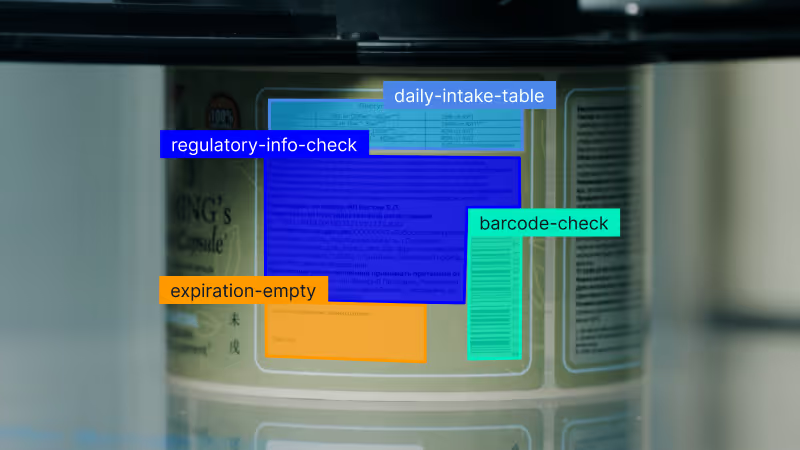
Add a real-time identification layer to every part with Vision AI for part identification and scanning. Roboflow extends part identification coverage to every touchpoint, on the cameras and inspection stations your facility and MRO teams already run.
Multi-Format Part ID Reading:
- Read direct part marking (DPM) on cast, machined, laser-etched, and dot-peened surfaces, printed and stamped serial numbers, data plates and nameplates, part number labels, and OCR-only identifiers across every part family the line handles
- Handle degraded IDs: painted-over, grease-covered, corroded, worn, low-contrast, and partially obscured marks that rule-based scanners return as no-reads
- Disambiguate part number vs. serial number vs. lot code vs. supplier ID vs. revision level on parts that carry multiple markings, and route on the correct current identifier
Traceability, Genealogy, and Counterfeit Detection:
- Tie every read to the PLM, PDM, MES, or ERP master and maintain unit genealogy from inbound receipt through WIP to finished assembly to field service and MRO turn
- Detect counterfeit and non-conforming parts by comparing surface morphology, marking font, data plate layout, and supplier signature against the approved reference library, catching the fakes that pass a rule-based scan
- Log every read with confidence score, image crop, timestamp, station ID, and operator ID for IATF 16949, AS9100, AS9110, ATA Spec 2000, MIL-STD-130 UID/IUID, and FDA UDI audit trail
Receiving, MRO, and Field Service Deployment:
- Deploy on receiving inspection cameras and dock scanners for inbound part identification against PO and BOM, fixed-mount WIP station cameras for genealogy tracking, robot-mounted stations for kitted assembly verification, MRO inspection benches for tail-number-linked parts and life-limited part identification, and mobile field service tablets for on-aircraft or in-plant part ID
- Integrate with PLM (Siemens Teamcenter, PTC Windchill, Dassault ENOVIA, SAP PLM, Aras Innovator), PDM systems, MES (Rockwell PharmaSuite, Siemens Opcenter, GE Proficy, Ignition, Wonderware, AVEVA), ERP (SAP, Oracle, Infor, NetSuite), warranty systems, and MRO platforms (Trax, AMOS, Ramco Aviation) through REST, MQTT, OPC UA, and direct database writes
- Maintain validated inspection records that support IATF 16949 registrar audits, AS9100 and AS9110 aerospace audits, ATA Spec 2000 parts audits, MIL-STD-130 UID/IUID compliance, FDA UDI compliance, and customer-specific PPAP submissions
Bring intelligence to every part today. Stop mis-identified parts and broken genealogy from becoming warranty escapes, audit findings, counterfeit infiltration, recalls, or life-limited-part safety events.
More About Part Identification and Scanning
What is part identification and scanning with Vision AI?
Part identification and scanning with Vision AI uses computer vision models to identify every part on every station, read every direct part marking (DPM), printed and stamped serial number, data plate, nameplate, and part number label, and tie every read to the PLM, PDM, MES, or ERP master record. Coverage spans the full lifecycle of a part: inbound receiving inspection against PO and BOM, WIP station handoffs, robot-mounted assembly verification, final QC, warehouse serialization, field service and warranty registration, and MRO turn (with tail-number-linked traceability on aerospace parts).
The system reads degraded, painted-over, grease-covered, corroded, and low-contrast marks that rule-based scanners return as no-reads, disambiguates part number vs. serial number vs. lot code vs. supplier ID on parts carrying multiple identifiers, detects counterfeit and non-conforming parts by comparing surface morphology and marking signature against the approved reference library, and produces the audit trail required under IATF 16949, AS9100, AS9110, ATA Spec 2000, MIL-STD-130 UID/IUID, FDA UDI, and customer-specific PPAP acceptance.
Automotive OEMs and Tier 1 suppliers, aerospace manufacturers and MROs, industrial equipment builders, medical device manufacturers, and heavy machinery operators use it to prevent warranty escapes, defend IATF and AS9100 audits, catch counterfeit infiltration, keep life-limited parts out of returned-to-service inventory past their due date, and document compliance under the full aerospace-automotive-defense traceability stack.
Can Vision AI read degraded, painted-over, and grease-covered part IDs that rule-based scanners return as no-reads?
Yes. Painted-over serials on returned engines, grease-covered DPMs on transmission housings, corroded nameplates on aerospace line replaceable units (LRUs), worn stamped serials on decades-old rotating equipment, and low-contrast IDs on cast iron surfaces are exactly where Roboflow excels. Roboflow models are trained on your actual part library, your real degradation patterns, and your receiving and MRO lighting, and co-pilot existing fixed and handheld scanners by adding a second-look layer that recovers reads before they divert to a manual identification station and take a labor and turnaround-time hit.
Does part identification and scanning support IATF 16949, AS9100, MIL-STD-130, and FDA UDI?
Yes. Roboflow models can be trained against IATF 16949 for automotive quality management and traceability, AS9100 for aerospace quality management systems, AS9110 for aerospace maintenance organizations, AS9120 for aerospace distributors, ATA Spec 2000 for aviation parts identification and marking, MIL-STD-130 for military and defense part marking including UID (Unique Identification) and IUID (Item Unique Identification) with GS1 DataMatrix, FDA UDI for medical device labeling, ISO/IEC 15415 (2D barcode print quality), ISO/IEC 15416 (1D barcode print quality), GS1 barcode symbology, ANSI/UCC barcode specifications, ANSI MH10.8.2 shipping marking, and customer-specific PPAP submissions and OEM traceability requirements. The system reads and grades every scan against the pass/fail logic your quality, traceability, and MRO teams already use, and produces validated inspection records that support IATF 16949 and AS9100 registrar audits, ATA Spec 2000 parts audits, DoD MIL-STD-130 UID/IUID compliance, FDA UDI compliance, and customer PPAP submissions.