Modular and Offsite Construction Inspection AI
Verify the nail pattern, the rough-in, and the blocking at the station, before the drywall closes over the evidence.
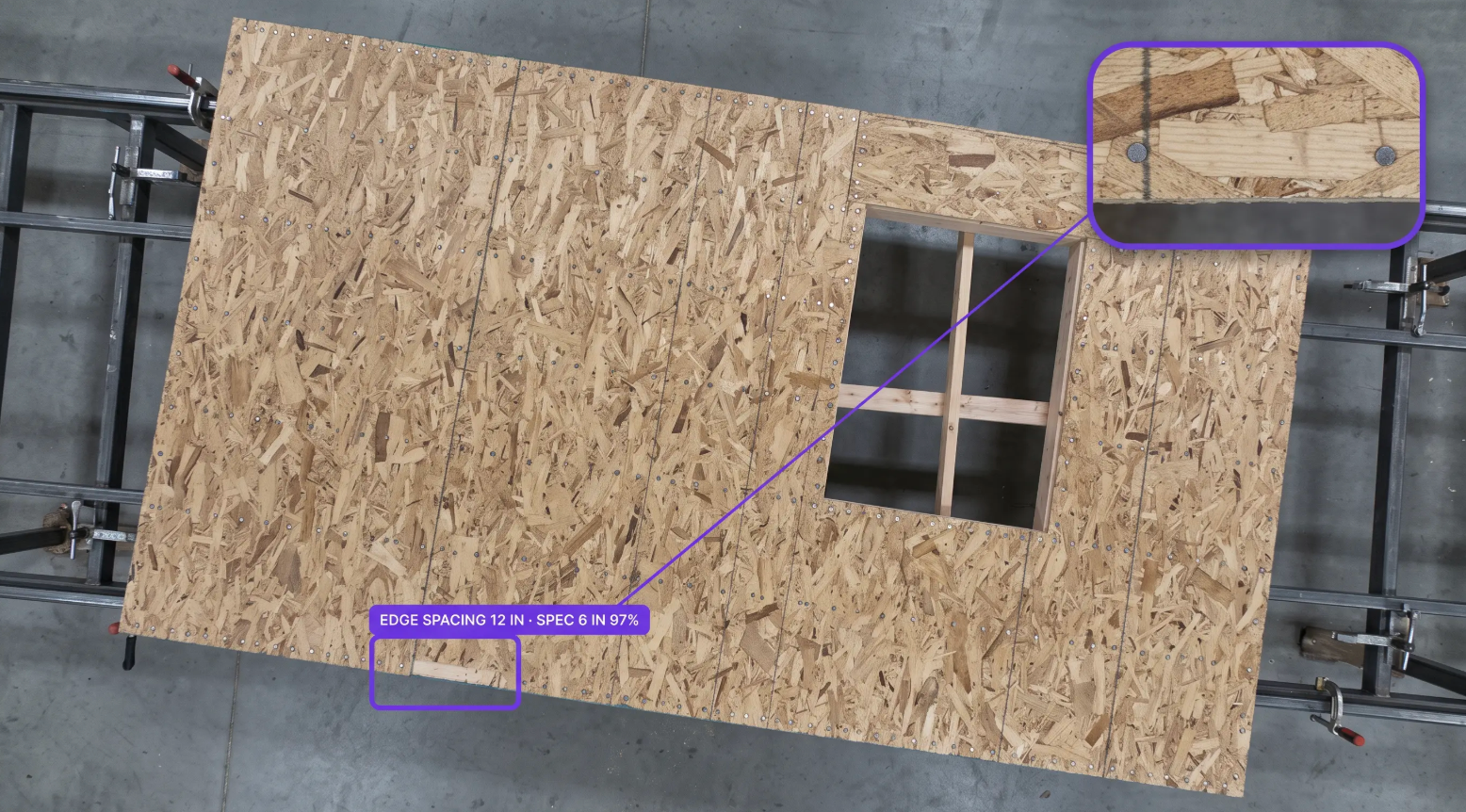
Offsite Construction Inspection AI Across Framing, Rough-In, Close-Up, and Set
Deploy Anywhere, Run Everywhere
Run offsite construction inspection on framing tables, nailing bridges, rough-in and close-up stations, module finish and shipping bays, the edge, on-prem, in your VPC, or via API, wherever your modular, panelized, or manufactured housing line needs it.
One Platform, Full Adoption
Tools every factory-built housing operation can adopt, from station leads and framers to plant quality, engineering, and the team working with a third-party inspection agency, no separate ML team required to ship and own inspection models.
Secure, Compliant, and Audit-Ready
Data stays safe with SOC 2 Type II compliance, encrypted data, and an uptime SLA, with per-module records that support the HUD Code (24 CFR 3280) with IPIA and DAPIA oversight, state modular programs and ICC/MBI 1200 and 1205, IRC and IBC provisions, and ISO 9001 quality systems.
- Nail & Screw Pattern Verification
- Stud Spacing, Headers & Blocking
- MEP Rough-In & Penetrations
- Insulation, Air & Vapor Barrier
- Straps, Hold-Downs & Connections
- Per-Module Closed-Wall Records
Talk to a vision AI engineer who's shipped inspection in a factory-built housing plant.
A sheathing panel nailed at twelve inches on an edge that called for six, an outlet box roughed in on the wrong side of a stud, or a missing strap that nobody caught before the drywall went on can mean a module held at the set for an open-wall inspection, a red tag from your third-party agency, or a defect that surfaces after the home is occupied with nothing on file to show how the wall was built. Bring us your toughest modular or panelized inspection problem and we'll map a working solution.
Ask us about:
- Solution architecture for HUD Code plants working with IPIA and DAPIA agencies, state modular programs and ICC/MBI 1200 and 1205, IRC and IBC provisions, and ISO 9001
- Live demo on your own station imagery, across framing tables, nailing bridges, rough-in and close-up stations, and shipping bays
- Deployment options: fixed station cameras, bridge-mounted and overhead cameras, handhelds and tablets, edge, on-prem, air-gapped, or VPC, with integration into MES, quality systems, and traveler workflows
- ROI modeling against rework and station holds, third-party findings, set-day delays and field service, and warranty and closed-wall claims
Over 16,000 organizations build with Roboflow.
- Rivian
- Pella
- Chobani
- USG Corporation
- BNSF Railway
- American Woodmark
Vision AI is transforming businesses
Customers across the board are solving complex challenges and driving meaningful impact.
- Automotive customer
$10 million
Saved by automatically detecting defects on the production line
- Logistics & freight company
90%
Less time spent manually tracking shipping inventory
- Building materials supplier
60%
Lower customer return rate with improved product quality