OEE Monitoring AI
Measure availability, performance, and quality on every machine and manual station from camera feeds, including the older equipment with no PLC data, and see exactly where each shift lost its minutes.
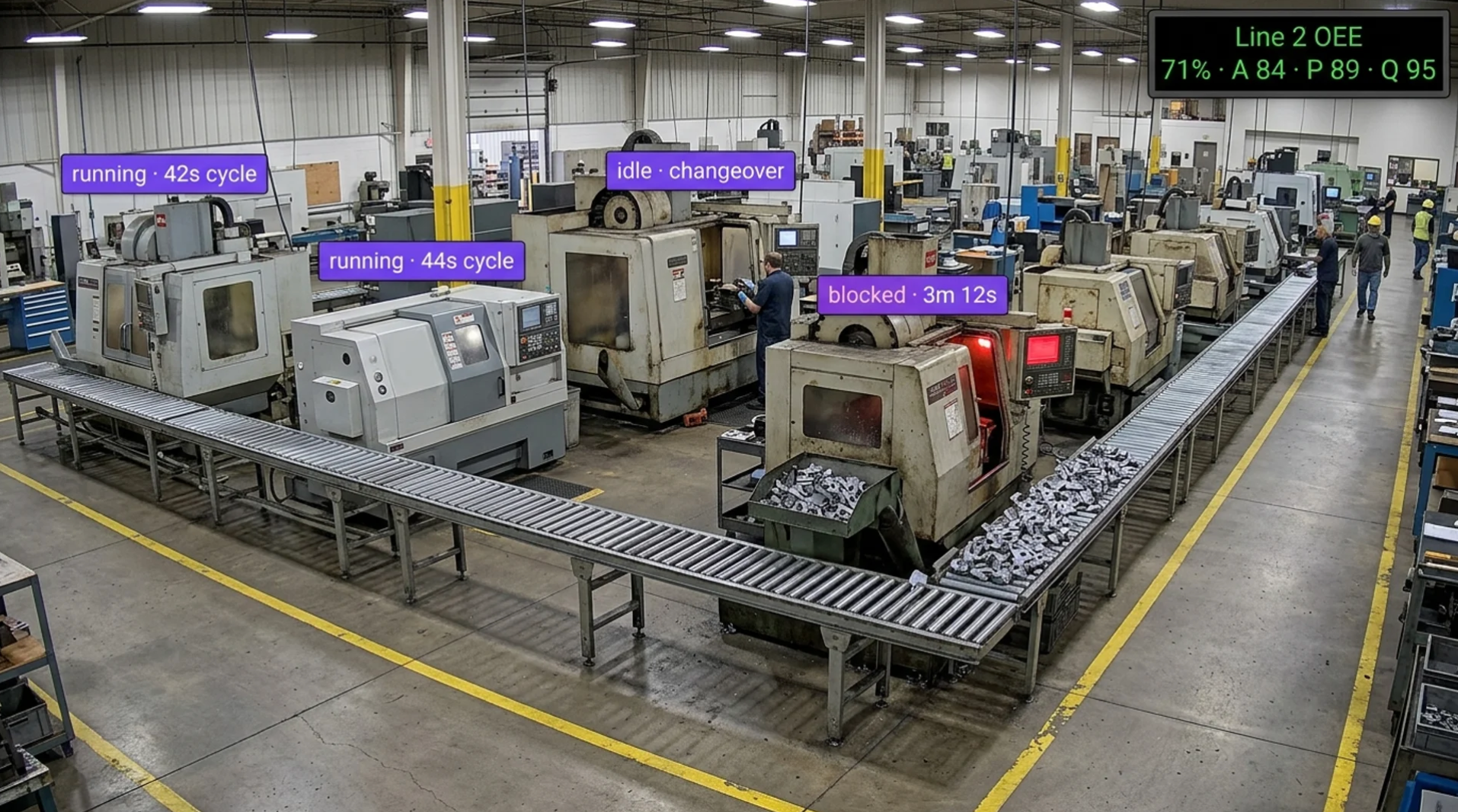
OEE Monitoring AI for the Toughest Mixed-Age, Multi-Vendor Production Floors
Deploy Anywhere, Run Everywhere
Run OEE monitoring on machine, conveyor, and station cameras on the edge, on-prem, in your VPC, or via API, alongside the PLC data you already collect.
One Platform, Full Adoption
Tools every operations team can adopt, from plant managers and continuous improvement leads to maintenance planners and line supervisors, no separate ML team required.
Secure, Compliant, and Audit-Ready
Data stays safe with SOC 2 Type II compliance, encrypted data, HIPAA compliance, and an uptime SLA, with documentation that supports ISO 22400 KPI definitions and ISO 9001 continual improvement records.
- Running, Idle, Blocked & Starved States
- Downtime & Micro-Stop Detection
- Unit Counts & Actual Cycle Time
- Good vs. Reject Part Counts
- OEE on Legacy & Manual Stations
- Loss Pareto by Machine & Shift
“Roboflow has been instrumental in accelerating our deployment of innovative AI solutions.”
Travis Turnbull
Vice President & CIO, Pella Corporation
Talk to a Vision AI engineer who's shipped in discrete and process manufacturing.
Bring us your toughest OEE monitoring problem and we'll map a working solution.
Ask us about:
- Solution architecture that fits ISO 22400 KPI definitions and your existing OEE, MES, and historian stack
- A live demo on your own machine or line footage
- Deployment options: edge, on-prem, air-gapped, VPC, or on the cameras already on your floor
- ROI modeling against downtime minutes, micro-stops, speed loss, scrap, and capacity you can recover without new equipment
Over 16,000 organizations build with Roboflow.
- Rivian
- Pella
- Chobani
- USG Corporation
- BNSF Railway
- American Woodmark
Vision AI is transforming businesses
Customers across the board are solving complex challenges and driving meaningful impact.
- Automotive customer
$10 million
Saved by automatically detecting defects on the production line
- Logistics & freight company
90%
Less time spent manually tracking shipping inventory
- Building materials supplier
60%
Lower customer return rate with improved product quality
Measure OEE on Every Machine and Station, from the First Part to the Last Shift
Bring real-time intelligence to every machine and station on the floor with Roboflow Vision AI for OEE monitoring. Built for plants where half the equipment has no usable PLC signal, downtime reasons come from a clipboard, and micro-stops never make it into the OEE number.
Availability: when and why lines stop:
- Detect running, idle, blocked, and starved states from what the camera sees, such as parts moving, an operator at the station, or an empty infeed.
- Catch micro-stops of seconds that manual logging misses, and add a clip to each longer stop so the reason code is accurate.
- Separate planned downtime (changeover, breaks) from unplanned stops using schedule data.
Performance: actual speed and cycle time:
- Count units as they pass and measure actual cycle time against ideal, on conveyors, presses, and manual stations.
- Flag slow cycles and speed loss by machine, product, and operator shift.
- Measure cycle time on manual stations where OEE usually cannot reach.
Quality and the loss Pareto:
- Count good parts and rejects with inline inspection so the quality term comes from the parts, not an end-of-shift estimate.
- Combine availability, performance, and quality into OEE per machine, line, and shift in real time.
- Build a loss Pareto with clips behind each bar so continuous improvement teams fix the biggest loss first.
Bring intelligence to every machine today. Stop hidden downtime and speed loss from becoming lost capacity.
Frequently asked questions
What is OEE monitoring with Vision AI?
OEE monitoring with Vision AI uses cameras on machines, conveyors, and stations and a trained computer vision model to measure the three parts of overall equipment effectiveness: availability (running, idle, blocked, and starved time), performance (unit counts and actual cycle time), and quality (good and reject parts). It works on legacy and manual equipment with no PLC data, and it adds a clip to every loss. It builds on cycle time and process monitoring and conveyor jam detection.
Can Vision AI measure OEE on machines with no PLC data?
Yes, and this is where it adds the most. A camera can see whether parts are moving, whether the machine is cycling, whether an operator is present, and whether the infeed is empty, so machine state and unit counts come from video even on a 30-year-old press. Where PLC signals exist, vision confirms them and adds the reason behind a stop, and each machine needs a short setup to define what running looks like.
Does OEE monitoring follow ISO 22400 definitions?
OEE monitoring can follow the key performance indicator definitions in ISO 22400 (the standard for manufacturing operations management KPIs, including OEE, availability, and effectiveness), and supports the continual improvement expectations of ISO 9001 (the quality management system standard) with a data record behind every loss category.
Roboflow serves as the measurement engine, and your operations and continuous improvement teams own the ideal cycle times, planned downtime rules, and loss categories.
Can it integrate with our MES, historian, and OEE dashboards?
Yes. Roboflow sends machine states, counts, and events over MQTT, OPC UA, or REST, or writes them to a database, so they feed MES, historians, and OEE platforms such as Ignition, AVEVA PI, Redzone, Vorne XL, and Evocon. Where a PLC already reports state, vision data can be merged with it so every stop carries both the signal and the clip.