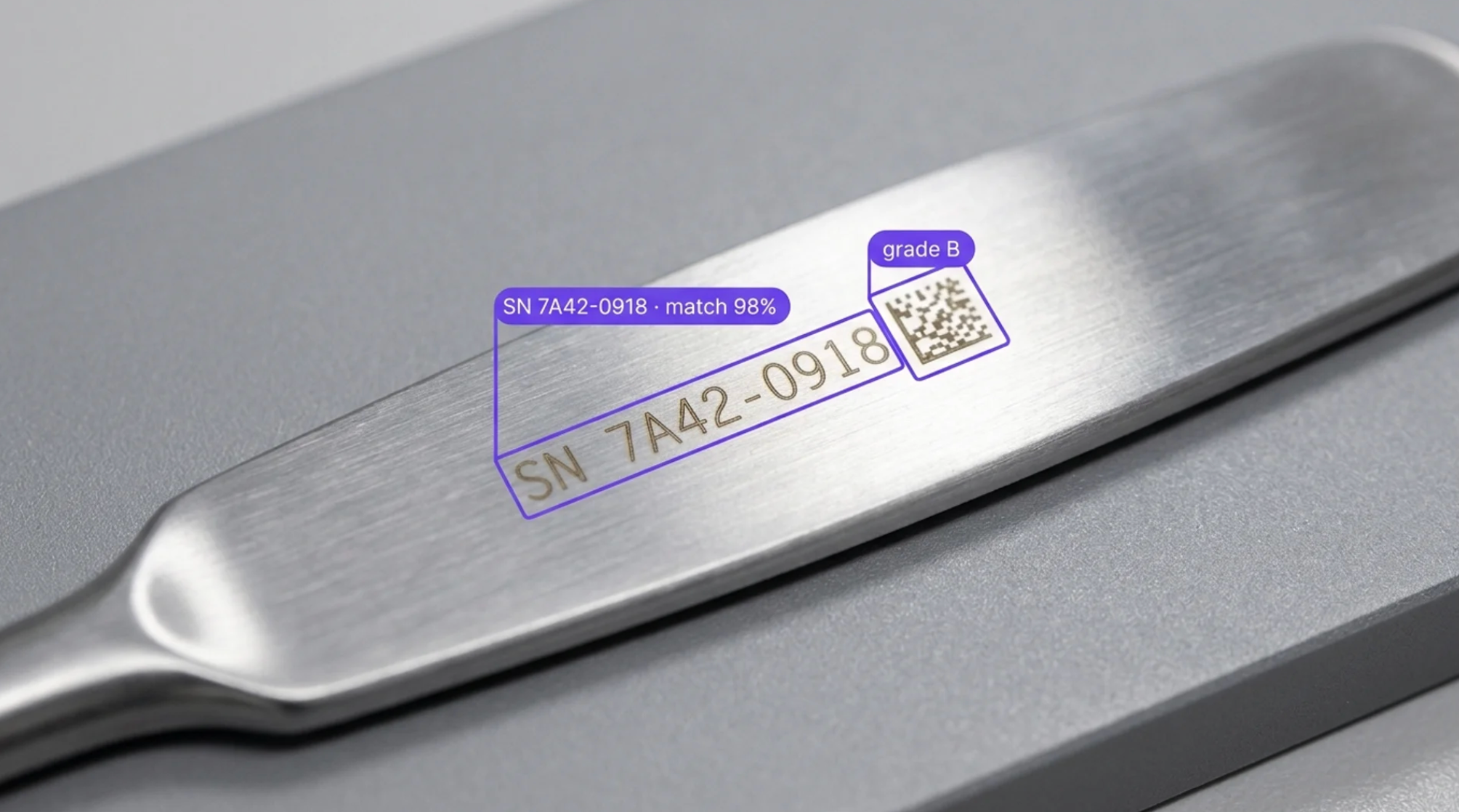
Add a real-time reading layer to every laser-marked part on the line with OCR for laser etched codes built on vision AI. Built for the operations where a serial number annealed into stainless steel disappears under the wrong light, a part number etched into a curved black plastic housing reads as a smear to a fixed-threshold reader, and the 2D code on a titanium implant has to be read through the passivation layer or the part cannot ship. Roboflow reads every etched character and code on the cameras your marking cells and inspection stations already run, and ties every read to the part's traceability record.
Etched Characters and Serials:
- Read laser-etched, annealed, and engraved serial numbers, part numbers, lot codes, and revision marks on stainless, titanium, aluminum, anodized and coated metals, plastics, glass, and ceramics
- Handle low-contrast marks, specular glare, brushed and machined textures, and characters that wrap around curved surfaces, without a rule-based reader's dependence on one lighting setup
- Verify every read against the expected value from the work order or marking file, so a mis-marked part is caught at the marker instead of at the customer
Direct Part Mark 2D Codes and Mark Quality:
- Locate and decode laser-etched Data Matrix and QR codes on parts of any shape, including dot-peen and low-contrast direct part marks that handheld scanners struggle with
- Grade mark quality and legibility on every part, so a fading laser, a wrong focus, or a coating over the mark shows up as a trend before it produces an unreadable batch
- Confirm mark presence, position, and orientation against the drawing, so the mark lands where the spec says and stays readable after machining and finishing
Traceability, Records, and Systems Integration:
- Tie every read to the part serial, operation, station, and timestamp, with the image attached, so traceability holds from marking through final assembly and into the field
- Re-read marks at downstream stations to verify the part is the one the traveler says it is, catching mixed parts and wrong-revision components before they are built in
- Route mis-marked and unreadable parts to rework through PLC and MES integration, with per-part records that support FDA UDI direct marking, MIL-STD-130, and AS9132 requirements
Bring intelligence to every etched mark today. Stop unreadable serials, mis-marked parts, and fading lasers from becoming traceability gaps, mixed-part escapes, or a UDI audit finding.
More About OCR for Laser Etched Codes
What is OCR for laser etched codes with Vision AI?
OCR for laser etched codes with vision AI uses computer vision and deep-learning OCR models to read the serial numbers, part numbers, lot codes, and 2D Data Matrix and QR codes that lasers etch, anneal, or engrave directly into metal, plastic, glass, and ceramic parts, and to verify each read against the expected value and grade the mark's legibility. Unlike rule-based OCR tuned to one font, contrast, and lighting setup, models trained on your actual parts, marks, and stations read through glare, texture, curvature, and coating variation, and keep a per-part image record that supports FDA UDI direct marking, MIL-STD-130, AS9132, and ISO/IEC 29158 traceability and mark-quality requirements. For printed and inkjet codes on packaging, see date and lot code verification; for more information, see industrial OCR.
Can Vision AI read low-contrast laser marks on shiny or curved metal?
That is the defining problem in direct part marking: an annealed mark on stainless is a slight color shift with no relief, an etched mark on machined aluminum sits inside a brushed texture that looks like characters, a curved surface throws specular highlights across half the string, and the same part reads differently at every station because the lighting is different. Rule-based readers solve this with a tuned dome light and a fixed font, and break when the part, the finish, or the laser drifts. Deep-learning OCR models trained on your actual parts, marks, and station lighting learn how each character looks under glare, on texture, and around a radius, and hold that read across finishes and stations. Where a mark is borderline, the model reports a confidence and the image, so a fading laser gets caught as a trend before it produces a batch nobody can read. Lighting and camera placement are still sized to the mark size and surface during solution design; the model makes the setup forgiving, not unnecessary.
Does this support FDA UDI direct marking and MIL-STD-130 traceability?
Yes. FDA UDI direct marking requirements (21 CFR 801.45, which require a UDI to be marked directly on reusable devices that are reprocessed), MIL-STD-130 (the Department of Defense standard for item unique identification marking), AS9132 (the aerospace standard for Data Matrix direct part mark quality), and ISO/IEC 29158 (the direct part mark verification grading standard) each expect that marks are present, readable, and verifiable, and that the read is recorded. Vision-based OCR produces exactly that record: every part's mark read, verified against the expected value, graded for legibility, and stored with the image, serial, station, and timestamp. Roboflow is the reading and verification engine; your quality and regulatory teams own the marking specifications, acceptance grades, and the traceability process that sits on top.
Can it integrate with our laser markers, MES, and traceability systems?
Yes. Roboflow Inference (opens in a new tab) exposes a standard API and supports common industrial protocols, so read and verification events flow into your existing systems: laser marking systems from Keyence, TRUMPF, Videojet, Domino, and Gravotech for mark-and-verify loops, line and cell PLCs from Allen-Bradley and Siemens driving rejects and rework routing, MES and ERP platforms like SAP, Oracle, and Aegis FactoryLogix for serial-level travelers, quality systems like ETQ and MasterControl, and SCADA and HMI platforms like Ignition and AVEVA, through REST, MQTT, OPC UA, and direct database writes. PLC-level integration holds a mis-marked part the moment the read fails to match, and every event carries serial, station, operation, timestamp, read value, confidence, and imagery, with a full audit trail behind every part shipped.