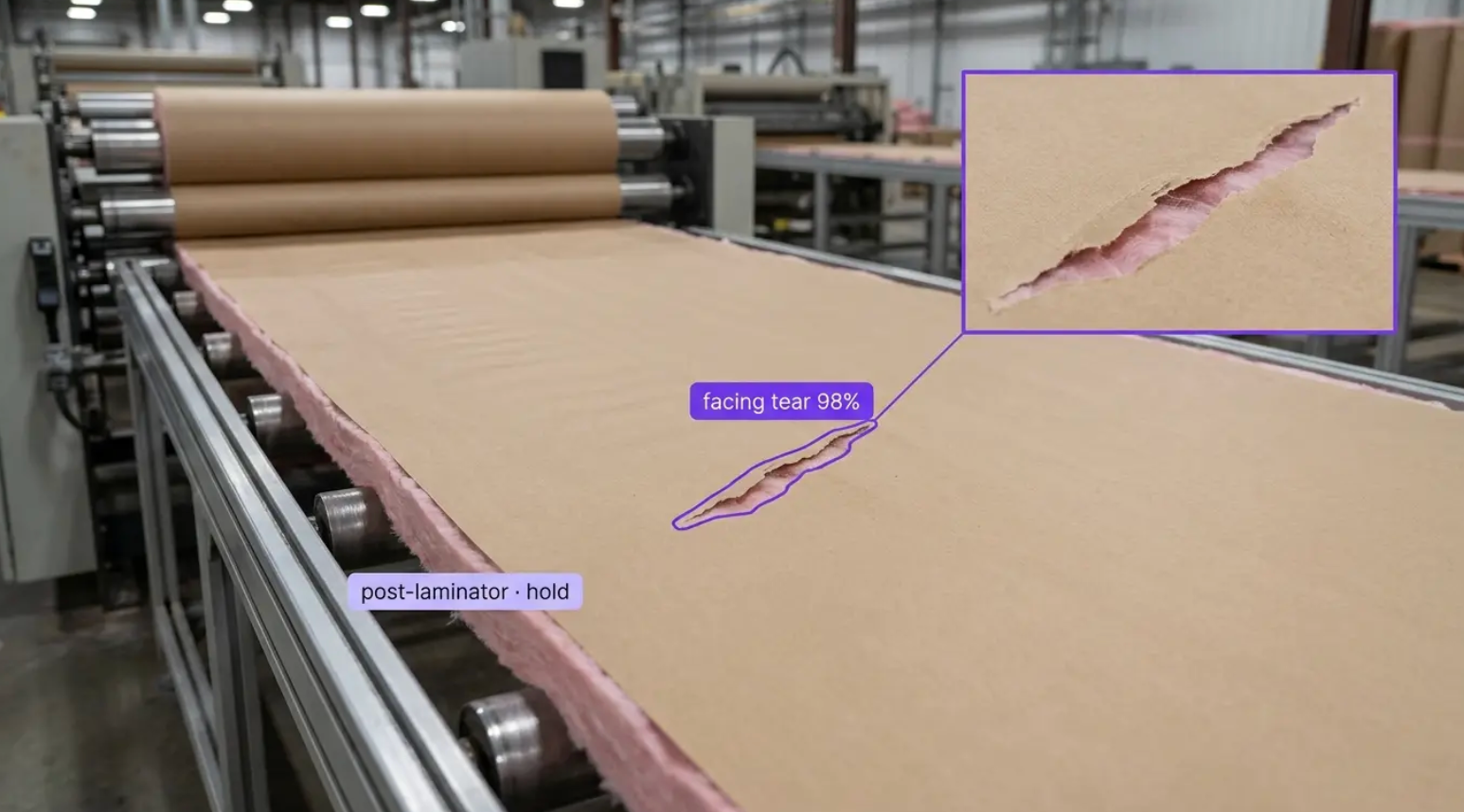
Add a real-time inspection layer to every foot of blanket with vision AI for insulation batt inspection. Built for the operations where the product is a wide, fast, low-contrast mat of fiber, a thin spot and a shadow look alike from across the line, the facing goes on at speed and stays wrong for as long as no one notices, and the R-value stamped on the bag is a claim the whole run has to back. Whether you're running fiberglass or mineral wool blanket lines, faced or unfaced batts, rolls, or board, Roboflow inspects the blanket, the facing, the cut, and the package on every unit, with a per-batt record behind every pallet.
Blanket and Density:
- Detect thin spots, voids, holes, and density streaks across the full blanket width, so the lane that would fail its R-value claim is caught at forming instead of at the pallet
- Detect tears, edge damage, and ragged selvedge before facing and cutting, so the damaged length is diverted instead of faced and bagged
- Detect binder spots, scorch, discoloration, and uncured areas coming out of the oven, so a curing problem surfaces as a flagged foot of product instead of a shift of it
Facing and Cut:
- Detect facing wrinkles, folds, tears, delamination, misalignment, and flange defects on kraft, foil, and poly facings, so a facing fault is fixed at the laminator instead of shipping in a bundle
- Detect shot, debris, and foreign material in mineral wool and fiberglass mats, so contamination is caught before it is inside a package
- Verify cut length, width, squareness, and end quality, so the batt that will not fit the cavity never leaves the line
Packaging, Traceability, and Systems Integration:
- Verify bundle count, compression, bag integrity, print, and the R-value and product stamp on every package, so what is on the bag matches what is in it
- Trend defects by lane, oven zone, facing roll, and shift, so a former nozzle or laminator roll that starts drifting surfaces before it becomes a run
- Integrate with line controls, MES, and quality systems, with per-batt records tied to lot, line, timestamp, and imagery for claims and audits
Bring intelligence to every foot of blanket today. Stop thin spots, torn facing, and binder faults from becoming failed R-value claims, distributor returns, or the hour of off-spec product no one saw.
More About Insulation Batt Inspection
What is insulation batt inspection with Vision AI?
Insulation batt inspection with vision AI uses computer vision models to inspect fiberglass and mineral wool blanket, batts, rolls, and board at every stage of the line: thin spots, voids, holes, and density streaks across the blanket, tears and edge damage, binder spots, scorch, and uncured areas out of the oven, facing wrinkles, tears, delamination, and flange defects, shot and foreign material, cut length, width, and end quality, and bundle, bag, print, and R-value stamp at packaging. Models trained on your actual product, lines, and lighting run at line speed on every foot, with per-batt records that support ASTM C665 and C612, the FTC R-value Rule, and ISO 9001.
Can Vision AI see a thin spot in a moving fiberglass blanket?
A thin spot in a wide, fast, uniform mat of fiber is exactly where insulation lines feel the most pressure: the product is low contrast, the texture is the same everywhere, a shadow from a guard or a lamp looks like a density streak from across the line, and the blanket is moving fast enough that a problem at the former is a hundred feet of product before anyone sees it. Deep-learning models trained on your actual blanket, colors, and lighting learn what a thin spot, a void, a density streak, and a binder spot look like on your product, and backlighting, structured light, or thermal imaging where the process allows gives the model the signal that a plain overhead camera loses in the fluff. Detections come back with the lane, the footage position, and the frame, so the operator goes to the former nozzle or the oven zone that caused it, and the record ties the flagged length to the lot that was cut from it.
Does this replace our basis-weight gauge and thickness scanner?
No. The basis-weight gauge and thickness scanner keep their role measuring the mass and loft that back the R-value, and the ASTM C665 and C612 test program and the FTC R-value Rule stay as the standard the product is held to. Vision AI adds what a gauge and a scanner do not see: the facing and its defects, tears, holes, and edge damage, binder spots and scorch, foreign material, cut and end quality, and the package and its print, plus a picture of every flagged length. Gauge readings, scanner profiles, and vision detections land in the same per-batt record, and the run that would have shipped with a torn facing or an uncured streak is caught at the line.
Can it integrate with our line controls, MES, and quality systems?
Yes. Roboflow Inference exposes a standard API and supports common industrial protocols, so inspection results flow into your existing systems: line PLCs and cutters, MES and ERP platforms like SAP and Oracle, quality and SPC systems, and SCADA and HMI platforms like Ignition and AVEVA, through REST, MQTT, OPC UA, and direct database writes. PLC-level integration flags or diverts a length at the cutter or holds a bundle at the bagger the moment a check fails, and every event carries the line, lane, footage position, lot, defect class, imagery, and disposition, with a full record behind every batt for claims, audits, and process improvement.