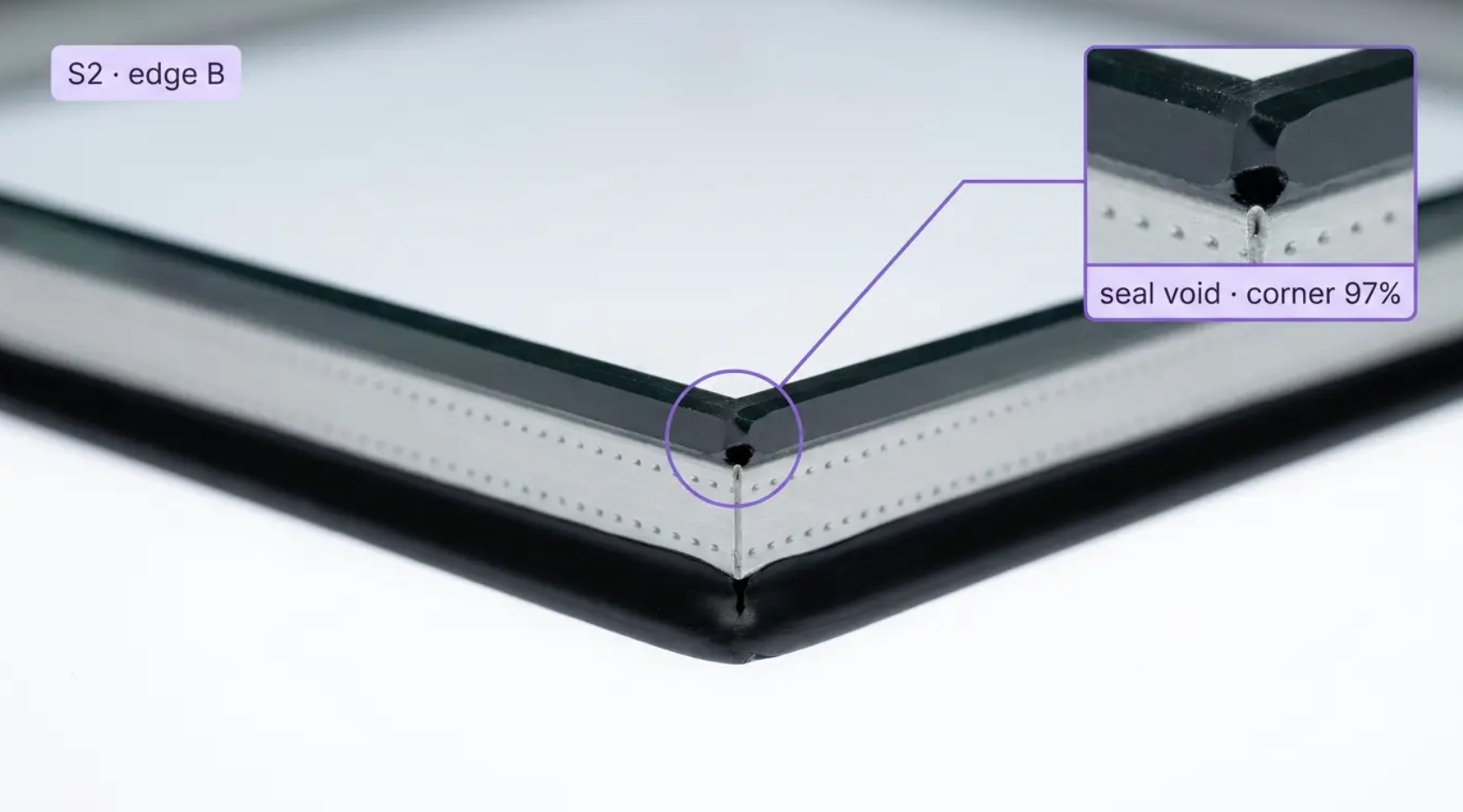
Add a real-time inspection layer to every insulated glass unit on the line with vision AI for insulated glass unit inspection. Built for the operations where the product is transparent, the defect can sit on any of four surfaces or inside the cavity between them, a low-E coating changes how every flaw reflects, and the seal defect that fails the unit is a void a few millimeters long at a corner that only shows from one angle. Whether you're running a high-volume IGU line, fabricating custom units, or glazing finished units into window and door frames, Roboflow inspects the seal, the spacer, the cavity, and the glass on every unit, with a record behind every serial.
Seal and Spacer:
- Detect voids, bubbles, thin spots, and overspill in primary and secondary seals along every edge and corner, so the seal that will fail in the field is caught at the sealing station
- Detect spacer offset, gaps, bowed bars, and misfit corner keys, so the spacer that compromises the seal path or the sightline is caught before the unit is sealed
- Detect desiccant spill and spacer surface defects visible through the glass, so the cavity that will fog is caught before it is closed
Cavity and Glass:
- Detect debris, fibers, fingerprints, and residue trapped inside the cavity, the contamination that only shows against certain backgrounds, so the unit that would be rejected on the job site is caught in the plant
- Detect scratches, chips, digs, edge damage, and inclusions on each lite, and coating scratches, pinholes, and edge deletion faults on low-E surfaces, so the surface flaw is caught with the surface named
- Verify muntin and grid alignment inside the cavity, unit dimensions, and glass offset, so the unit that would not fit the frame never gets to the frame
Glazing, Traceability, and Systems Integration:
- Inspect finished units at glazing and after framing, so the defect introduced during handling is caught before the sash ships
- Trend defects by station, sealant lot, spacer supplier, and shift, so a sealing head that starts leaving voids surfaces before it becomes a lot
- Integrate with MES, ERP, and line equipment, with per-unit records tied to serial, order, station, and imagery for certification and warranty
Bring intelligence to every unit today. Stop seal voids, spacer defects, and cavity contamination from becoming fogged units, warranty replacements, or the audit that pulls the lot.
More About Insulated Glass Unit Inspection
What is insulated glass unit inspection with Vision AI?
Insulated glass unit inspection with vision AI uses computer vision models to inspect double- and triple-glazed units at every stage of the IGU line and at glazing: voids, bubbles, and overspill in primary and secondary seals, spacer offset, gaps, and corner key faults, debris and contamination trapped inside the cavity, scratches, chips, and edge damage on each lite, low-E coating and edge deletion defects, and muntin alignment and unit dimensions. Models trained on your actual units, coatings, and stations run on every unit, with per-unit records that support ASTM E2190 and IGCC/IGMA certification, EN 1279, ASTM C1036, and ISO 9001.
Can Vision AI find defects in a transparent, coated, multi-surface unit?
Inspecting an IGU is one of the hardest visual tasks in fenestration: the product is transparent, a flaw can sit on surface one, two, three, or four or inside the cavity, a low-E coating changes how each surface reflects, and a fiber inside the cavity is invisible against a bright background and obvious against a dark one. Deep-learning models trained on your actual units, coatings, lighting, and stations learn what a seal void, a spacer gap, a cavity fiber, and a coating scratch look like on your product, and multi-angle imaging with controlled backgrounds and both bright-field and dark-field lighting makes the contamination that only shows against the sky show up in the plant. Surface attribution comes from imaging geometry, so the record says which surface the flaw is on, and every flagged unit comes back with the frame, so the operator sees the defect instead of hunting for it.
Does this replace our inline glass scanner?
No. Inline flat-glass scanners keep their role on the washer and cutting lines, scanning each lite for scratches, inclusions, and coating faults at speed, and the certification program keeps its ASTM E2190 and EN 1279 tests. Vision AI adds what a lite scanner does not cover: the seal and spacer after assembly, the cavity after the unit is closed, the finished unit at glazing and after framing, and the stations where a scanner was never installed. Scanner results and vision inspections land in the same per-unit record, and the unit that would have fogged in the field is caught before it leaves the plant.
Can it integrate with our MES, ERP, and line equipment?
Yes. Roboflow Inference exposes a standard API and supports common industrial protocols, so inspection results flow into your existing systems: MES and ERP platforms like SAP and Oracle, fenestration order and production systems, and SCADA and HMI platforms like Ignition and AVEVA, through REST, MQTT, OPC UA, and direct database writes. PLC-level integration diverts a failed unit or holds a station the moment a check fails, and every event carries the unit serial, order, station, surface, imagery, and disposition, with a full record behind every unit for certification audits and warranty claims.