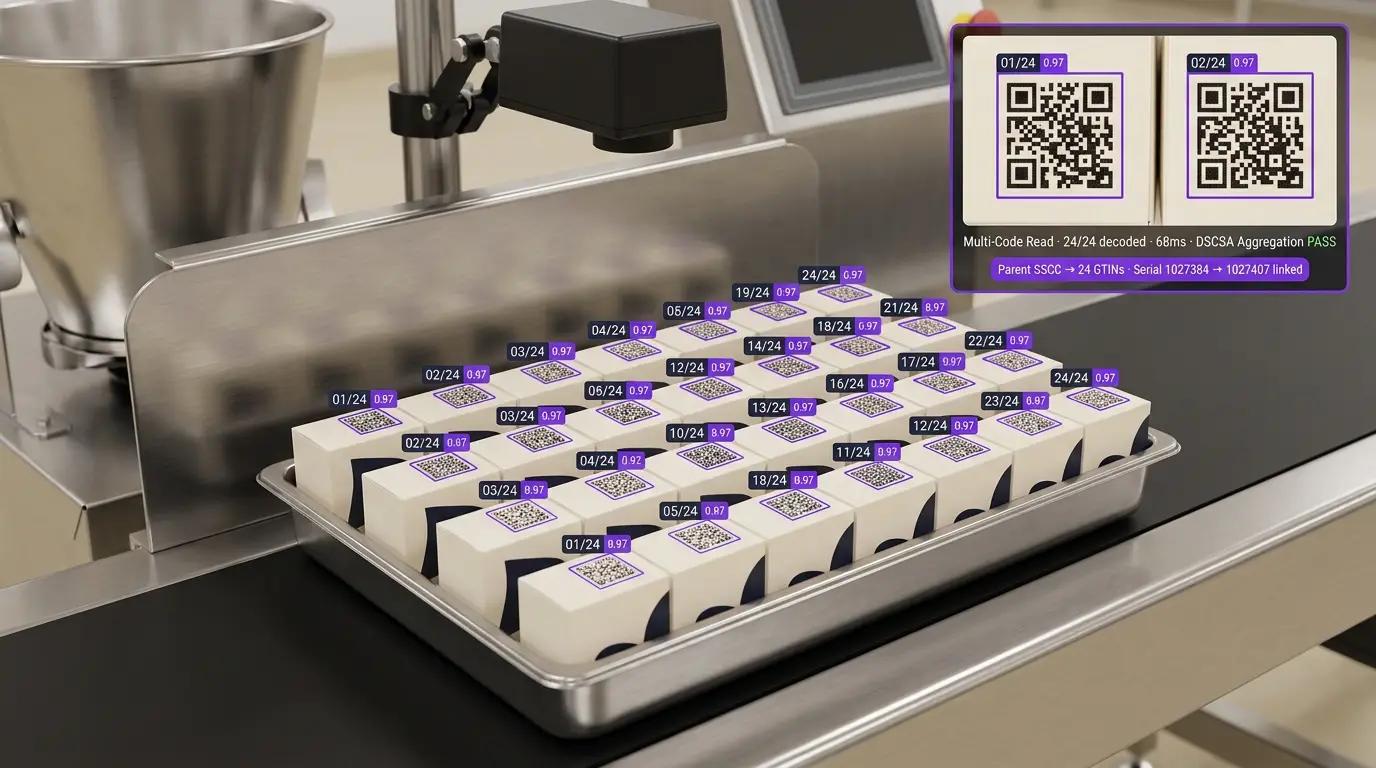
Add a real-time scanning layer to every moving barcode with Vision AI for high speed barcode scanning. Whether you're scanning at bottling and canning lines running 800+ BPM, sortation induction at 12,000+ PPH, pharma serialization lines at 400 vials per minute, or automotive assembly line rates, Roboflow extends barcode coverage to every read at every belt speed.
Multi-Code and High-Density Reads:
- Decode 10 or more barcodes in a single frame across mixed-symbology fields of view: cases with SSCC, case ID, carrier label, and hazmat placard visible simultaneously, or pharma serialization trays with dozens of unit-dose 2D codes captured in one aggregation shot
- Read multi-pack aggregation frames where every unit dose, vial, or bottle in a serialization tray must be decoded in one capture to close the DSCSA parent-child record
- Handle overlapping codes, edge codes, and codes at every angle in a shared field of view without station-by-station rescans or re-orientation stations
Speed, Motion Blur, and Line-Rate Compensation:
- Sustain sub-100ms end-to-end latency from image capture to decoded read to PLC signal at every belt speed, including bottling lines at 800+ BPM, sortation crossbelts at 12,000+ PPH, pharma serialization at 400 vials per minute, and automotive assembly line rates
- Compensate for motion blur, exposure drop, and belt vibration on high-speed conveyors, cross-belt sorters, and tunnel scanners without re-tuning fixed scanner hardware between shifts
- Maintain read rates across belt-speed changes within a shift and across SKU changes across shifts, with model updates deployed in minutes when line rates or symbologies change
Real-Time PLC Integration and Line Genealogy:
- Trigger PLC actions (reject arms, diverter gates, station releases, andon calls, sortation induct-rejects) in real time on borderline reads, before the line moves past the reject window
- Log every read with confidence score, image crop, timestamp, station ID, and belt position for genealogy, IATF and AS9100 audit trail, and DSCSA aggregation record
- Integrate with PLC control (Rockwell, Siemens, Beckhoff, Allen-Bradley, Omron), sortation (Beumer, Vanderlande, Dematic, Honeywell Intelligrated), WMS (Manhattan Associates, Blue Yonder, SAP EWM, Oracle WMS), MES (Rockwell PharmaSuite, Werum PAS-X, Siemens Opcenter, GE Proficy, Ignition), and ERP (SAP, Oracle, NetSuite) through REST, MQTT, OPC UA, and direct database writes at line speed
Bring intelligence to every scan today, at every belt speed.
More About High Speed Barcode Scanning
What is high speed barcode scanning with Vision AI?
High speed barcode scanning with Vision AI uses computer vision models to read every barcode on every unit at production-line speed, at every stage where line rate is the constraint: bottling and canning at 800+ BPM, sortation induction at 12,000+ PPH, pharma serialization aggregation at 400 vials per minute, and automotive assembly at cycle-time rates. The system decodes 1D barcodes (Code 128, Code 39, EAN, UPC, ITF-14), 2D codes (QR, GS1 DataMatrix, Aztec, PDF417), direct part marking (DPM), and GS1-128 pallet labels across multi-code fields of view where 10 or more codes must be read in a single frame.
Every read is delivered under sub-100ms end-to-end latency (image capture to PLC signal) with confidence, image crop, and station ID logged for audit. Bottlers, canneries, pharma serialization lines, e-commerce fulfillment sites, and automotive assembly plants use it to prevent stalled lines from no-reads at line speed, defend IATF 16949 and AS9100 audits, close DSCSA aggregation records without re-scans, avoid retailer OTIF chargebacks, and document compliance under FDA UDI, DSCSA, GS1-128 and SSCC, ISO/IEC 15415/15416, IATF 16949, AS9100, and FSMA.
Can Vision AI keep up with 800+ BPM bottling lines and 12,000+ PPH sortation, and read multiple codes in one frame?
Yes. Roboflow models are trained on your actual line footage at your actual belt speeds and lighting, and co-pilot existing fixed and tunnel scanners by adding a second-look layer that closes multi-code drop-outs before the line moves past the reject window. Sub-100ms end-to-end latency (image capture to decoded read to PLC signal) is sustained on standard NVIDIA Jetson edge hardware or plant GPU, and read rates hold across belt-speed transitions within a shift.
Does high speed barcode scanning support GS1-128, SSCC, FDA UDI, DSCSA aggregation, IATF 16949, and AS9100?
Yes. Roboflow models can be trained against GS1-128 barcode symbology, SSCC (Serial Shipping Container Code), GS1 DataMatrix, GTINs, ANSI/UCC barcode specifications, ISO/IEC 15415 (2D barcode print quality), ISO/IEC 15416 (1D barcode print quality), FDA UDI for medical device labeling, DSCSA serialization and aggregation for pharma (parent-child, homogeneous and heterogeneous cases, tote and pallet aggregation), EU FMD 2D data matrix, IATF 16949 for automotive traceability, AS9100 for aerospace quality management, AS9110 for aerospace maintenance, and FSMA (traceability, sanitary transportation).
The system reads and grades every scan against the pass/fail logic your quality, traceability, and serialization teams already use, and produces validated inspection records that support IATF 16949 and AS9100 registrar audits, FDA UDI compliance, pharma DSCSA aggregation audits, and customer PPAP submissions.