Fill Level Measurement AI
Measure how full every bin, hopper, tank, tote, and dumpster is, as a percentage, from the cameras on site.
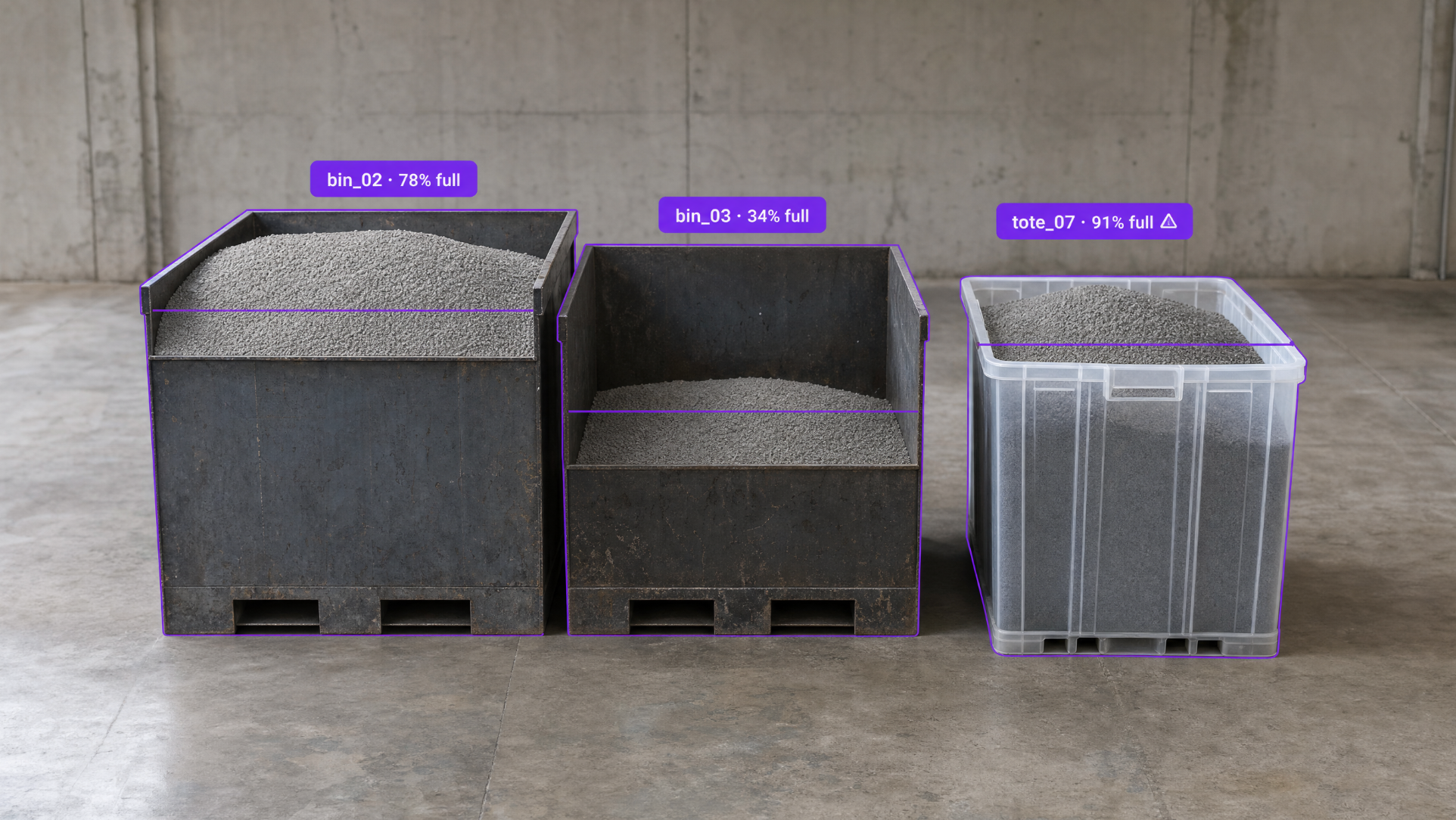
Fill Level Measurement AI for the Toughest Plants, Yards, and Bulk Storage Sites
Deploy Anywhere, Run Everywhere
Run fill level measurement on overhead, hopper hatch, tank room, and yard cameras on the edge, on-prem, in your VPC, or via API.
One Platform, Full Adoption
Tools every operations and materials team can adopt, from plant engineers to materials planners and facilities leads, no separate ML team required.
Secure, Compliant, and Audit-Ready
Data stays safe with SOC 2 Type II compliance, encrypted data, HIPAA compliance, and an uptime SLA.
- Percent Full per Bin, Hopper & Tote
- Material Level in Open Hoppers & Tanks
- Sight Glass & Level Gauge Reads
- Dumpster & Waste Container Fullness
- Overflow & Low-Level Alerts
- Fill Trends by Line, Shift & Site
“Roboflow has been instrumental in accelerating our deployment of innovative AI solutions.”
Travis Turnbull
Vice President & CIO, Pella Corporation
Talk to a Vision AI engineer who's shipped in manufacturing and bulk materials.
Bring us your toughest fill level measurement problem and we'll map a working solution.
Ask us about:
- Solution architecture that fits your containers, control system, and refill and waste hauling processes
- A live demo on your own bin, hopper, tank, or yard camera footage
- Deployment options: edge, on-prem, air-gapped, VPC, or on the cameras and network your site already runs
- ROI modeling against line stops from empty hoppers, overflow cleanup, extra hauls, and excess inventory
Over 16,000 organizations build with Roboflow.
- Rivian
- Pella
- Chobani
- USG Corporation
- BNSF Railway
- American Woodmark
Vision AI is transforming businesses
Customers across the board are solving complex challenges and driving meaningful impact.
- Automotive customer
$10 million
Saved by automatically detecting defects on the production line
- Logistics & freight company
90%
Less time spent manually tracking shipping inventory
- Building materials supplier
60%
Lower customer return rate with improved product quality
Measure Every Fill, from the Feed Hopper to the Waste Bin
Add a real-time measurement layer to every bin, hopper, tank, and container on site with Roboflow Vision AI for fill level measurement. Built for plants, yards, and storage areas where a hopper that runs empty stops a line, a tote that overflows becomes a spill, and a half-full dumpster still gets hauled.
Bins, hoppers, and totes:
- Measure percent full per bin, gaylord, and tote by segmenting the material surface and comparing it to the container's known height, with a model trained on your own containers.
- Read material level in open hoppers and surge bins from an overhead camera, and use depth estimation to measure volume where the surface is heaped or uneven.
- Count full, partial, and empty containers in a staging area so material handlers know what to move next.
Tanks, sight glasses, and gauges:
- Read liquid level through a sight glass or level tube and convert it to a percentage or a volume with your tank's calibration chart.
- Read level gauges on tanks and vessels from a fixed camera or during rounds, with the same models that power analog gauge reading.
- Flag low and high levels on day tanks, IBC totes, and chemical containers before a pump runs dry or a container overfills.
Waste, alerts, and trends:
- Measure how full dumpsters, compactors, roll-off bins, and recycling containers are, so haulers come when containers are full, not on a fixed schedule.
- Send an overflow or low-level alert to the PLC, a dashboard, or a phone the moment a container crosses its threshold.
- Trend fill level by container, line, shift, and site to plan refills, pickups, and inventory.
Bring intelligence to every container today. Stop empty hoppers, overflowing totes, and half-empty pickups from costing you downtime and money.
Frequently asked questions
What is fill level measurement with Vision AI?
Fill level measurement with Vision AI uses overhead, yard, or station cameras and a trained computer vision model to find each container, segment the material or liquid surface inside it, and report how full it is as a percentage or a volume. It covers bins, hoppers, totes, tanks, sight glasses, and waste containers, and pairs with fill level inspection on filling lines, trailer fill monitoring at the dock, and ore car fill detection in mining.
Can Vision AI measure fill level in containers of different shapes and sizes?
Yes. For straight-walled bins and totes, the surface height compared to the container height gives percent full. For tapered hoppers, cone-bottom tanks, and other shapes, a calibration curve or geometric model turns the surface reading into a volume, and depth estimation measures heaped or sloped material across the whole surface.
Does it work alongside our radar, ultrasonic, and load cell level sensors?
Yes. One camera can cover a row of open bins or totes that would each need their own sensor, and on tanks that already have a level transmitter, a camera reading the sight glass or gauge adds an independent check. Readings from both can land in the same control system tag.
Roboflow serves as the measurement engine, and your operations and engineering teams own the thresholds, alarm limits, and refill rules.
Can it integrate with our PLC, SCADA, and inventory systems?
Yes. Roboflow writes fill percentage and alarm states to a PLC tag over OPC UA, Modbus TCP, or MQTT, so Allen-Bradley and Siemens controllers can start a refill or stop a feed. Results and images can be sent over REST or written to a database for SCADA platforms such as Ignition and AVEVA, and for inventory and waste hauling systems.