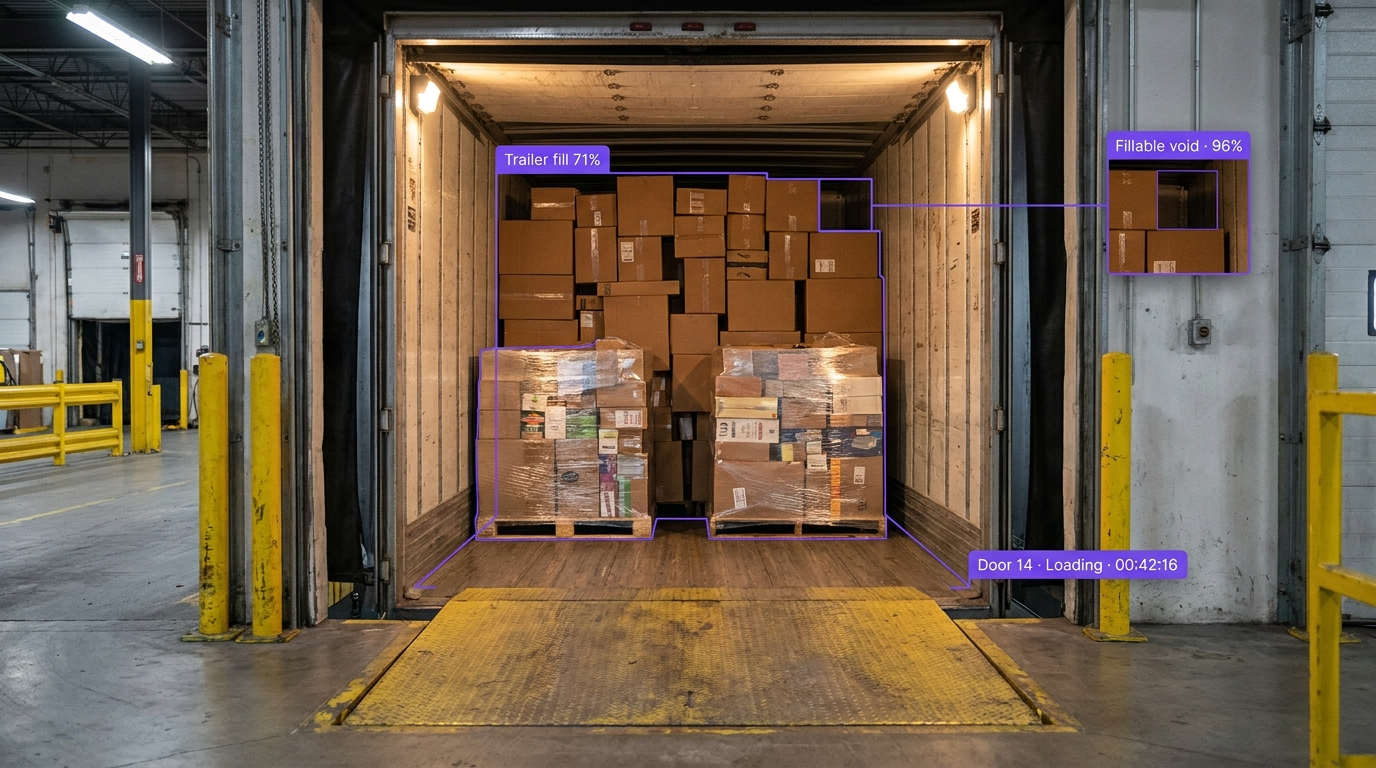
Add a real-time fill layer to every dock door with vision AI for trailer fill monitoring. Roboflow reads the dock door cameras you already have, measures how much of each trailer is filled as loading happens, flags voids and air gaps before the doors close, and gives every door, lane, and carrier a fill number backed by an image, without in-trailer sensors on every door or a supervisor walking the dock with a clipboard.
Real-Time Fill Measurement:
- Measure trailer fill percentage and cube utilization from a camera at the dock door as loading progresses, so the loader and the supervisor see the number while there is still time to add freight
- Track load progress from first pallet to last, with elapsed time at door and time to complete, so a door that has stalled shows up before the trailer misses its cut
- Distinguish floor-loaded cartons, palletized freight, gaylords, and mixed loads, so the fill number reflects how the trailer was actually built
Load Quality and Air Gaps:
- Detect voids between pallets, unused vertical space above short stacks, and the gap behind the last row, and classify which gaps can still take freight
- Flag unstable stacking, leaning columns, and unsecured rear rows before the doors close, so load shift is caught on the dock rather than at the destination
- Verify the trailer is loaded to the plan when a load plan exists, and record how it was loaded when one does not, so the same lane stops shipping the same voids every night
Dispatch, Reporting, and Systems Integration:
- Alert the dock supervisor when a trailer is about to close under the fill target, and confirm when it is full enough to dispatch, so the decision is made on a number rather than a glance
- Report fill by door, lane, shift, carrier, and site, so the hub that ships at 62% and the lane that runs a second truck it does not need are visible to network operations
- Push fill percentages, door status, and door close images into the WMS, TMS, YMS, and dock scheduling system through API integration, with a picture behind every dispatch
Stop the half-full trailer, the void nobody saw, and the second truck that should never have rolled from becoming linehaul cost, a cargo claim, and a scorecard chargeback. Bring intelligence to every dock door today.
More About Trailer Fill Monitoring
What is trailer fill monitoring with Vision AI?
Trailer fill monitoring with vision AI uses a camera at the dock door and deep-learning models to measure how much of a trailer is filled while it is being loaded: estimating fill percentage and cube utilization from the visible load face, detecting voids and air gaps, tracking load progress and time at door, and recording a fill number and image at door close. It turns fill from a number estimated after dispatch into a number seen during loading, so the loader can add freight, the supervisor can hold a door, and network operations can compare doors, lanes, and carriers on the same measure. It is the dock-side counterpart to truck load optimization, which plans and verifies the load against weight and axle limits, and to yard management, which tracks the trailer once it leaves the door.
How accurate is camera-based fill compared to in-trailer sensors and dimensioners?
Accurate enough to run the dock on, and far cheaper to cover every door with. In-trailer LiDAR and stereo rigs measure volume precisely but cost enough that most sites instrument a handful of doors and estimate the rest, and dimensioners measure freight before it goes in rather than the trailer as it fills. A dock door camera sees the load face, the floor line, and the ceiling line, and a model trained on your trailers, your freight mix, and your lighting estimates fill within a few percentage points, which is the precision the decision needs: is this trailer full enough to close, and is this lane consistently shipping light. Sites that already have in-trailer sensors on some doors use them as ground truth to calibrate the camera-based measurement on the rest.
Does this work with floor-loaded parcel trailers and mixed freight?
Yes, and floor-loaded parcel is where fill matters most, because a wall built two feet short of the ceiling for the length of a 53-foot trailer is a lot of air on a linehaul. Models are trained on your freight: floor-loaded cartons, palletized retail freight, gaylords, irregulars, and mixed loads, and they learn the difference between a wall that is built to the ceiling and one that looks full from the door. The fill number is reported with the image it was measured from, so a loader or supervisor can check it in a second, and every disagreement between the number and the dock becomes training data rather than an argument.
Can it integrate with our WMS, TMS, and dock scheduling system?
Yes. Roboflow Inference runs on an edge device at the building and exposes a standard API and webhooks, so fill percentages, door status, load progress, and door close images flow into your existing systems: WMS platforms from Manhattan, Blue Yonder, Körber, and SAP EWM, TMS platforms from Blue Yonder, Manhattan, Descartes, and Oracle OTM, yard and dock scheduling systems from C3 Solutions and Descartes, load planning tools like MaxLoad Pro and Cube-IQ, dock displays and stack lights, and alerting into Slack, Microsoft Teams, and radio dispatch, through REST, MQTT, webhooks, and direct database writes. Every dispatch carries door, trailer, carrier, timestamp, fill percentage, and the image, so a carrier scorecard dispute or a cargo claim has a picture behind it.