Fiber Optic Connector Inspection AI
Grade every end face against the zone rules, on single ferrules and on 24-fiber MPO, at production volume.
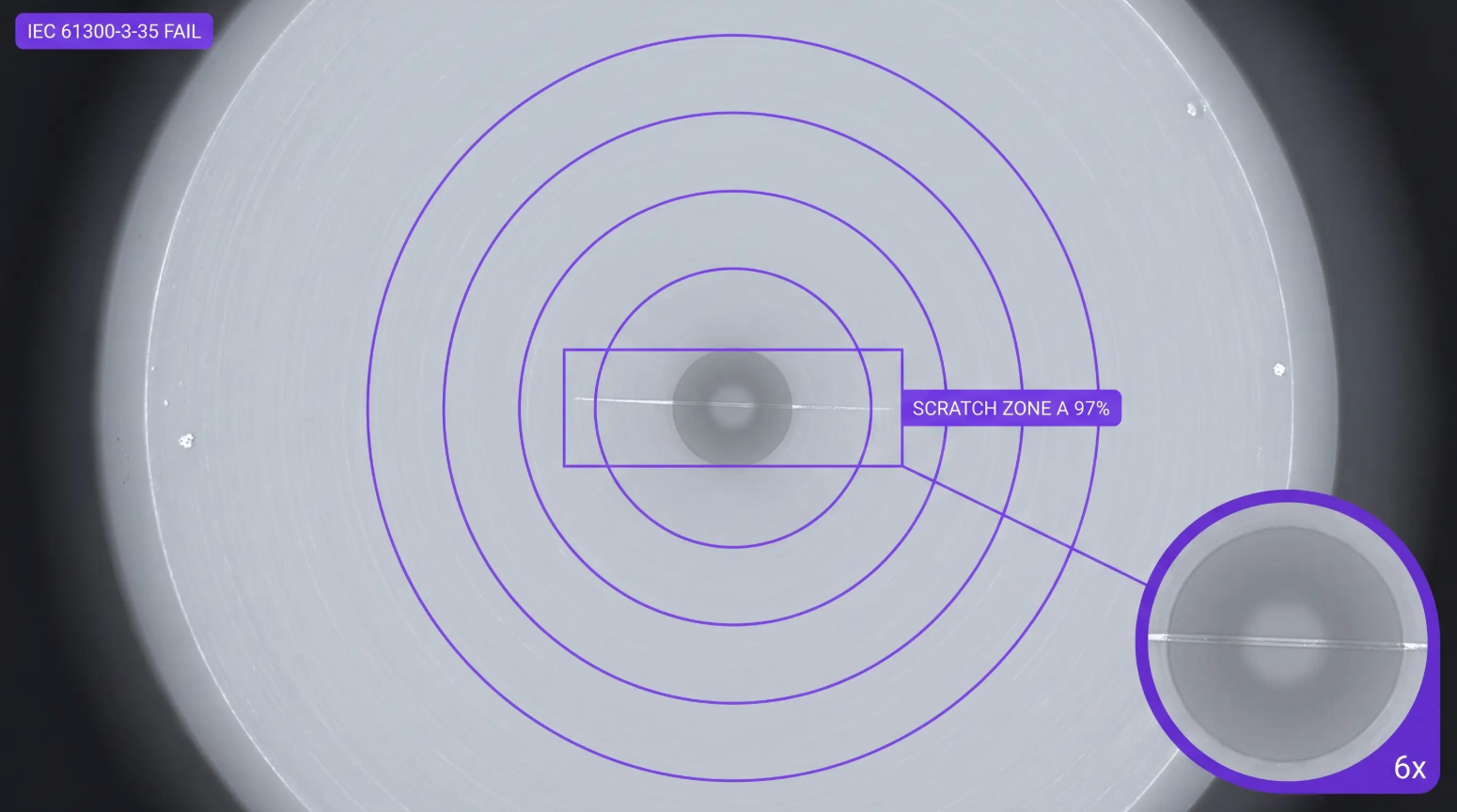
Fiber Optic Connector Inspection AI Across Cable Plants, Data Centers, and Field Installation
Deploy Anywhere, Run Everywhere
Run fiber optic connector inspection on benchtop and inline probe microscopes, automated polish and test cells, handheld field scopes, the edge, on-prem, in your VPC, or via API, wherever your connector lines, patch cord cells, and install crews need it.
One Platform, Full Adoption
Tools every organization can adopt, from polish and termination operators and process engineers to quality leads, field technicians, and the data center commissioning team, no separate ML team required to ship and own inspection models.
Secure, Compliant, and Audit-Ready
Data stays safe with SOC 2 Type II compliance, encrypted data, and an uptime SLA, with per-connector records that support IEC 61300-3-35 end-face grading, Telcordia GR-326 qualification programs, TIA-568 installation standards, and ISO 9001 quality systems.
- IEC 61300-3-35 Zone Grading
- Scratches, Pits & Digs
- Particles & Contamination
- Chips, Cracks & Epoxy Residue
- MPO Multi-Fiber Ferrules
- Per-Connector Pass/Fail Records
“Roboflow has been instrumental in accelerating our deployment of innovative AI solutions.”
Travis Turnbull
Vice President & CIO, Pella Corporation
Talk to a vision AI engineer who's shipped end-face inspection at production volume.
A particle sitting on the core of a connector nobody inspected, a scratch crossing Zone A on a patch cord heading to a hyperscaler, or an MPO where one fiber out of twenty-four failed and the grader only had time to check a handful can mean insertion loss on a link nobody can locate, a returned lot from a customer whose incoming inspection is stricter than your outgoing, or two connectors destroyed in the instant they were mated. Bring us your toughest end-face inspection problem and we'll map a working solution.
Ask us about:
- Solution architecture for IEC 61300-3-35 zone grading, Telcordia GR-326 qualification, TIA-568 installation standards, and ISO 9001 quality systems
- Live demo on your own probe microscope imagery, across your connector types, polish grades, and single-fiber and multi-fiber ferrules
- Deployment options: benchtop and inline probe scopes, automated polish and test cells, handheld field scopes, edge, on-prem, air-gapped, or VPC, with integration into test systems and MES
- ROI modeling against grading labor per connector, MPO inspection time, scrap and rework at polish, and customer incoming-inspection returns
Over 16,000 organizations build with Roboflow.
- Rivian
- Pella
- Chobani
- USG Corporation
- BNSF Railway
- American Woodmark
Vision AI is transforming businesses
Customers across the board are solving complex challenges and driving meaningful impact.
- Automotive customer
$10 million
Saved by automatically detecting defects on the production line
- Logistics & freight company
90%
Less time spent manually tracking shipping inventory
- Building materials supplier
60%
Lower customer return rate with improved product quality