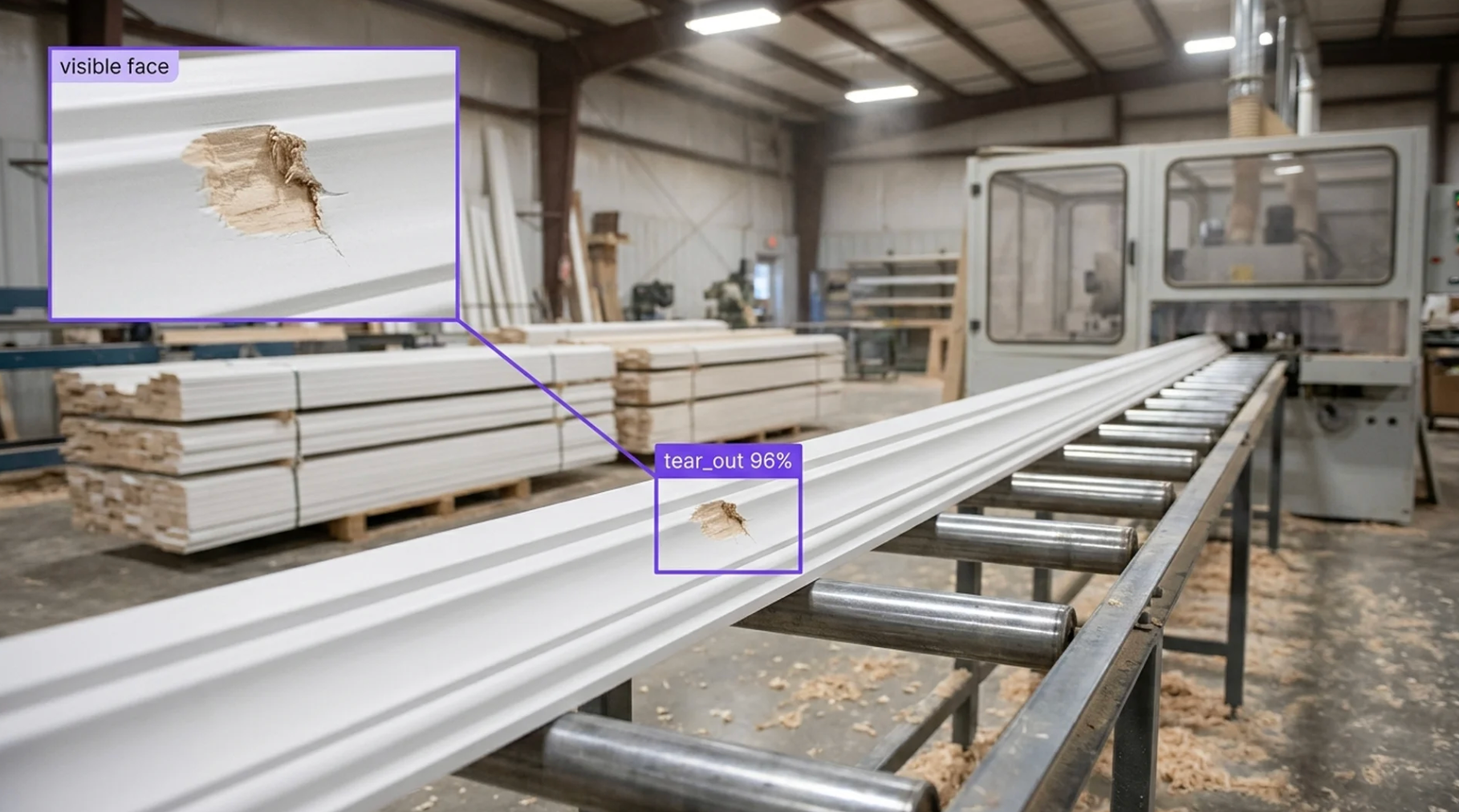
Add a real-time inspection layer to every moulding, frame, glass unit, and door on the line with Roboflow vision AI for door and window manufacturing inspection.
Moulding, millwork, and surface finish:
- Detect knots, tear-out, chatter marks, dents, splits, and raised grain on moulding and moldboard faces at the moulder outfeed, on wood, MDF, primed, and wrapped profiles.
- Flag paint, stain, and finish defects such as runs, orange peel, holidays, contamination, and color mismatch on doors, frames, and trim after the finish line.
- Grade and sort by defect location so a flaw on a hidden face does not downgrade a piece that would pass on the wall.
Glass, frames, and joints:
- Inspect glass and IGUs for scratches, chips, edge damage, spacer misalignment, sealant gaps, and desiccant or debris in the airspace before glazing.
- Verify vinyl weld corners and frame joints for voids, flash, incomplete cleaning, and misaligned profiles, and check wood and composite joints for gaps.
- Measure frame squareness, sash fit, and reveal on the assembled unit as a dimensional check on the same camera.
Hardware, labels, and order verification:
- Confirm hinges, locks, handles, weatherstrip, screens, and grilles are present, correctly oriented, and match the ordered configuration and handing.
- Read and verify NFRC and Energy Star labels, order tickets, and barcodes against the shop order so the unit on the cart matches the unit the customer bought.
- Log every inspection with image and result for ISO 9001 traceability and for the certification and warranty records your customers and dealers ask for.
Bring intelligence to every door and window today. Stop surface flaws, bad seals, and missing hardware from becoming jobsite rejections and warranty calls.
Frequently asked questions
What is door and window manufacturing inspection with Vision AI?
Door and window manufacturing inspection with Vision AI uses cameras at the moulder, the welding and cleaning cell, the IGU line, the finish booth, and final assembly, along with computer vision models (opens in a new tab) trained on your own products, to find surface defects on moulding and millwork, glass and seal problems on insulated glass units, voids and misalignment at weld corners and frame joints, missing or wrong hardware, finish defects, and label or order mismatches on every unit. Results and images are logged so the inspection supports ISO 9001 quality records and the documentation behind AAMA/FGIA, NFRC, ASTM, and Energy Star certifications.
Can Vision AI find surface defects on primed and wrapped moulding without overflagging grain?
Surface inspection on moulding is one of the highest-stakes tasks in millwork, because a knot, tear-out, or chatter mark on a visible face means a downgraded or scrapped piece, and a fixed-threshold scanner tuned for raw lumber tends to either miss defects under primer or flag natural grain, joints in finger-jointed stock, and wrap seams as defects. A deep-learning model trained on your profiles learns what your good product looks like across species, primer, and wrap, and flags the deviations that matter while ignoring the ones that do not.
Does door and window manufacturing inspection support AAMA/FGIA, NFRC, and ISO 9001?
Yes. ISO 9001 (the general quality management standard) expects documented, monitored inspection with traceable results. AAMA/FGIA standards (the Fenestration and Glazing Industry Alliance performance specifications for windows, doors, and skylights, such as AAMA/WDMA/CSA 101/I.S.2/A440), NFRC (the National Fenestration Rating Council energy performance rating and labeling program), and ASTM test methods (such as ASTM E283, E330, and E547 for air, structural, and water performance) govern how products are tested, rated, and labeled. Roboflow serves as the inspection engine: it runs the models, records every image and decision, and gives your quality team the production records that back up certified performance and correct labeling. Your quality and engineering teams keep ownership of the acceptance criteria and the certification program.
Can it integrate with our MES, ERP, and line equipment?
Yes. Inspection results are available over REST (opens in a new tab), MQTT, and OPC UA and can be written directly to a database, so pass/fail, defect, and order-verification data flow into MES and ERP systems such as SAP, Epicor, Infor, Plex, and Ignition, and into the shop-order and label systems that drive made-to-order production. Where a result needs to divert a piece at the moulder outfeed, hold a frame at the weld cell, or stop a cart at shipping, the result can drive a PLC output or a light tower.